|
Civil War Killed from All Causes of Death
Total Casualties, Fatalities, and Statistics for Civil War Dead
Introduction
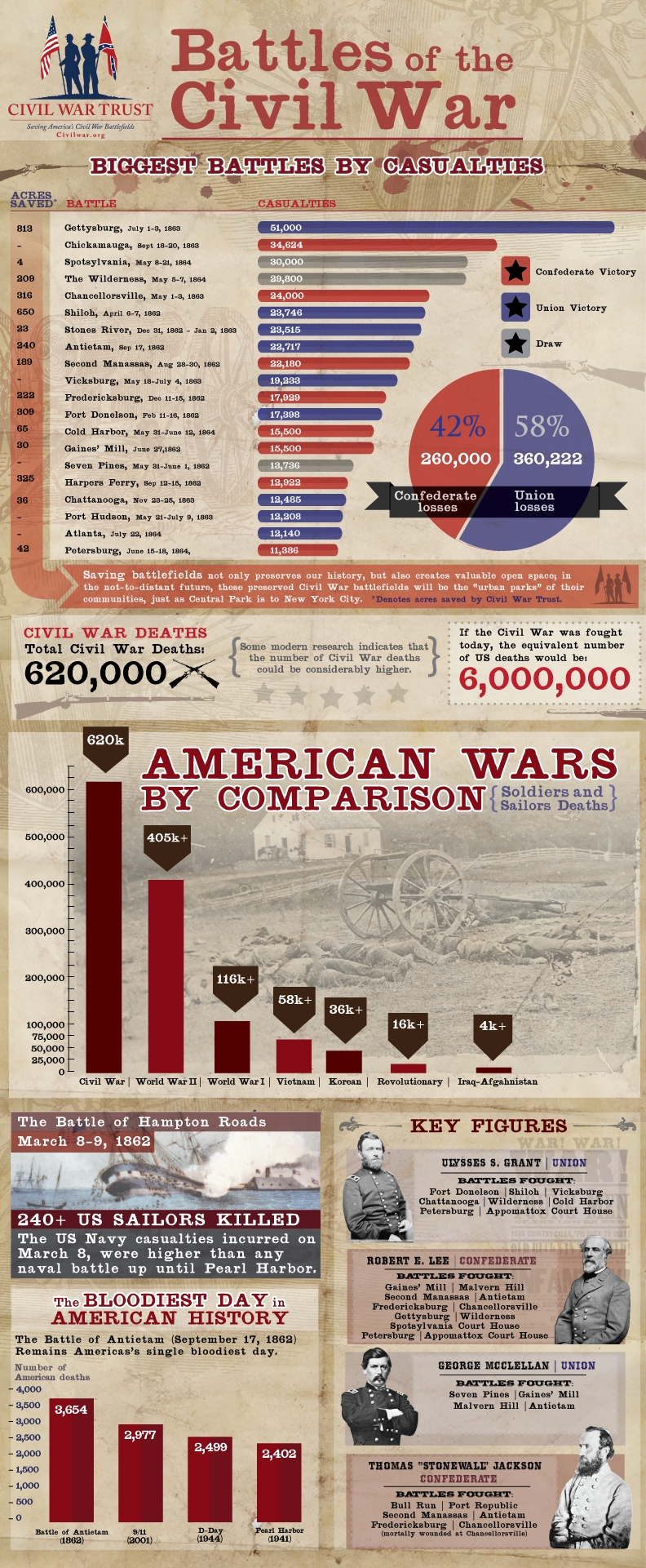
An estimated three-and-a-half million men fought in the American Civil War and approximately 620,000 died, which is more
than the total combat fatalities of all the nations previous wars combined. The Civil War remains the deadliest
conflict in the nation's history.
As
for an approximate number of casualties, there are various reasons why an exact fatality and casualty count for the American
Civil War doesn't exist. While there were incomplete, inaccurate, and even destroyed military records prior to the cessation of
hostilities, there were existing reports and tabulations that went uncorrected for the total number of battle
deaths, mortally wounded, and those who died as prisoners-of-war. To enhance morale, there were also exaggerated
reports of enemy casualties, particularly in total killed, while underreporting the unit's own casualty figures.
After battle reports were at times not adjusted with final tabulation totals for mortally wounded and deaths by disease,
and there were many instances where the missing-in-action, the MIAs, had actually deserted and assumed new
identities. A soldier who was declared missing following a battle, unless he was identified as captured, or prisoner-of-war,
was soon marked and tabulated as dead.
"The force of a mini ball or piece of shell striking any solid portion
of a person is astonishing; it comes like a blow from a sledge hammer, and the recipient finds himself sprawling on the ground
before he is conscious of being hit; then he feels about for the wound, the benumbing blow deadening sensation for a few moments.
Unless struck in the head or about the heart, men mortally wounded live some time, often in great pain, and toss about upon
the ground." History of the 35th Massachusetts Volunteers
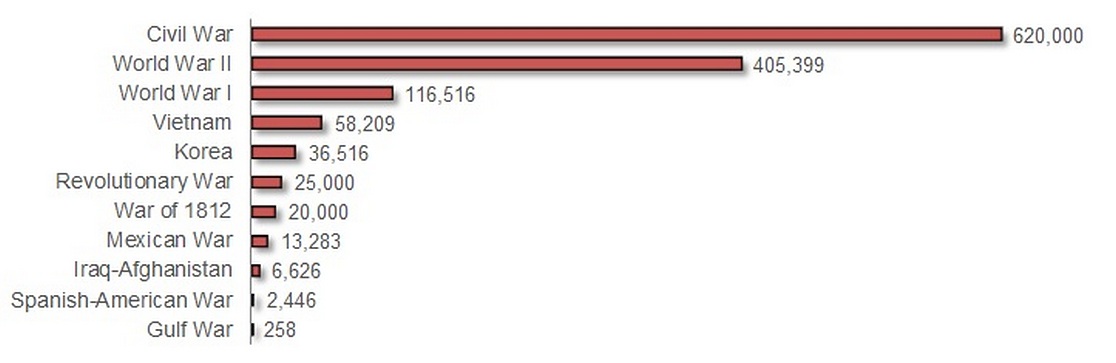
| Civil War Casualties, Total Killed, All War Deaths |
|
| Civil War Total Killed, Casualties, Mortally Wounded, Died of Disease, Total Dead from All Causes |
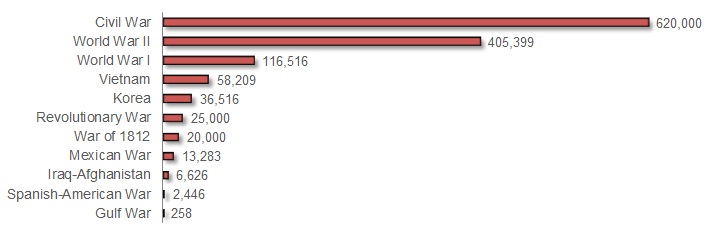
(About) Lesson Graph shows total killed in each US war. Death totals include
killed-in-action, mortally wounded, died of disease and as prisoner-of-war, and deaths from all causes other than battle.
The American Civil War was the bloodiest and deadliest war in American history, and accounted for more deaths
and killed in all categories, known as casualties, than all previous U.S. wars combined.
Definition
There is difference between
the terms casualty and fatality. A fatality is defined as death of a combatant during time of war. A casualty is a military
individual lost through death, wounds, injury, sickness, disease, internment, capture, or missing in action. A casualty is
a combatant (soldier, marine, sailor, etc.) who is expected but unable to fight in a battle. Many soldiers became casualties
several times during the Civil War: some soldiers were captured during multiple actions; others were wounded in several battles;
and some were too ill to fight in the engagement. A basic definition of fatality is any combatant who dies during the war,
including killed in action, mortally wounded, died of disease, accidental death, and deaths from all other causes, including
suicide.
Summary
More than three million soldiers fought in the war from 1861-1865. More
than half a million died, the majority by disease, and almost as many were wounded but survived. Hundreds of thousands were
permanently disabled by battlefield wounds or surgery, which saved lives by sacrificing limbs. These men served as a
symbol of the fractured nation and remained a stark reminder of the costs of the conflict for decades following the war.
While examining casualties of the Civil War, it
is important to understand how and why the majority of the men died. Army surgeons treated a wide spectrum of illness as well
as performed advanced surgical procedures. Of the 620,000 estimated deaths from both the Union and Confederate forces
during the four years of war, 414,000 were the result of disease. Poor diet, lack of proper clothing, and equipment,
and unsanitary conditions contributed greatly to the deaths from disease. Acute and chronic dysentery were referred to
as fluxes and eruptive fevers were the diseases of small pox, measles and scarlet fever. Gangrene is not mentioned in the
official records because at the time it was not considered a disease but the result of an operation. It is now known
that gangrene is a result of a unique organism and qualifies as a disease.
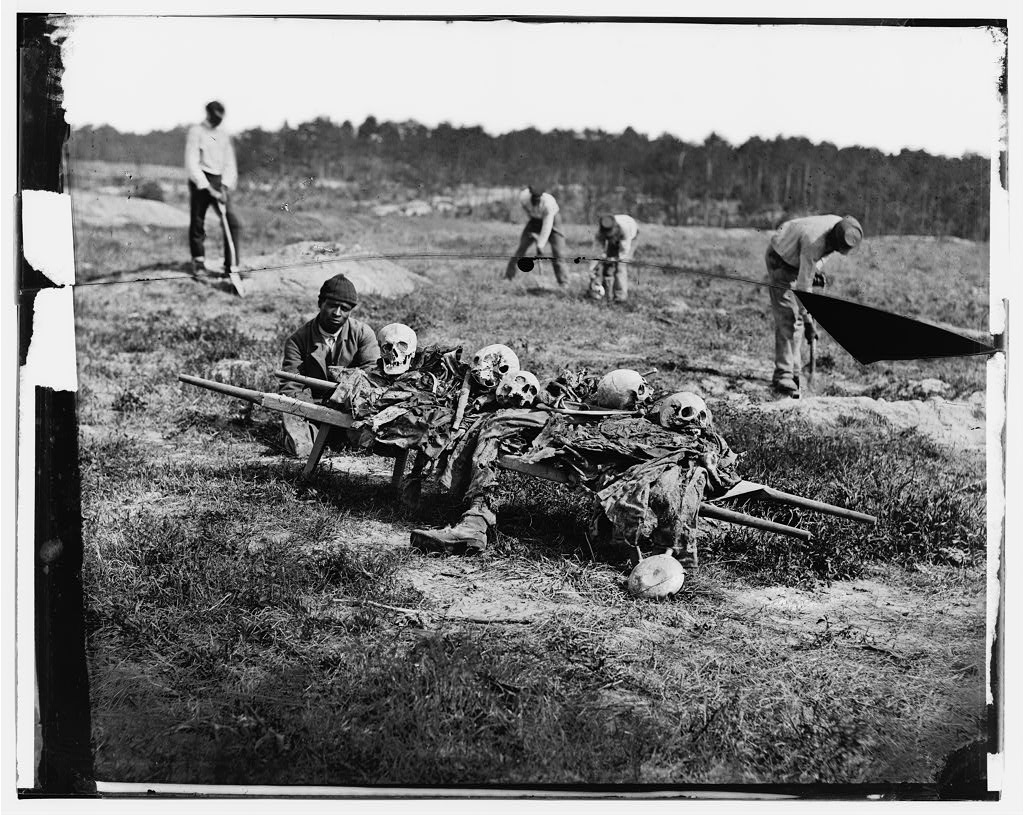
| Civil War Casualties, Fatalities & Statistics |
|
| Civil War Casualties, Fatalities & Statistics. Civil War Killed, Dead, and Mortally Wounded |
"I recall a soldier with the cartridge between his thumb and
finger, the end of the cartridge bitten off, and the paper between his teeth when the bullet had pierced his heart, and the
machinery of life--all the muscles and nerves--had come to a standstill." Charles
Carlton Coffin, Army Correspondent
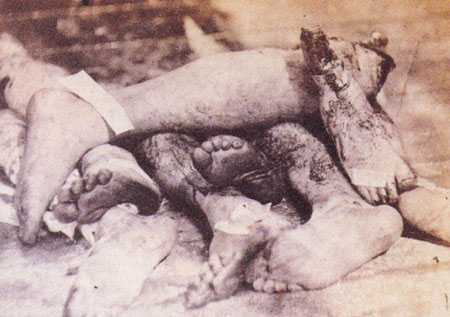
| Loss of limb or loss of life |
|
| Civil War amputees generally died of disease |
(Right) Casualties
of Civil War. "Amputations of Feet and Legs, A Morning's Work." A stack of amputations performed during the morning by a
single surgeon outside Harwood Army Hospital, Washington City (now D.C.).
Causalities, Wounded and Mortally Wounded
New technologies increased both the risk of injury and its severity to soldiers,
causing from loss of limb to loss of life. From the battlefield, many soldiers were initially reported as wounded but soon
declared as mortally wounded because of the lethality of weapons engaged and the trauma that followed. Rifled
muskets fired farther and more accurately than older weapons and could be quickly reloaded with the minié ball, a bullet of
soft lead invented in the 1840s. The ammunition caused extensive damage as it changed shape on impact, shattering two to three
inches of bone and dragging skin and clothing into the wound. The scale of the damage and risk of infection was a major cause
of amputations.
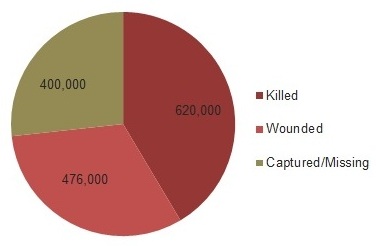
| Civil War Killed, Wounded, Missing and Captured |
|
| Total Civil War Killed, Wounded, Captured / Missing |
Facts, Figures, Casualties, and Fatalities
The general
consensus, or best estimates, is 618,000 to 700,000 fatalities. Sadly, however, there
is not a single record researching, tracking and studying the total number of wounded and diseased soldiers of the
Civil War who died postwar or in its aftermath.
What were the causes of the high casualties
of the Civil War? Diseases and Napoleonic Linear Tactics were the contributing factors for the high casualties during the American Civil
War. See also Union and Confederate Casualty Totals in Killed and Mortally Wounded and Total Civil War Casualties for each Northern and Southern State: Deaths, Wounded, Missing and Captured.
(Right) Chart showing Total Civil War Killed, Wounded, Missing and Captured. Courtesy CivilWar.Org.
The tendency
to exaggerate enemy desertions and casualties, while minimizing their own, was characteristic of Union
and Confederate armies in their respective reports of the many skirmishes and battles of the American Civil War. Each
side was also eager to enhance its own morale by writing favorable reports. According to Lt. Col. Walter Clark's Regiments: An Extended Index to the Histories of the Several Regiments and Battalions from
North Carolina in the Great War 1861-1865, p. 5: "The majority of troop rosters and official military records
had been forcibly confiscated by Lincoln’s hordes or wantonly destroyed.”
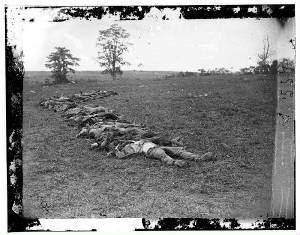
"Under the dark shade of a towering oak near the Dunker Church lay the lifeless form
of a drummer boy, apparently not more than 17 years of age, flaxen hair and eyes of blue and form of delicate mould. As I
approached him I stooped down and as I did so I perceived a bloody mark upon his forehead...It showed where the leaden messenger
of death had produced the wound the caused his death. His lips were compressed, his eyes half open, a bright smile played
upon his countenance. By his side lay his tenor drum, never to be tapped again." Pvt.
J. D. Hicks, Company K, 125th Pennsylvania Volunteers
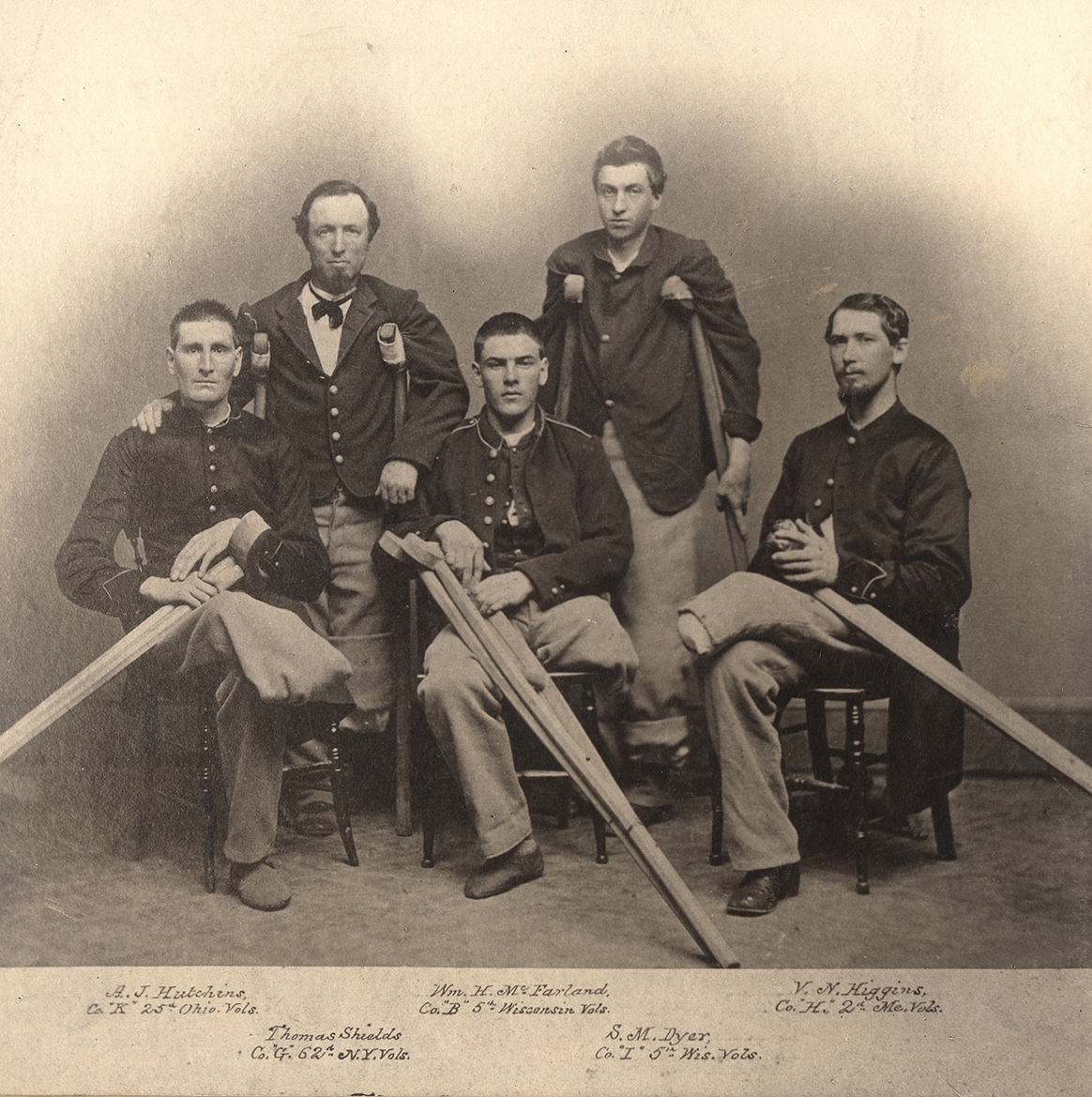
| Civil War Casualties in Wounded |
|
| Civil War casualties included the wounded, including amputees. |
"Comrades with wounds of all conceivable shapes were brought
in and placed side by side as thick as they could lay, and the bloody work of amputation commenced." George Allen, Company A, 6th New York Volunteers
Casualty Does Not Equal Dead
Casualties
include three categories: 1) dead (aka fatalities, killed-in-action and mortally wounded); 2) wounded; and 3) missing
or captured. In general terms, casualties of Civil War battles included 20% dead and 80% wounded. Of the soldiers who were
wounded, about one out of seven died from his wounds. Over 2/3 of the estimated 620,000 men who gave their lives in the Civil
War died from disease, not from battle. See also Top Ten Civil War Battles with Most Casualties and Fatalities.
When
one totals the Americans that died in the Revolutionary War, War of 1812, Mexican American War, Spanish American War,
World War One, World War Two, Korean War and Vietnam War, it is less than the total American Civil War casualties.
See also Civil War Killed : A History.
"A man lying upon the ground asked for drink--I stooped to give it, and having raised him
with my right hand, was holding the cup to his lips with my left, when I felt a sudden twitch of the loose sleeve of my dress--the
poor fellow sprang from my hands and fell back quivering in the agonies of death--a ball had passed between my body--and the
right arm which supported him--cutting through the sleeve, and passing through his chest from shoulder to shoulder." Clara Barton
Union Casualty (Fatality) Estimates:
Battle Deaths: 110,070
Disease,
etc.: 250,152
Total Deaths: 360,222
Confederate Estimated Losses (Fatalities):
Battle Deaths: 94,000
Disease, etc.: 164,000
Total Deaths: 258,000
Casualties, Disease, and Death
Soldiers were vulnerable to infectious diseases that spread rampantly in
crowded camp conditions. In fact, yellow fever, smallpox, malaria, and diarrheal diseases took more lives than battlefield
injuries. Among those who had not been previously exposed to them, childhood illnesses such as measles, mumps, and diphtheria
became a serious threat. Some men never even saw combat, falling so ill as to require immediate hospital care. They perished
or recovered alongside the rising numbers of wounded swelling the wards after every battle. Most casualties and deaths in
the Civil War were the result of non-combat-related disease. For every three soldiers killed in battle, five more died
of disease. The primitive nature of Civil War medicine, both in its intellectual underpinnings and in its practice in
the armies, meant that many wounds and illnesses were unnecessarily fatal. From the 20th Century conception, casualties included
those who have been psychologically damaged by warfare, but this distinction did not exist during the Civil War. Soldiers
suffering from what would later be known as post-traumatic stress disorder, shell shock, and battle fatigue, went
undiagnosed and uncatalogued, and therefore no remedy was offered, save one, the asylum.
Wounded, Amputations, and Casualty or Fatality
The class or category of wounds dictated the type of cutting away or amputation performed and the odds of
survival. There was a common view and saying among surgeons performing amputations during the era: "The more we
remove the less chance you have to live." But the reverse could also be true, because if the wounded area was
not completely removed or cut away, then gangrene was nearly a certainty. Surgeons therefore performed the
amputation accordingly, period.
Amputations, such
as feet or below the knee, allowed amputees a higher rate of survival. Battle wounds requiring the removal of a single
foot meant that the casualty had a 80% chance of recovery. Surgery and cutting away at the hip joint caused death in
9 of 10 patients, for it had a 90% mortality rate. There were other factors that determined the odds of survival: time
lapsed between wounds and surgery; age and health of the wounded soldier; loss of blood; and whether infection followed.
Many soldiers who received battle wounds returned to military service- but minus a limb or two.
"Both before and after a battle, sad and solemn thoughts come to the soldier.
Before the conflict they were of apprehension; after the strife there is a sense of relief; but the thinned ranks, the knowledge
that the comrade who stood by your side in the morning never will stand there again, bring inexpressible sadness." Charles Coffin, Army Correspondent
| Civil War Casualties, Fatalities & Statistics |
|
| American Civil War Casualties, Fatalities & Statistics |
| Civil War Casualties, Fatalities & Statistics |
|
| Killed, Dead, Deaths, Died, Wounded = Casualties |
|
American Deaths in All Wars
The following numbers reflect deaths (excluding wounded and missing):
Source: U.S. Army Military
History Institute, Carlisle, PA |
|
Revolutionary War (1775-1783) |
4,435 |
| War of 1812 (1812-1815) |
2,260 |
| Mexican War (1846-1848) |
13,283 |
| Civil War (1861-1865) |
623,026 |
| Spanish-American War (1898) |
2,446 |
| World War I (1917-1918) |
116,708 |
| World War II (1941-1945) |
407,316 |
| Korean War (1950-1953) |
36,914 |
| Vietnam War (1964-1973) |
58,169 |
| Persian Gulf War (1991) |
269 | |
Aftermath
| Total Civil War Casualties; Total Civil War Dead |
|
| Civil War Casualties, Fatalities, Total US War Deaths, Total Died From Each US War, All Dead US Wars |
Because of advances in medical care, casualties, such as infections and
diseases, which were major causes of deaths during the Civil War, are no longer the dominant factors. The ratio
of death by disease, mortally wounded, or died of wounds, killed as result of inadequate battlefield or field care,
have long since been identified and addressed. As scientific advances continue,
the recovery rate for all categories, from disease, wounds, to death from other causes, are expected to improve.
Total deaths from all casualties, which at one time in our nation's history almost certainly equated to fatalities, have
been reduced dramatically, and the Civil War played a pivotal role in the improvements in today's treatment and healthcare
of our men and women in uniform.
The contributions to medical care
that developed during the Civil War have not been fully appreciated, probably because the quality of care administered
was compared against modern standards rather than the standards of the time. The specific accomplishments that constituted
major advances were as follows. 1. Accumulation of adequate records and detailed reports for the first time permitted a complete
military medical history. This led to the publication of the Medical and Surgical History of the War of the Rebellion, which
was identified in Europe as the first major academic accomplishment by US medicine. 2. Development of a system of managing
mass casualties, including aid stations, field hospitals, and general hospitals, set the pattern for management of the wounded
in World War I, World War II, and the Korean War. 3. The pavilion-style general hospitals, which were well ventilated and
clean, were copied in the design of large civilian hospitals over the next 75 years. 4. The importance of immediate, definitive
treatment of wounds and fractures was demonstrated and it was shown that major operative procedures, such as amputation, were
optimally carried out in the first 24 hours after wounding. 5. The importance of sanitation and hygiene in preventing infection,
disease, and death among the troops in the field was demonstrated. 6. Female nurses were introduced to hospital care and Catholic
orders entered the hospital business. 7. The experience and training of thousands of physicians were upgraded and they were
introduced to new ideas and standards of care. These included familiarity with prevention and treatment of infectious disease,
with anesthetic agents, and with surgical principles that rapidly advanced the overall quality of American medical practice.
8. The Sanitary Commission was formed, a civilian-organized soldier's relief society that set the pattern for the development
of the American Red Cross.
(Continued below)
Recommended Reading: The History Buff's Guide to the Civil War
(512 pages). Description: Exploring the Civil War can be fascinating, but with so many battles, leaders, issues, and more
than 50,000 books on these subjects, the task can also be overwhelming. Was Gettysburg the most important battle? Were Abraham
Lincoln and Jefferson Davis so different from each other? How accurate is re-enacting? Who were the worst commanding generals?
Thomas R. Flagel uses annotated lists organized under more than thirty headings to see through the powder smoke and straighten
Sherman’s neckties, ranking and clarifying the best, the worst, the largest, and the most lethal aspects of the conflict.
Continued below...
Major sections are fashioned around the following topics:
• Antebellum: Investigates the critical years before the war, in particular
the growing crises, extremists, and slavery.
• Politics: Contrasts the respective presidents and constitutions
of the Union and Confederacy, the most prominent politicians, and the most volatile issues of the times.
• Military Life: Offers insights into the world of the common soldiers,
how they fought, what they ate, how they were organized, what they saw, how they lived, and how they died.
• The Home Front: Looks at the fastest growing field in Civil War
research, including immigration, societal changes, hardships and shortages, dissent, and violence far from the firing lines.
• In Retrospect: Ranks the heroes and heroines, greatest victories
and failures, firsts and worsts.
• Pursuing the War: Summarizes Civil War study today, including films,
battlefield sites, books, genealogy, re-enactments, restoration, preservation, and other ventures.
From the antebellum years to Appomattox and beyond, The History Buff’s
Guide to the Civil War is a quick and compelling guide to one of the most complex and critical eras in American history.
Total American Civil War Casualties and Fatalities
(Continued below)
Recommended Reading: The Civil
War Battlefield Guide: The Definitive Guide, Completely Revised, with New Maps and More Than 300 Additional Battles
(Second Edition) (Hardcover). Description: This new
edition of the definitive guide to Civil War battlefields is really a completely new book. While the first edition covered
60 major battlefields, from Fort Sumter to Appomattox, the second covers all of the 384
designated as the "principal battlefields" in the American Civil War Sites Advisory Commission Report. Continued
below...
As in the first edition, the essays are authoritative and concise, written by such leading Civil War
historians as James M. McPherson, Stephen W. Sears, Edwin C. Bearss, James I. Robinson, Jr., and Gary W. Gallager. The second
edition also features 83 new four-color maps covering the most important battles. The Civil War Battlefield
Guide is an essential reference for anyone interested in the Civil War. "Reading
this book is like being at the bloodiest battles of the war..."
Recommended Reading: This Republic of Suffering: Death and the
American Civil War. Publishers Weekly: Battle is the dramatic centerpiece of Civil War history; this penetrating
study looks instead at the somber aftermath. Historian Faust (Mothers of Invention) notes that the Civil War introduced America
to death on an unprecedented scale and of an unnatural kind—grisly, random and often ending in an unmarked grave far
from home. Continued below...
She surveys the many ways the Civil War generation coped with the trauma: the concept of the Good Death—conscious,
composed and at peace with God; the rise of the embalming industry; the sad attempts of the bereaved to get confirmation of
a soldier's death, sometimes years after war's end; the swelling national movement to recover soldiers' remains and give them
decent burials; the intellectual quest to find meaning—or its absence—in the war's carnage. In the process, she
contends, the nation invented the modern culture of reverence for military death and used the fallen to elaborate its new
concern for individual rights. Faust exhumes a wealth of material—condolence letters, funeral sermons, ads for mourning
dresses, poems and stories from Civil War–era writers—to flesh out her lucid account. The result is an insightful,
often moving portrait of a people torn by grief.
Recommended Reading: Ordeal By Fire: The Civil War and Reconstruction (816 pages). Description:
Pulitzer Prize winning author, James McPherson, Battle Cry of Freedom: The Civil War Era and For Cause and Comrades: Why Men Fought in the Civil War , describes the causes and origins of the Civil War; motivations and experiences of common soldiers
and the role of women; social, economic, political and ideological conflicts; as well as a comprehensive study of the Reconstruction
Era and its consequences. Continued below... , describes the causes and origins of the Civil War; motivations and experiences of common soldiers
and the role of women; social, economic, political and ideological conflicts; as well as a comprehensive study of the Reconstruction
Era and its consequences. Continued below...
Professor McPherson also includes many visual aids such as detailed maps and comprehensive charts. Well
received by pro-North buffs, but may be a bit to swallow by the Civil War buff that is looking for the well-balanced, non-biased,
research. McPherson is rather present in his work, which often clouds the sky of fairness, balance, and objectivity. However,
it should be read by anyone interested in the Civil War or War of Northern Aggression because it does allow each
individual an opportunity to formulate whether or not McPherson is correct in each point.
North Carolina War Deaths
The following numbers reflect deaths (excluding wounded and missing)
Source: North Carolina Museum of History
| Civil War |
992,622 (1860) |
40,275 (CSA) |
| World War I |
2,206,287 (1910) |
2,375 |
| World War II |
3,571,623 (1940) |
7,000 |
| Korean War |
4,061,929 (1950) |
876 |
| Vietnam War |
4,556,155 (1960) |
1,572 |
Recommended Reading:
Fields of Honor: Pivotal Battles of the Civil War, by Edwin C. Bearss (Author),
James McPherson (Introduction). Description: Bearss, a former chief historian of the
National Parks Service and internationally recognized American Civil War historian, chronicles 14 crucial battles, including
Fort Sumter, Shiloh, Antietam, Gettysburg, Vicksburg, Chattanooga, Sherman's march through the Carolinas, and Appomattox--the
battles ranging between 1861 and 1865; included is an introductory chapter describing John Brown's raid in October 1859. Bearss describes the terrain, tactics, strategies, personalities,
the soldiers and the commanders. (He personalizes the generals and politicians, sergeants and privates.) Continued below...
The text is augmented by 80 black-and-white photographs and 19 maps. It is like touring the battlefields
without leaving home. A must for every one of America's countless Civil War buffs,
this major work will stand as an important reference and enduring legacy of a great historian for generations to come. Also
available in hardcover: Fields of Honor: Pivotal Battles of the Civil War . .
Recommended Reading: The Gallant Dead: Union and Confederate Generals Killed in the Civil War
(Hardcover). Description: More than 400 Confederate and 580 Union soldiers advanced to the rank of general during
the course of the Civil War. (More than 1 in 10 would die.) A total of 124 generals died--78 for the South and 46 for the North. Continued below...
Weaving their
stories into a seamless narrative of the entire conflict, Derek Smith paints a fascinating and often moving portrait of the
final moments of some of the finest American warriors in history, including Stonewall Jackson, Albert Sidney Johnston, Jeb
Stuart, James B. McPherson, John Reynolds, and numerous others.
Sources: Fox's Regimental Losses; United States Department
of Veterans Affairs; Library of Congress: American War Casualty
Lists and Statistics; Official Records of the Union and Confederate Armies; National Park Service
|
