|
Civil War Turning Points
Turning Points of the American Civil War
Battle of Antietam
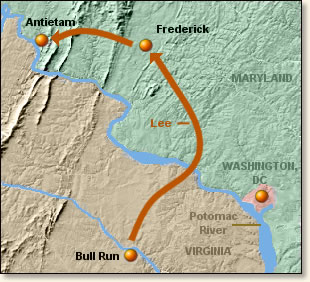
The battle was fought on Wednesday, September 17, 1862, and less than 3 weeks after the
costly Confederate victory at the Second Battle of Manassas (aka Second Bull Run). The Battle of Antietam, or Sharpsburg, changed
the entire course of the Civil War and it not only stalled General Robert E. Lee's bold invasion of the North, but it thwarted efforts to force Lincoln to sue for peace. The Union victory at Antietam further provided Lincoln with
the victory he needed in order to announce the abolition of slavery
and it removed any chance of European recognition of the Confederacy. The arming of black soldiers soon followed, which
Lincoln would later credit for turning the tide of war. See Why Lee Invaded Maryland.
The
Battle of Sharpsburg, Maryland, witnessed eleven solid hours of fierce fighting and a man was
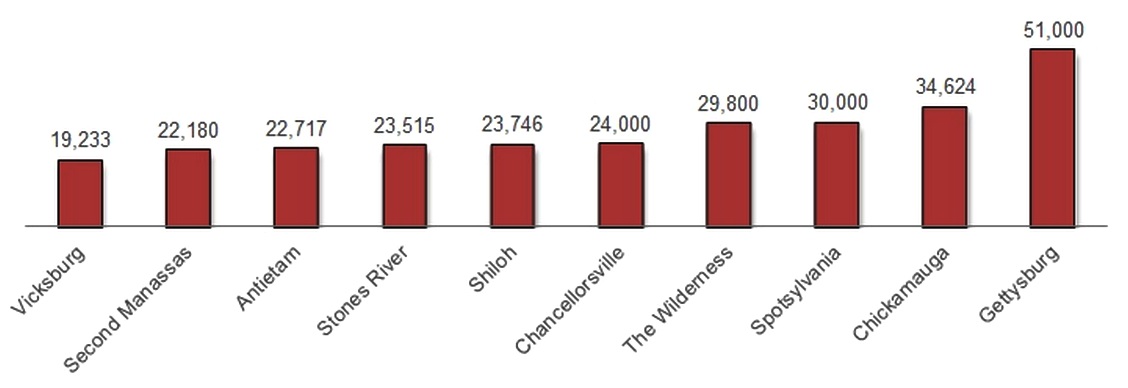
killed or wounded every two seconds. The casualties were 6 Generals killed, 12 Generals wounded, and approximately 23,000 killed, wounded, and missing, which was 9 times the number that fell on the beaches of Normandy. Antietam remains the bloodiest single-day battle in the history
of the United States. (See also Maryland Civil War History.)
The First Texas Infantry Regiment lost eighty-two percent of the 226 engaged at Antietam, and at
least four female soldiers, including Sarah Emma Edmundson Seelye, participated in the battle. Antietam also produced twenty Medals of Honor. The fight had changed the course of a nation.
"In the time that I am writing, every stalk of corn in the northern and greater part of the field was
cut as closely as could have been done with a knife, and the slain lay in rows precisely as they had stood in their ranks
a few moments before. It was never my fortune to witness a more bloody, dismal battlefield." Maj.
Gen. Joseph Hooker, USA, Commander, I Corps, Army of the Potomac, while at the Antietam Battle
| Turning Point of the Civil War |
|
| Turning Points and Pivotal Battles of the Civil War |
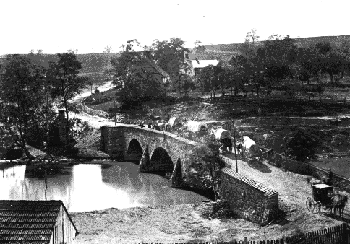
| Burnside Bridge: Antietam |
|
| Library of Congress |
The Burnside Bridge was named after Union General Ambrose
Burnside who commanded the Ninth Corps at Antietam. His soldiers made repeated attacks against the small force of Confederates
who defended this crucial Antietam Creek crossing.
At
approximately 1 p.m. on Sept. 17, the Confederates, outflanked and outnumbered, and running low on ammunition, began to retreat
or withdraw. The Yankees stormed the bridge, finally crossing the hotly contested Antietam Creek. However, the time taken
to cross and resupply the Union troops had provided Lee with the opportunity to bring his final reserves on the field and
turn back Burnside's attack, thus ending the bloody day.
Antietam
was General Robert E. Lee's first attempt to "take the war to the Northerners," while Gettysburg was Lee's second and final
attempt to invade Northern soil. As Lee pushed his Army of Northern Virginia into Maryland in 1862 and into Pennsylvania in
the summer of 1863, he would be swept quickly from the fields by the superior Union numbers and the overwhelming manufacturing
capability by the juggernaut of the North. The industrial might of that behemoth north of the Mason-Dixon, combined with the
fresh Union numbers arriving on the fields daily, would prove to be far too strong for Lee as his army had little to no logistical
support and no fresh troops arriving on the field. For the Southerners, both battles would prove disastrous.
Antietam and Ramifications for the South and North
South Fought a Defensive War Only
During Lee's first invasion of the
North in September 1862, some Southerners refused to participate and therefore deserted the Confederate army because
they believed in fighting against an enemy that had invaded their home state and homestead, and they wanted
no part of invading someone else's state and community up in the North. They had conviction about fighting a defensive
war only. It was a common phrase in the Southern states to hear the citizens boast that the "South was defending its
homeland against Northern Aggression." But there was also division
within many of the Southern states. On June 20, 1863, for instance, with
strong pro-Unionist sentiment, the western portion of the State of Virginia, a mountainous region, broke
away, it divorced Virginia and formed the State of West Virginia. There was the cry of
the rich man's war and the poor man's fight, and that meant that the rich slaveholders were exempted from combat, they
were able to sit out the war and stay on the large plantation and enjoy their luxury and lifestyle while the
poor folk fought and died to preserve it.
North and Preservation of the Union
Antietam had led to Lincoln's issuance of the Emancipation Proclamation and had reflected that
the "pen is mightier than the sword." With the proclamation, however, Northern
soldiers also deserted the army and many stated that "I am not fighting to free the blacks or to abolish slavery."
In plain words, many Federal soldiers were fighting to preserve the Union, to force the rebellious Southern states back into
the fold. And the Copperhead ranks swelled as a direct result of Lincoln's Proclamation. A wealthy Northerner
could also acquire a “military exemption” by purchasing or paying a "commutation fee." This also
invoked the cry of "a rich man's war and a poor man's fight." In The Union Army, vol. 3, p. 93, it reflects Northern
sentiment: "The crowning argument at the time, among the people
was, "a poor man who has not $300 must go to the wars; a rich man, who can pay $300, or who can hire a substitute, need not
go." It has been said that wars will always exist, because the poor will always be available to fight them.
Subsequent Turning Points
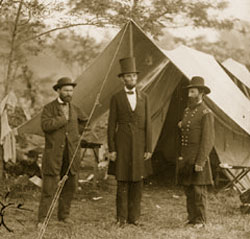
| President Lincoln at Union Camp in October 1862 |
|
| (Library of Congress) |
The fall of Vicksburg gave more tangible results to the Union than the defeat of Lee's army at Gettysburg. At Vicksburg,
the Union army split the South in two along the line of the Mississippi, making it extremely difficult for the Southern blockade
runners into Texas to supply the Confederates east of the Mississippi. In general, it made it extremely difficult for the
fledgling Southern Confederacy to transfer supplies and troops to its Eastern and Western Theaters, fulfilling Gen.
Scott's Anaconda Plan.
The Union also gained political objectives at Vicksburg and to a degree at Gettysburg. Lee was turned back at Gettysburg,
and the public perception of Lee's invincibility was tainted. With the North's victory at Gettysburg, however,
the South discontinued its offensive war in the North. For the remainder of the conflict, the South fought a defensive war.
(Related reading is listed below.)
Recommended Reading: The
Antietam Campaign (Military Campaigns of the Civil War). Description: The Maryland campaign of September
1862 ranks among the most important military operations of the American Civil War. Crucial political, diplomatic, and military
issues were at stake as Robert E. Lee and George B. McClellan maneuvered and fought in the western part of the state. The
climactic clash came on September 17 at the battle of Antietam, where more than 23,000 men fell in the single bloodiest day
of the war. Continued below...
Approaching
topics related to Lee's and McClellan's operations from a variety of perspectives, numerous contributors to this volume explore
questions regarding military leadership, strategy, and tactics, the impact of the fighting on officers and soldiers in both
armies, and the ways in which participants and people behind the lines interpreted and remembered the campaign. They also
discuss the performance of untried military units and offer a look at how the United States Army used the Antietam battlefield
as an outdoor classroom for its officers in the early twentieth century. Also available in paperback: The Antietam Campaign (Military Campaigns of the Civil War)
Recommended Reading: Crossroads
of Freedom: Antietam (Pivotal Moments in American History) (Hardcover). Description: The bloodiest day
in United States
history was September 17, 1862, when, during the Civil War battle at Antietam, approximately
6,500 soldiers were killed or mortally wounded, while more than 15,000 were seriously wounded. James M. McPherson states
in Crossroads of Freedom the concise chronicle of America’s bloodiest day and that it may well have been the
major turning point of the Civil War ("the pivotal moment of the entire Civil War") and critical turning point of the young
republic itself. Continued below...
The South, after a series of setbacks in the spring of 1862, had reversed the war's momentum during the
summer, and was on the "brink of military victory" and about to achieve diplomatic recognition by European nations, most notably
England
and France. Though the bulk of his book
concerns itself with the details--and incredible carnage--of the battle, McPherson raises it above typical military histories
by placing it in its socio-political context: The victory prodded Abraham Lincoln to announce his "preliminary" Emancipation
Proclamation, freeing slaves. England and France deferred their economic alliance with the battered secessionists. Most importantly,
it kept Lincoln's party, the Republicans, in control of Congress.
McPherson's account is accessible, elegant, and economical. Also available in paperback:
Crossroads of Freedom: Antietam (Pivotal Moments in American
History)
Recommended Reading:
Fields of Honor: Pivotal Battles of the Civil War,
by Edwin C. Bearss (Author), James McPherson (Introduction). Description: Bearss,
a former chief historian of the National Parks Service and internationally recognized American Civil War historian, chronicles
14 crucial battles, including Fort Sumter, Shiloh, Antietam, Gettysburg, Vicksburg, Chattanooga, Sherman's march through the
Carolinas, and Appomattox--the battles ranging between 1861 and 1865; included is an introductory chapter describing John
Brown's raid in October 1859. Bearss describes the
terrain, tactics, strategies, personalities, the soldiers and the commanders. (He personalizes the generals and politicians,
sergeants and privates.) Continued below...
The text is augmented by 80 black-and-white photographs and 19 maps. It is like touring the battlefields
without leaving home. A must for every one of America's countless Civil War buffs,
this major work will stand as an important reference and enduring legacy of a great historian for generations to come. Also
available in hardcover: Fields of Honor: Pivotal Battles of the Civil War . .
Recommended
Reading: The Civil War
Battlefield Guide: The Definitive Guide, Completely Revised, with New Maps and More Than 300 Additional Battles
(Second Edition) (Hardcover). Description: This
new edition of the definitive guide to Civil War battlefields is really a completely new book. While the first edition covered
60 major battlefields, from Fort Sumter to Appomattox, the second covers all of the 384
designated as the "principal battlefields" in the American Civil War Sites Advisory Commission Report. Continued
below...
As in the first edition, the essays are authoritative and concise, written by such leading Civil War
historians as James M. McPherson, Stephen W. Sears, Edwin C. Bearss, James I. Robinson, Jr., and Gary W. Gallager. The second
edition also features 83 new four-color maps covering the most important battles. The Civil War Battlefield Guide is an essential
reference for anyone interested in the Civil War. "Reading this book is like being at the bloodiest battles of the
war..."
Editor's
Pick: The Maryland Campaign of September 1862: Ezra A. Carman's Definitive
Study of the Union and Confederate Armies at Antietam (Hardcover). Description: Completed
in the early 1900s, The Maryland Campaign of September 1862
is still the essential source for anyone seeking understanding of the bloodiest day in all of American history. As the U.S.
War Department’s official expert on the Battle of Antietam, Ezra Carman corresponded with and interviewed hundreds of
other veterans from both sides of the conflict to produce a comprehensive history of the campaign that dashed the Confederacy’s
best hope for independence and ushered in the Emancipation Proclamation. Nearly a century after its completion, Carman's manuscript
has finally made its way into print, in an edition painstakingly edited, annotated, and indexed by Joseph Pierro. The Maryland Campaign of September 1862 is a crucial document for anyone
interested in delving below the surface of the military campaign that forever altered the course of American history. Continued
below...
Editorial Reviews:
Ted
Alexander, Chief Historian, Antietam
National Battlefield
"The
Ezra Carman manuscript is the definitive study of that bloody September day in 1862. By editing it Joseph Pierro has done
a tremendous service to the field of Civil War studies. Indeed, this work is one of the most important Civil War publications
to come out in decades."
James
M. McPherson, author of Crossroads of Freedom: Antietam
"Many
accounts of Civil War battles were written in the decades after the war by soldiers who had participated in them. None rivals
in accuracy and thoroughness Ezra Carmen's study of the battles of South Mountain and Antietam, in which he fought as colonel of the 13th New Jersey. Students of the 1862 Maryland
campaign have long relied on this manuscript as a vital source; Joseph Pierro's scrupulous editorial work has now made this
detailed narrative accessible to everyone. A splendid achievement."
Jeffry
D. Wert, author of The Sword Of Lincoln: The Army of the Potomac
"At
last, after a century, Ezra A. Carman's The Maryland Campaign
of September 1862 has received the attention it deserves. A Union veteran, Carman authored a remarkable primary study of the
critical operations that ended along Antietam Creek. Editor Joseph Pierro has given students of the Civil War and American
history a most welcome and long overdue book."
Edwin
C. Bearss, author of Fields of Honor: Pivotal Battles of the Civil War
"My
introduction to the Ezra A. Carman Papers at the Library of Congress and National Archives came in the spring of 1961. I was
astounded and amazed by their depth and scope. The correspondence, troop movement maps, etc, along with Carman's unpublished
manuscript on the Antietam Campaign constitutes then as now an invaluable legacy to the American people by Carman and the
veterans of Antietam. But for too long that resource has only been available to the general public as microfilm or by traveling
to Washington. Now thanks to the publishers and skilled,
knowledgeable, sympathetic, but light-handed editor Joseph Pierro, an annotated copy of Carman's masterpiece The Maryland Campaign of September 1862 will be available to the public."
William
C. Davis, author of Look Away! A History of the Confederate States of America
"Joseph
Pierro brings into the open one of the great and largely unknown masterworks of Civil War history. Ezra Carman's work on Antietam
is a fountainhead for study of that pivotal battle, written by a man who was in the fight and who spent most of his life studying
and marking the battlefield. No student can afford to ignore this stunningly thorough and brilliantly edited classic."
|
