|
American Civil War Causes
What Caused the Civil War?
What Caused the American Civil War?
| Causes of the Civil War |
|
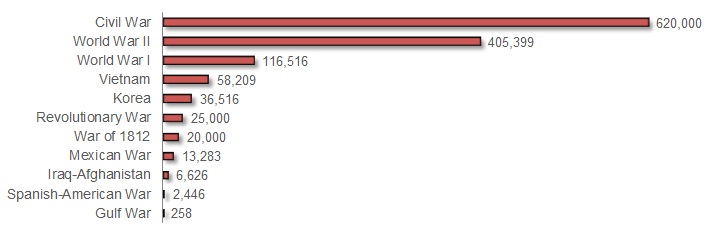
| What caused the Civil War? The Civil War caused more deaths than all previous US wars combined |
Causes of the American Civil War
Introduction
What caused the Civil War? The subject quickly enters the discussion
and often times becomes the most hotly debated topic of the conflict. What caused the Civil War? After 150 years, the
subject, aka the causes of the Civil War, remains unsettled and debated from Civil War buffs to seasoned historians. There
are, however, two dominant positions regarding what caused the Civil War: Slavery or States' Rights.
While longing for their day of jubilee, only never to experience
it, were thousands of blacks who died as a result of President Lincoln refusing to free one-half million slaves with the Emancipation
Proclamation in 1863. Because the Border States remained in, and did not rebel against, the Union, Lincoln exempted the states from emancipating their nearly
500,000 slaves. Some of the Border States refused to free a single slave until forced to do so by the Thirteenth
Amendment two years later.
When President Abraham Lincoln signed the Emancipation Proclamation on January 1, 1863, and midway through the Civil War, he intentionally refused to emancipate 500,000 slaves in the Union
controlled Border States and in all areas that were not in rebellion. The limited proclamation freed slaves only in the rebellious
Southern states, but the Union army had to first conquer the South before it could free the slaves. The Civil War (1861-1865)
had already witnessed two bloody years of carnage by the time Lincoln signed and enacted the hypocritical proclamation. Candidly
stated, two years into the Civil War and with no end in sight for the conflict, Lincoln, by his very own actions, literally
condoned and supported the institution of slavery by forcing 500,000 blacks to remain in shackles and bonds, to be treated
like rabid animals, and to beaten at the nod of the master.
History books indicate that the victor
has not been kind to the vanquished. When the conqueror recorded its version of the conflict, the demoralized
foe was further disgraced and discredited because absent in most history books was fair, balanced, and objective work.
When any history book becomes a fallacious work, then the vanquished, the victor, and the reader all join the ranks of
the conquered.
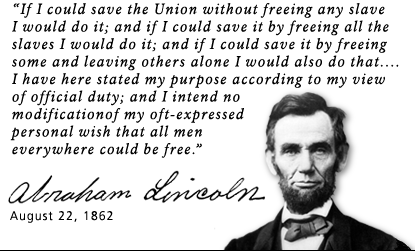
As you examine the subject, what caused the civil war, ask the following
questions: Why didn't Lincoln free all the slaves with the Emancipation Proclamation? And did President Lincoln himself ever
state that slavery caused the Civil War?
| Causes of the Civil War |
|
| Causes of the Civil War and States' Rights |
| What Caused the Civil War? |
|
| Abraham Lincoln and Emancipation Proclamation |
Summary
The Civil War grew out of longstanding tensions
and disagreements about American life and politics. For nearly a century, people in the Northern and Southern states had been
debating the issues that ultimately led to war: economic policies and practices, cultural values, the extent and reach of
the Federal government, and, most importantly, the role of slavery within American society. Against the backdrop of these larger issues, individual soldiers had their own reasons for
fighting. Their motivations often included a complex mix of personal, social, economic and political values that didn't necessarily
match the aims expressed by their respective governments.
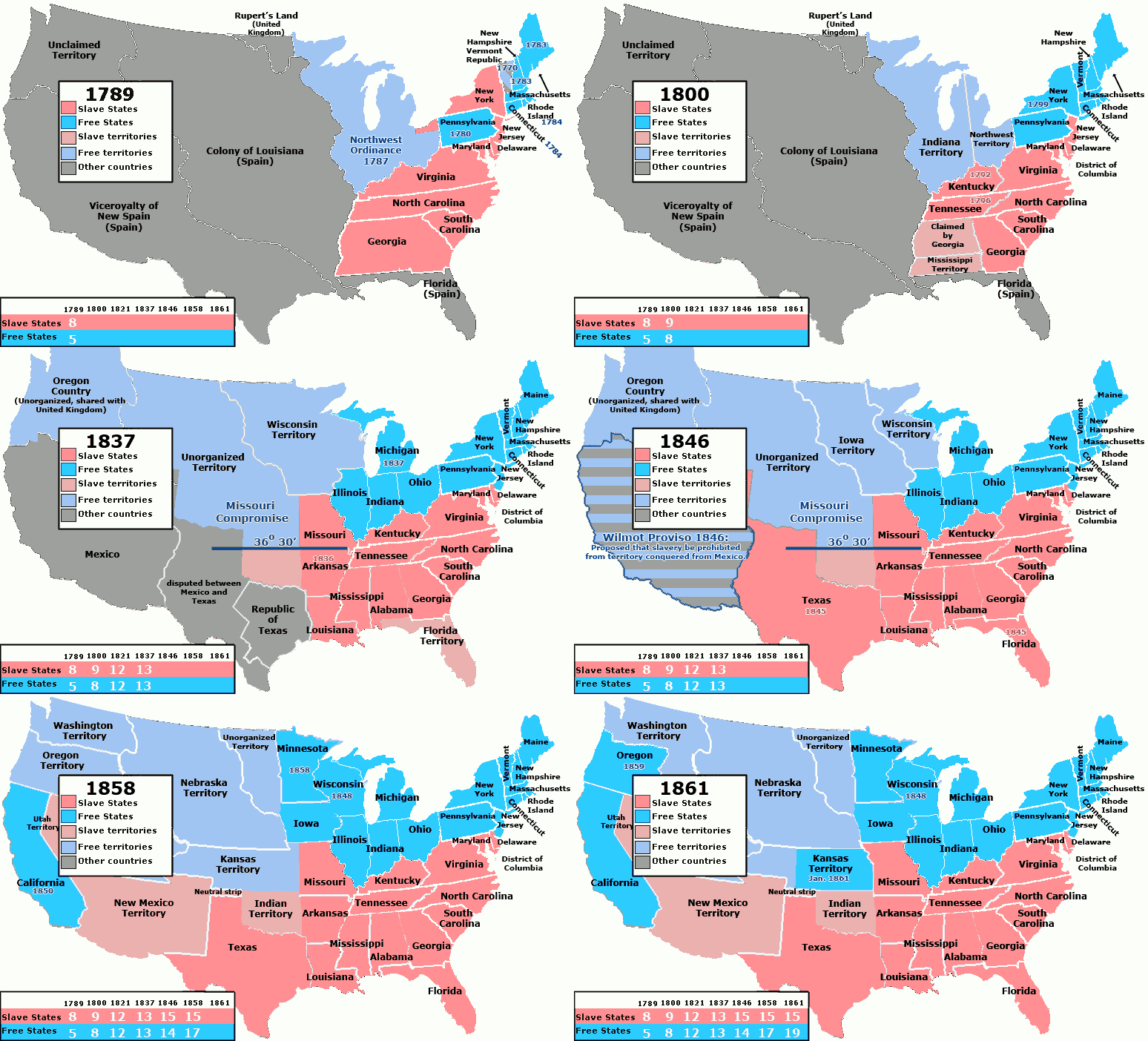
States' Rights* (Bill of Rights and the 10th Amendment), High Tariffs, Nullification Crisis, Sectionalism, Missouri Compromise, Mexican Cession and American Expansionism, Kansas-Nebraska Act, Manifest Destiny, Compromise of 1850 (which included the controversial Fugitive Slave Act), Dred Scott Case, Bleeding Kansas, Crittenden Compromise, John Brown, and President Abraham Lincoln's election (Lincoln didn't receive a single Southern electoral
vote). However, according to President Lincoln's position, the principal or main cause of the Civil War was Secession itself.
Regarding what caused the Civil War, or causes of the Civil War, the President
of the United States -- as commander-in-chief and chief executive -- declared himself that the sole cause of the Civil
War was secession. Lincoln chose war to suppress what he deemed a rebellion in
the Southern states. If the South embraced and espoused slavery and if the South stated that the institution, alone,
justified war, it was ultimately the President of the United States, possessing absolute responsibility and duty as
chief executive for the nation, who, to the contrary, declared war on the South because of secession. As President, Lincoln
declared that the South was guilty only of rebellion, and, without the consent of Congress and contrary to
pleas from the Supreme Court, the President raised an army of 75,000 troops and subsequently invaded the Southern states. Moreover, the decision
to declare war or to suppress a rebellion, and to state what caused the Civil War, was proclaimed by President Abraham
Lincoln himself; and he stated his position for war clearly. See also Abraham Lincoln on Causes of the Civil War and Secession and Lincoln's Call For Troops.
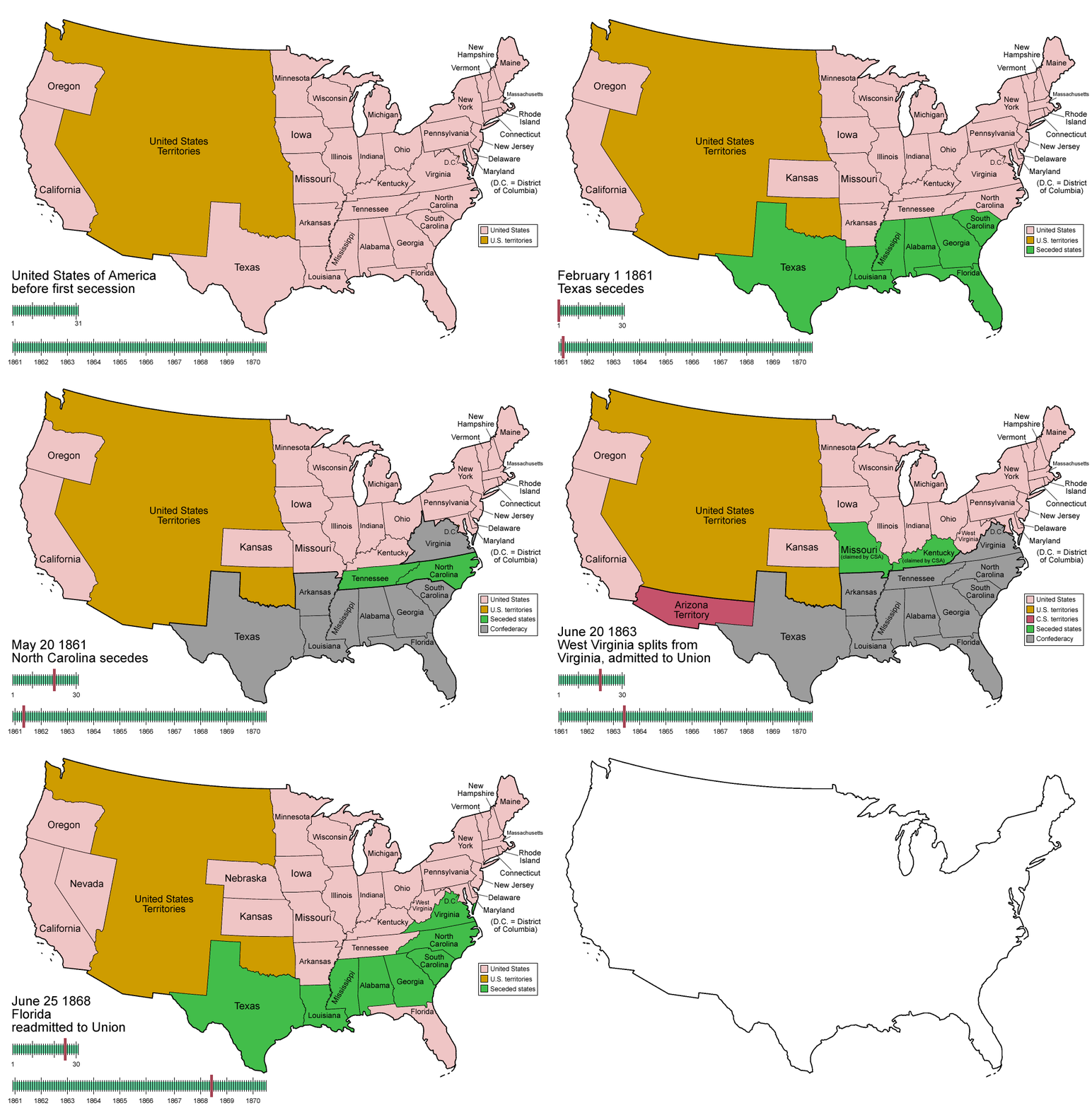
Prior to April 15, 1861, seven Southern states,
South Carolina, Georgia, Alabama, Florida, Mississippi, Louisiana and Texas, had seceded from the Union. On April
15, 1861, Lincoln stated in his Call For Troops that the only cause of the Civil War was secession in the Southern states, and that troops were being called
upon in order to "suppress the rebellion" and force the states back into the Union. Just 2 days after Lincoln's Call for Troops
to raise an army and invade the South, Virginia seceded (April 17), followed by Arkansas, North Carolina and Tennessee. Kentucky, meanwhile, refused to recruit a single soldier for Lincoln's "wicked cause," and Maryland, a free state, was invaded by U.S. troops and placed under martial law, while Delaware, though of divided loyalty, did not attempt it. In Missouri, on October 31, 1861, a pro-CSA remnant of the General Assembly met and passed an ordinance of secession.
Lincoln, contrary to persisting myths and continuing revisionism, never
stated publicly or in any document that abolishing the institution of slavery was why he called upon the troops, or to free the slaves was the cause of the Civil War. The Southern states had seceded, and Lincoln was now
determined to suppress it. According to the President, secession was the cause of the Civil War.
Five Civilized Tribes Align With Southern States
The Five Civilized Tribes even aligned themselves with the Confederacy, and the Cherokee Nation in its formal declaration to unite with
the Southern states leveled, among many, the following blistering accusations against Lincoln and the Union: “But
in the Northern States the Cherokee people saw with alarm a violated Constitution, all civil liberty put in peril, and all
the rules of civilized warfare and the dictates of common humanity and decency unhesitatingly disregarded. In States which
still adhered to the Union a military despotism has displaced the civil power and the laws became silent amid arms. Free speech
and almost free thought became a crime. The right to the writ of habeas corpus, guaranteed by the Constitution, disappeared
at the nod of a Secretary of State or a general of the lowest grade. The mandate of the Chief Justice of the Supreme Court
was set at naught by the military power, and this outrage on common right approved by a President sworn to support the Constitution.
…Lincoln sent armies into Southern States to aid in subjugating a people struggling for freedom, to burn, to plunder,
and to commit the basest of outrages on women; while the heels of armed tyranny trod upon the necks of Maryland and Missouri,
and men of the highest character and position were incarcerated upon suspicion and without process of law in jails, in forts,
and in prison-ships, and even women were imprisoned by the arbitrary order of a President and Cabinet ministers; while the
press ceased to be free.”
| The Causes of the Civil War History |
|
| Major Causes of the American Civil War List |
Causes of the Civil War, Secession, and the Constitution
The lawful and constitutional right for a state to secede (secession) from
the Union (United States) has been debated from Civil War buffs to constitutional scholars. Regarding Southern Secession at
that time, however, it had never been discussed before the United States Supreme Court, which was the nation's highest court
and final lawful arbiter.
When U.S. Supreme Court Chief Justice Roger Brooke Taney stated that the
constitutionality of "Southern Secession must be decided by the Supreme Court," President Lincoln opined otherwise and simply rebuked Taney. Taney, himself,
believed that secession, not forbidden by the Constitution, was perhaps legal. The Judicial Branch (also known as the
Judiciary) was equal, separate, and not subject to the Executive Branch (known as Separation of Powers).
Our government was established with checks and balances to prohibit any branch, such as the Executive Branch, from overstepping
its constitutional powers. When that occurs, the nation becomes a despotism. See also:President Abraham Lincoln and War Powers, President Abraham Lincoln and the Chief Justice, and President Abraham Lincoln and Ex Parte Milligan.
In the midst of the secession crisis that would lead to the Civil
War, President James Buchanan, in his final State of the Union address on December 3, 1860, acknowledged the South would "after
having first used all peaceful and constitutional means to obtain redress, would be justified in revolutionary resistance
to the Government of the Union."
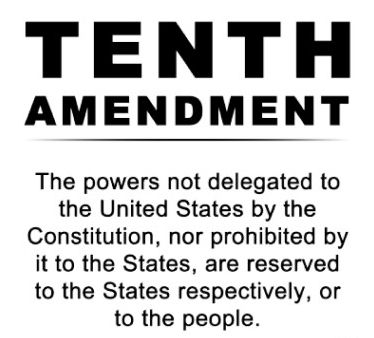
The Union (United States) had been compared to a compact or agreement between
the states as referenced in the Declaration of Independence, and the Federal government had been stated as having limited
powers with the states as referenced in the 10th Amendment to the U.S. Constitution.
Many analogies have also been used or applied to the Union and secession.
Perhaps one of the best analogies regarding secession is divorce. When a couple divorces, there is dissolution of the union
or agreement between two parties. The cause or causes which led to the divorce may vary, but the end result is that the two
parties are no longer in union. When the parties are engaged in a contested divorce, consequently, it must then proceed to
court. What led to the divorce is now irrelevant and moot; the principal fact is that the divorce itself is being contested.
If the divorce is denied the right to a hearing, then the divorce itself is now the sole subject in question and it leads
to the core and greatest question: Why do we have courts and laws and the Constitution? Regarding said discussion, to resolve
disputes between parties.
Furthermore, what are the roles and responsibilities
of the three branches of government and what is the purpose of Separation of Powers? When the Executive Branch obstructs the Judiciary, or Judicial Branch, it also denies the Supreme
Court's existence, essence, and purpose. We
then become a lawless nation. Secession, like divorce, was denied the most basic and fundamental right to the nation's legal
system and process. So, what caused the Civil War? Secession was therefore the principal or main cause of the Civil War.
See also: Causes of the Civil War, Slavery, South and States' Rights, Constitution, Supreme Court, and Southern
Secession.
| Causes of the Civil War |
|
| What caused the Civil War? |
The
day after the firing on Fort Sumter,
the United States Secretary of War, Edwin Stanton, directed that all United States Military Academy (West Point) cadets must take a "new oath
of allegiance." Previously, each cadet had taken an "oath
of allegiance to his respective State." Now, they were required to "swear feilty** to the United States
paramount to any other state, county or political entity." While the cadets were in full uniform, the new oath was administered
in the chapel in the presence of the Academy staff.
**feilty
is an old English word that is not in all dictionaries but is best equated to the modern word ‘fidelity’.
Robert E. Lee had rejected the offer to command the Union forces on the grounds that he could
not draw his sword against his beloved home state of Virginia. Lee stated that his "loyalty to Virginia ought to take
precedence over that which is due the Federal Government." He further proclaimed that he had no greater duty than to his native state of Virginia. Lee was a 4th generation Virginian, son of Henry "Light Horse Harry" Lee (one of George Washington's favorite lieutenants), and Lee's wife, Mary Anne Custis, was the great granddaughter of
Martha Washington.
Today, most people view and identify
themselves as Americans. During the 1800s, however, many identified and viewed themselves
as North Carolinians, Virginians, Texans, Tennesseans, etc.
But following the Spanish-American War and both world wars, we, as a people, have placed a greater emphasis on national
identity.
Robert
E. Lee also had very strong family ties to the South, and many of his relatives served in the Confederate Army: Major General George Washington Custis Lee (graduated
first in West Point class of 1854), eldest son of Robert E. Lee and Mary Anne Custis Lee; General
William Henry Fitzhugh Lee,
second son of Robert E. Lee and Mary Anne Custis Lee; Captain Robert
Edward Lee, Jr., youngest son of Robert E. Lee and Mary Anne Custis Lee,
and the sixth of their seven children; General Fitzhugh Lee, nephew of Robert E. Lee;
Brigadier General Edwin Gray Lee,
second cousin of Robert E. Lee.
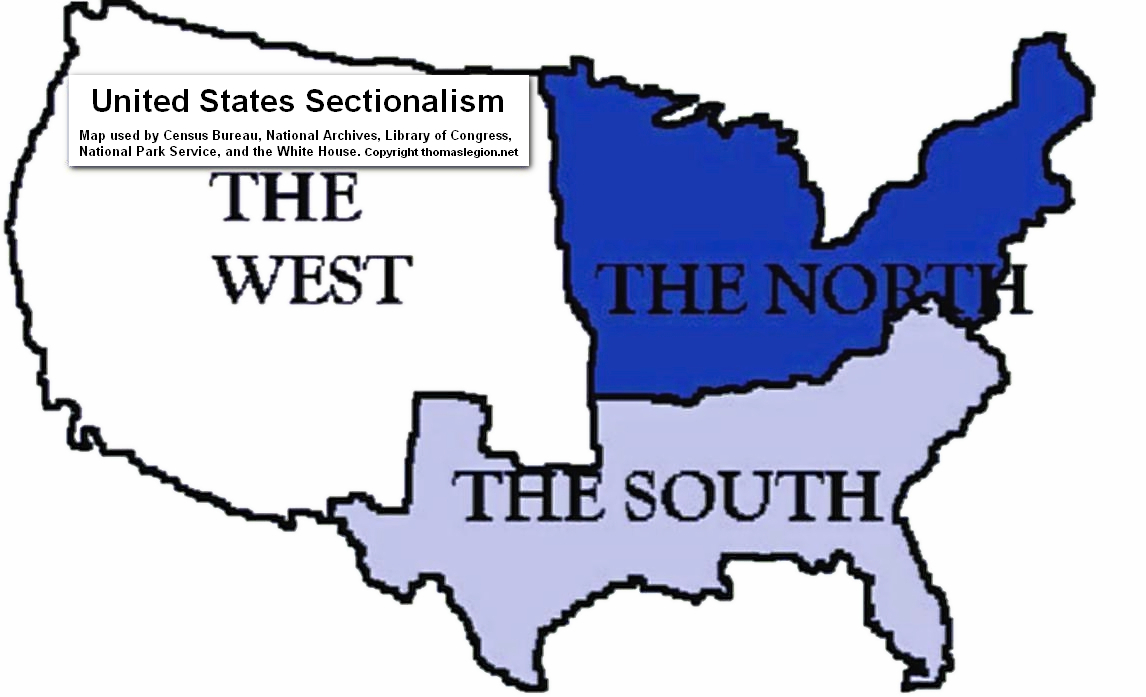
| Sectionalism Map. What caused the Civil War? |
|
| Causes of the Civil War. Lesson Plan Map. |
(About) Causes of the Civil War. This sectionalism map is superimposed on
map of the United States in 1860 and shows the shared border separating "The North" from "The South," slave
and free states, as well as which states remained in the Union (North) and the Southern section which formed the
Confederacy. This map has also been superimposed on the present-day US Census Bureau map showing the official geographical
sections of the nation, and the sections, after more than 150 years, remain almost precisely as they were prior to the Civil
War. The entire section indicated as West, was added to the United States through treaties and acquisitions in a
period spanning less than 10 years, allowing the nation to span from sea to shining sea.
"No one has ever proven secession to be either constitutional or unconstitutional. The question never reached the United States Supreme
Court, which would be the only lawful arbiter. The outcome of the Civil War did decide that secession was not lawful AT THAT
TIME, in that it was tried and it failed to secede. If it is tried again and this time the attempt is successful, then
it will be "lawful" for the time being. But in the end, only a court decision can decide the matter. It is pretty ambiguous."
Excerpt from a letter that Historian William C. Davis wrote to me and the emphasis, caps and quotations, belong
to him.
Jack is the senior consultant for 52 episodes of the History Channel's "Civil War Journal"
(A&E Television Networks). Davis has twice been nominated for the Pulitzer Prize in History and is
the only three-time winner of the Jefferson Davis Award given for book-length works on Confederate history.
"I apprehend that if all living Union soldiers were summoned to the witness stand, every one of them would testify that it was the preservation of the American Union and
not the destruction of Southern slavery that induced him to volunteer at the call of his Country. As for the South, it is
enough to say that perhaps eighty percent of her armies were neither slave-holders, nor had the remotest interest in the institution...both
sides fought and suffered for liberty as bequeathed by the Fathers--the one for liberty in the union of the States, the other
for liberty in the independence of the States." Reminiscences of the Civil War, by John B. Gordon, Maj. Gen. CSA
General Gordon was shot 5 times during the Battle of Antietam but did not die until January 9, 1904. Regarding General John Gordon, President Theodore Roosevelt
stated, "A more gallant, generous, and fearless gentleman and soldier has not been seen by our Country."
"A great majority of the people were poor and had no interest
in slavery, present or prospective. But most of them had little mountain homes and, be it ever so humble, there is no place
like home...but when the Federal army occupied East Tennessee and threatened North Carolina..." Lt. Col. William W. Stringfield. Histories of the Several Regiments and Battalions from North Carolina in the Great War 1861-'65, Vol.,
3, p. 734.
(Continued below.)
Recommended Reading: Lincoln and
Chief Justice Taney: Slavery, Secession, and the President's War Powers, by James F. Simon (Simon &
Schuster) (Hardcover). Publishers Weekly: This surprisingly taut and gripping book by NYU law professor Simon (What Kind of
Nation) examines the limits of presidential prerogative during the Civil War. Lincoln and Supreme Court Chief Justice Roger
Taney saw eye to eye on certain matters; both, for example, disliked slavery. But beginning in 1857, when Lincoln criticized
Taney's decision in the Dred Scott case, the pair began to spar. They diverged further once Lincoln became president when
Taney insisted that secession was constitutional and preferable to bloodshed, and blamed the Civil War on Lincoln. In 1861,
Taney argued that Lincoln's suspension of habeas corpus was illegal. This holding was, Simon argues, "a clarion call for the
president to respect the civil liberties of American citizens." Continued below...
In an 1862 group of cases,
Taney joined a minority opinion that Lincoln lacked the authority to order the seizure of Southern ships. Had Taney had the
chance, suggests Simon, he would have declared the Emancipation Proclamation unconstitutional; he and Lincoln agreed that
the Constitution left slavery up to individual states, but Lincoln argued that the president's war powers trumped states'
rights. Simon's focus on Lincoln and Taney makes for a dramatic, charged narrative—and the focus on presidential war
powers makes this historical study extremely timely.
Recommended Reading:
The South Was Right! (Hardcover). Description: Kin Hubbard said "'Tain't
what a man don't know that hurts him; it's what he does know that just ain't so." Much of what people "know" about the causes,
conduct, and consequences of the Civil War "just ain't so." The Kennedy brothers make a strong case that the real reasons
and results of the War Between the States have been buried under the myth of Father Abraham and his blue-clad saints marching
south to save the Union and free the slaves. Sure, the tone is polemical. But the "enlightened"
elements of American opinion have been engaging in a polemic against the South and its people for decades. Continued below...
This book adopts the "following the
money approach" to analyzing who profited most from slavery – a convincing argument that reflects that much of the wealth
went to the North. It also points out that slavery was not new to Africa, and was practiced
by Africans against Africans without foreign intervention. A strong case is made that the North and Lincoln held strong racist
views. Lincoln proposed shipping, or transporting, blacks back to Africa… The blacks residing in the Northern states were in a precarious predicament (e.g.
draft riots and lynchings in NY City). The authors, however, do not make any argument supporting slavery - their consistent
line is the practice is vile. The fact that many blacks served, assisted and provided material support to Union
and Confederate Armies is beyond refute. Native Americans also served with distinction on both sides during the Civil War.
“A controversial and thought-provoking book that challenges the status-quo
of present teachings…”
Recommended Reading: Secession Debated: Georgia's Showdown in 1860. Review: The critical northern antebellum
debate matched the rhetorical skills of Abraham Lincoln and Stephen A. Douglas in an historic argument over the future of
slavery in a westward-expanding America. Two years later, an equally historic oratorical showdown between secessionists and
Unionists in Georgia generated as much popular interest south of the Mason-Dixon line, and perhaps had an even more profound
immediate effect on the future of the United States. Continued below...
With Abraham Lincoln's "Black Republican" triumph in the presidential election of
1860, the United States witnessed ardent secessionist sentiment in the South. But Unionists
were equally zealous and while South Carolina--a bastion
of Disunionism since 1832--seemed certain to secede; the other fourteen slave states were far from decided. In the deep South,
the road to disunion depended much on the actions of Georgia,
a veritable microcosm of the divided South and geographically in the middle of the Cotton South. If Georgia
went for the Union, secessionist South Carolina could be
isolated. So in November of 1860, all the eyes of Dixie turned to tiny Milledgeville, pre-war capital of Georgia, for a legislative confrontation that would help chart the course toward
civil war. In Secession Debated, William W. Freehling and Craig M. Simpson have for the first time collected the seven surviving
speeches and public letters of this greatest of southern debates over disunion, providing today's reader with a unique window
into a moment of American crisis. Introducing the debate and debaters in compelling fashion, the editors help bring to life
a sleepy Southern town suddenly alive with importance as a divided legislature met to decide the fate of Georgia, and by extension,
that of the nation. We hear myriad voices, among them the energetic and self-righteous Governor Joseph E. Brown who, while
a slaveholder and secessionist, was somewhat suspect as a native North Georgian; Alexander H. Stephens, the eloquent Unionist
whose "calm dispassionate approach" ultimately backfired; and fiery secessionist Robert Toombs who, impatient with Brown's
indecisiveness and the caution of the Unionists, shouted to legislators: "Give me the sword! but if you do not place it in
my hands, before God! I will take it." The secessionists' Henry Benning and Thomas R. R. Cobb as well as the Unionists Benjamin
Hill and Herschel Johnson also speak to us across the years, most with eloquence, all with the patriotic, passionate conviction
that defined an era. In the end, the legislature adopted a convention bill which decreed a popular vote on the issue in early
January 1861. The election results were close, mirroring the intense debate of two months before: 51% of Georgians favored
immediate secession, a slim margin which the propaganda-conscious Brown later inflated to 58%. On January 19th the Georgia
Convention sanctioned secession in a 166-130 vote, and the imminent Confederacy had its Southern hinge. Secession Debated
is a colorful and gripping tale told in the words of the actual participants, one which sheds new light on one of the great
and hitherto neglected verbal showdowns in American history. It is essential to a full understanding of the origins of the
War Between the States.
Recommended Reading: When in the Course
of Human Events: Arguing the Case for Southern Secession. Review: As a historian, I have learned that
the heart of any great work in history lies in the ample and accurate use of primary sources, and primary sources are the
great strength of this work. While countless tomes have debated the perceived moral sides of the Civil War and the motivations
of the various actors, this work investigates the motives of the primary players in the era and in their own words and writings.
This gives the work an excellent realism and accuracy. The author, Charles Adams, has earned a reputation as one of the leading
economic historians in the field, particularly in the area of taxes. He utilizes this background to investigate the American
Civil War, and comes to some very striking conclusions, many that defy the politically-correct history of today. His thesis
postulates that the Civil War had its primary cause not in slavery or state's rights, but rather in cold, hard economic concerns.
Continued below...
He shows that the North used its supremacy in Congress to push through massive
tariffs to fund the government, and that these tariffs fell much harder on the export-dependent South than upon the insular
north. In fact, the total revenue from the "Compromise" Tariffs on the 1830s and 40s amounted to $107.5 million, of which
$90 million came from the South. The majority of the revenue, moreover, was spent on projects “far from the South.”
According to Adams, this disparity finally pushed the South to seek its own independence. Supporting this conclusion is the
fact that the South enacted extremely low tariffs throughout the war, whereas the north enacted the Morrill Tariff of 1861,
which enacted tariffs as high as 50 percent on some goods. Adams also chronicles the oft-overlooked excesses of the Lincoln
Administration, and compares them to the actions of Julius Caesar. Using the letters and reports of the times, he tells how
Lincoln suspended habeas corpus, trod roughshod over the Constitution, jailed thousands of U.S. citizens who dared disagree
with him and even wrote a warrant for the arrest of the Chief Justice of the United States. Adams also ably uses the viewpoints
of British and other Europeans to describe different contemporary views on the struggle. These provide excellent outside insight.
On the whole, readers will find the book a superb and scholarly analysis, providing fresh insights into the motivations and
causes of the defining war in American history. AWARDED 5 STARS by americancivilwarhistory.org
Recommended
Reading:
One Nation, Indivisible? A Study of Secession and
the Constitution. Description: Is
secession legal under the United States Constitution? "One Nation, Indivisible?" takes a fresh look at this old question by
evaluating the key arguments of such anti-secession men as Daniel Webster and Abraham Lincoln, in light of reason, historical
fact, the language of the Constitution, and the words of America's Founding Fathers. Modern anti-secession arguments are also
examined, as are the questions of why Americans are becoming interested in secession once again, whether secession can be
avoided, and how an American state might peacefully secede from the Union. Continued below…
"The federal
government's growth of power at the expense of individuals and natural human communities has been the trend so long now that
it has seemed inevitable. But thoughtful people of late have been rediscovering the true decentralist origins of the United
States. Robert Hawes states the case beautifully for the forgotten decentralist tradition
- which may be our only hope for the preservation of freedom."
Recommended Reading: Lincoln and Douglas:
The Debates that Defined America (Simon & Schuster) (February 5, 2008) (Hardcover). Description:
In 1858, Abraham Lincoln was known as a successful Illinois lawyer who had achieved some prominence in state politics as a
leader in the new Republican Party. Two years later, he was elected president and was on his way to becoming the greatest
chief executive in American history. What carried this one-term congressman from obscurity to fame was the campaign he mounted
for the United States Senate against the country's most formidable politician, Stephen A. Douglas, in the summer and fall
of 1858. Lincoln challenged Douglas directly in one of his greatest speeches -- "A house divided against itself cannot stand"
-- and confronted Douglas on the questions of slavery and the inviolability of the Union in seven fierce debates. As this
brilliant narrative by the prize-winning Lincoln scholar Allen Guelzo dramatizes, Lincoln would emerge a predominant national
figure, the leader of his party, the man who would bear the burden of the national confrontation. Continued below...
Of course, the great issue between
Lincoln and Douglas was slavery. Douglas was the champion of "popular sovereignty," of letting states and territories decide
for themselves whether to legalize slavery. Lincoln drew a moral line, arguing that slavery was a violation both of natural
law and of the principles expressed in the Declaration of Independence. No majority could ever make slavery right, he argued.
Lincoln lost that Senate race to Douglas, though he came close to toppling the "Little Giant," whom almost everyone thought
was unbeatable. Guelzo's Lincoln and Douglas brings alive their debates and this whole year of campaigns and underscores their
centrality in the greatest conflict in American history. The encounters between Lincoln and Douglas engage a key question
in American political life: What is democracy's purpose? Is it to satisfy the desires of the majority? Or is it to achieve
a just and moral public order? These were the real questions in 1858 that led to the Civil War. They remain questions for
Americans today.
Recommended Reading: The Real Lincoln: A New
Look at Abraham Lincoln, His Agenda, and an Unnecessary War. Description: It hardly seems possible that there is more to say about someone who has been subjected
to such minute scrutiny in thousands of books and articles. Yet, Thomas J. DiLorenzo’s The Real Lincoln manages to raise fresh and morally probing questions, challenging the image of the martyred
16th president that has been fashioned carefully in marble and bronze, sentimentalism and myth. In doing so, DiLorenzo does
not follow the lead of M. E. Bradford or other Southern agrarians. He writes primarily not as a defender of the Old South
and its institutions, culture, and traditions, but as a libertarian enemy of the Leviathan state. Continued below...
DiLorenzo holds
Lincoln and
his war responsible for the triumph of "big government" and the birth of the ubiquitous, suffocating modern U.S. state. He seeks to replace the nation’s memory
of Lincoln as the “Great Emancipator” with the record of Lincoln as the “Great Centralizer.”
Recommended Reading: Lincoln Unmasked: What You're Not Supposed to Know About Dishonest Abe. Description: While many view our 16th president as the nation’s greatest president and
hero, Tom Dilorenzo, The Real Lincoln: A New Look at Abraham Lincoln, His Agenda, and an
Unnecessary War, through his scholarly research, exposes the many unconstitutional decisions of Abraham Lincoln. Lincoln Unmasked, a best-seller, reveals that ‘other side’ – the inglorious character
– of the nation’s greatest tyrant and totalitarian. A controversial book that is hailed by many and
harshly criticized by others, Lincoln Unmasked, nevertheless, is a thought-provoking study and view of Lincoln that was not taught in our public school system. (Also available
in hardcover: Lincoln Unmasked: What You're Not Supposed to Know About Dishonest
Abe .) .)
Editor's Picks for the
causes and origins of the Civil War. This list, moreover, includes both Northern
and Southern views.
This page discusses the Order of Secession of Southern
States, Sectionalism, Causes and Origins of the Civil War, and What caused the Civil War?
|
