|
Researching Ancestors of the Civil War Era...
How to Research the Civil War Soldier
for Genealogy and the Family Tree
Introduction
Researching
your ancestors who served in the Union or Confederate military during the Civil War can be very rewarding, but it requires
a lot of patience and a basic understanding of the servicemen of the era. While gathering and organizing the volumes of information
on your 19th Century soldier, it is important to know what to look for as well as where to look, because
it really saves a lot of time (not to mention headaches) as you are trekking for the most reliable and detailed
genealogy for your family history. It is therefore helpful to acquire a basic understanding of the life of the Civil
War soldier while researching the military service.
While
the Civil War claimed the lives of 2% of the U.S. population, it affected everyone in the nation, so the four-year conflict may
hold some valuable info on your ancestor. Military records may even produce complete names, birthplaces, important relatives,
education, vocations, publications, military grades, wartime assignments, wounds, captures, exchanges, paroles, honors, and
place of death and interment. In short, don't underestimate the war time data, especially for Union soldiers since the Federal
government went to great lengths to preserve the records. The National Archives is a great tool for researching and collecting data on your Civil War ancestor. While
access to most records is free, it offers from basic facts such as enlistment location, muster locations,
assignments, unit designations, promotions, notes on wounds, transfers, desertions, and prisoners, to exhaustive compiled
military service records.
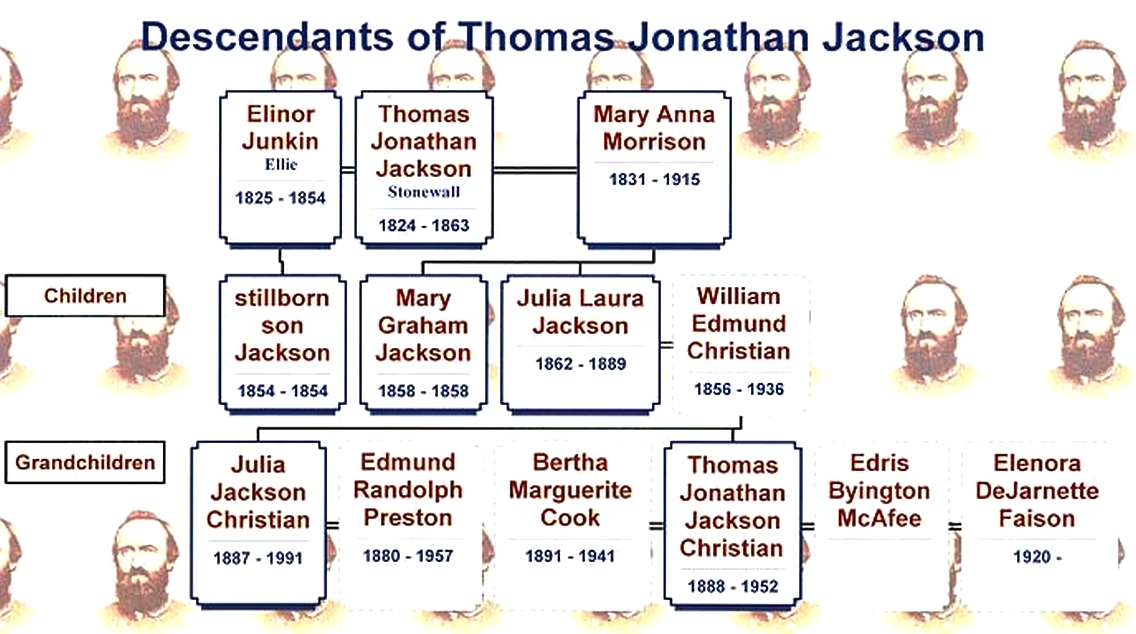
| Civil War soldier family tree & genealogy research |
|
| Help and assistance researching Civil War soldier genealogy and family tree. Courtesy VMI. |
Soldiers
During the Civil War, for both the North and South, many soldiers
enlisted in the company being raised in the local community and they often served with brothers, fathers, sons,
brothers, uncles, and best friends. The common soldier served in at least two units while some served in as many as seven
or more. Serving in multiple units generally causes problems for the researcher, because, in the following example, Private
John Hero enlisted in a company from his hometown in 1861, but because of an illness he was discharged in 1862, and having
fully recovered, Hero enlisted in another company and received his bounty in 1863, but in in a matter of weeks, the parent
regiment was decimated during the fight at Gettysburg in 1863, so Hero was transferred to a battalion, where he
served until that unit was captured and paroled near Petersburg in 1864. Hero, having been paroled, enlisted in
a unit that was in the process of reorganization, where he served until April of 1865, when he, along with
his unit, was paroled at Appomattox.
It is important to have a basic understanding of the life of the
Civil War soldier in order to better assist in researching the soldier's military service. Gathering service information
on an ancestor who served in the Union military is usually profitable, so the emphasis in the Confederacy.
During the four year Civil War, many soldiers served in at least two units
while some served in as many as six or more. Serving in multiple units generally causes problems for the researcher, because
most of the Confederate records were destroyed before the conflict concluded. Why keep records that may serve only
as incriminating evidence for a possible treason trial, was one consensus among Confederate officers. While many Southern
soldiers complained after the war that Lincoln's so-called hordes intentionally destroyed their compiled military service
records, the soon to be former Confederate soldiers were burning and destroying all
traces of Rebel service as the outcome of the conflict was rather obvious. To
fully appreciate the complexity of collecting information on the Southern soldier's military service, one only needs
to know that when the Civil War was finally over, neither the Confederate states nor the U.S. government had
any idea of how many Southern soldiers had died during the conflict. Neither side had any clue as to the total Confederate
troops killed, wounded, captured, missing in action, desertions, and for deaths other than battle, so the word estimate
is used often when discussing the late conflict.
Consider the example
of Private John Hero who enlisted in a company from his hometown in 1861, but because of an illness he was discharged
in 1862, but having fully recovered, Hero enlisted in another company and received his bounty in 1863, but in in a matter
of weeks, the parent regiment was decimated during the fight at Gettysburg in 1863, so Hero was transferred to a
battalion, where he served until that unit was captured and paroled near Petersburg in 1864. Hero, having
been paroled, now enlisted in a unit that was concluding its reorganization, where he served until April of
1865, when he, along with his unit, was paroled at Appomattox.
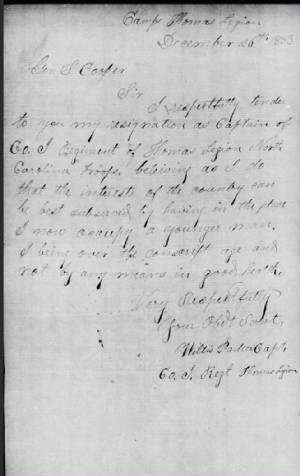
| Civil War Soldier & Ancestry Research |
|
| Civil War Soldier Genealogy & Ancestry |
| Civil War genealogy |
|
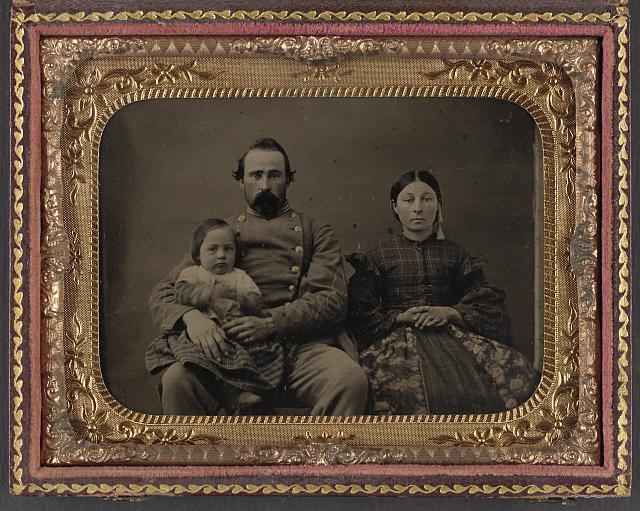
| Confederate First lieutenant with wife and baby, ca. Civil War. |
(About) Tintype photograph of Confederate First lieutenant with wife and
baby. While her husband was at war, one may only imagine the difficulties and hardships his wife endured. Many cold nights
passed while the pangs of war kept papa from his precious baby and darling wife. While preparing for battle, most soldiers said
their last prayer and wrote their last letter to their loved ones. As days turned to weeks and weeks to months and months
to years, a husband, a father, held firmly to only what mattered in this short life, to only what sustained him: family.
Ca. 1860-1865. Library of Congress.
Records
After the war, when the soldier
or widow applied for his military pension, his state required proof, such
as enlistment papers, showing the former soldier's military service. Notice that the state didn't have the required Confederate
records and troop rosters, because they had already been destroyed, so burden rested with the soldier alone. Often times affidavits
from former troops were sought by the veteran in an attempt to receive the pension.
For research purposes, to
locate a Confederate soldier's enlistment, discharge and parole papers is akin to winning the lottery,
and since the war was fought some 150 years ago, from 1861 to '65, time too has not been kind to the sleuth. For
the veteran's pension to be approved, it was necessary to establish both entry and exit dates for military
service. So it is elementary to understand that to also fill in the blanks between the two dates with the soldier's daily
life, is a rather challenging task.
When a soldier was wounded and subsequently returned to service, he may have transferred to different regiment, or simply been ordered
to serve in a mustering unit that was pushing toward a fight. Exigencies of the Civil War have the tendency of making it
difficult for those researching kin of that conflict. Late in the war, 1864 onward, there were many occasions when all available men were called up, including convalescents and those fit to carry a firearm, in
a last ditch attempt to defend the homeland.
After a soldier was separated from his company during battle, he
may have straggled and then temporarily served in the first unit he encountered. This also occurred after a prisoner exchange. The prisoner exchanges
occurred for the first half of the war en masse, with each side usually trading soldiers of equal rank, and while some
prisoners were paroled under the condition that they would not bear arms and rejoin the fight, others simply refused
the condition and returned to their old unit. There was a segment, however, that was determined to honor their
word, even when threatened with desertion by their commander. When a soldier was absent from his command, regardless
of the reason, it was documented.
Some military units
had various numerical designations, particularly early in the war when most units were raised for only 90 days. Other commands, for instance, were
initially raised as an artillery regiment but later redesignated as infantry. In 1864, many of the fighting regiments, as they were called in
the North, were reduced by some 70%, so the unit was either increased in numbers to achieve the desired strength, remained
understrength, disbanded, reorganized, or it consolidated. Unit attrition was attributed to killed-in-action, mortally
wounded, diseases, wounds, desertion, capture, missing-in-action, death from all causes other than battles, and enlistment
expiration. A typical regiment consisted of approximately 1,100 soldiers or ten companies. Each company
consisted of 110 soldiers, and by subtracting 70% because of attrition, the high cost of war becomes quite obvious.
As the contest endured and attrition increased, brigade and division commanders would have to determine
whether or not to strengthen, consolidate, or disband a regiment.
When a
soldier such as Robert Gustavus Adolphus Love, who
on paper was R. G. A. Love, initially served as a captain in the 16th North Carolina Infantry, Army
of Northern Virginia, but upon his promotion to colonel of the 62nd North Carolina, he was now in command of a regiment
that was assigned to the Department of East Tennessee. Every promotion needs to be verified as an official
promotion through channels because, while collecting information on an ancestor who fought during the Civil War, it is
common to find contradictions in the highest rank held. The best route to pursue and verify the soldier's rank is
to try and obtain any or all of the following: discharge papers, official promotion document, parole letter when the war ended, approved pension record (if not approved then don't state the rank claimed either),
muster records, troop rosters, and correspondence in the Official Records of the Union and Confederate Armies.
Apply information from the soldier's diary,
memoirs, and personal correspondence cautiously since they were written by the soldier himself, who may or may not have embellished
his military service. In the case of memoirs, which were generally written decades afterwards, they were well-known for
their accounts describing spectacular actions while also being prone to bouts of memory lapses.
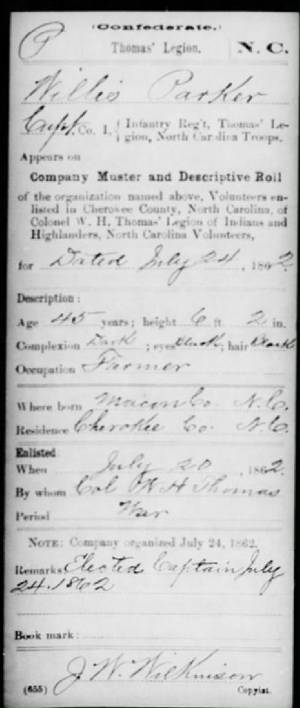
| Civil War Genealogy & Soldier Research |
|
| Civil War Ancestor & Ancestry Research |
| "We Made It" |
|
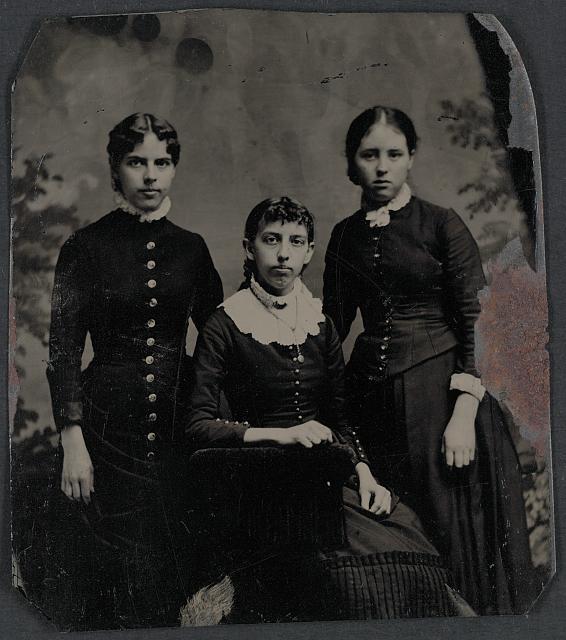
| Nellie Carhart, Annie Mead, Lizzie Palmer, sisters |
(About) Left to right: Nellie Carhart, Annie Mead, Lizzie Palmer, sisters.
This tintype photograph was found with the tintype of Private Abram M. Carhart, Company C, 177th New York Infantry Regiment.
The three sisters were raised only knowing the bitter realities of Civil War. Between 1870 and 1879. Library of Congress.
Units
While most soldiers served in the same regiment with
family, friends, and neighbors, it was always the band of brotherhood that kept the unity strong. Many contemporary writers
believe that the main reason why many soldiers refused to coward and run in the other direction while confronted with
battle, known as the White Feather, was because of the disgrace the soldier would be confronted with back in the local
community. So they insist it was shame that kept many soldiers firmly in rank and file formation as they pushed and marched
headlong into an onslaught of musketry and cannonading. This writer has a serious
problem with that flawed position, because it was and always has been the man next to you that kept the unit strong and as
a fierce fighting force regardless of the odds and outcome. They fought for each other and not because of the likelihood of
being confronted with shame and humiliation at home. By being assigned to a unit with family and friends would actually serve
as an even greater motivator to fight and to fight like furies.
Although many served in the same unit because its ranks were being filled with able-bodied men from the
same local community, it was love, yes love, that compelled the majority to serve alongside their family and friends
as combat and carnage awaited them. While fight or flight applies to combat, fear results in flight while love commands the
fight. The community as a whole also entrusted their loved ones to enlist and serve with relatives and
neighbors-- and they had conviction that the men of the extended family would look out and care for their loved
ones during the war.
The folks from the soldier's hometown are good sources
of information for the locally recruited army company, for they would be in receipt
of personal letters and diaries and local newspapers telling of the day-to-day life and struggles of the unit along with its
assignments, battles, and casualties.
While
the war dragged on, letters and communication became more scarce, making them all the more valuable when located by the family
genealogist. Oral history, the unit's history, memoirs, diaries, letters, and old newspapers are all resources
for the researcher, but their information should be corroborated if possible. Early in the conflict, stomachs were generally
full and the bands of bushwhackers had yet to wreak havoc on the homefront, so greater focus was given toward recording
the unit's information both at home and by men of the unit.
The first impression was a lasting impression as the saying goes, so the local
unit that the soldiers originally enlisted in was generally well-known by many
of the area's citizens, but as soldiers began to transfer one by one to various units that had been raised outside
of the town or county, only a few individuals, namely family members, would receive and have knowledge of the command's
activities. But as correspondence continued to falter as months passed, making it more difficult to ascertain the
soldier's whereabouts during any given month, casualties too continued to rise, making less information available to the family
researcher.
Significant battles and events were generally front or near front page news in both Northern and Southern papers,
such as the fight at Gettysburg and Gen. Early's assault on the nation's capitol. But as the
exchange of letters continued to decline because of hardship reasons, Confederate soldiers were also now torching and
shredding the unit's records, and that meant all available records for many units. From muster to transfer to casualty reports,
all were destroyed, and what the Confederates failed to erase, the Union troops were happy to oblige.
During 1864-65, the
exigencies of the conflict caused mayhem for the troops (and now the researcher) as patchwork detachments were being
formed and moved rapidly to engage the foe on battlefields near and far, and in concert the unit made lieutenants out
of privates by laity vote and without official authorization. They did it because they could, but in diaries
and memoirs it may explain why the rank indicated is higher than the rank listed on the pension and parole
document. During the war the more popular actions and deeds were generally discussed by citizens and soldiers, while other
events generally received little attention. Some soldiers abbreviated their name during the war, for instance, signing
all military related documents as J. Jones instead of Joshua Jones, which at face value can be problematic for the genealogist.
As the Civil War continued to bludgeon
the nation in early 1865, some Confederate commanders accepted the obvious outcome of the conflict as the "Lost
Cause" and made little to no effort maintaining records, and other commands began to summarily destroy all
Confederate documents in a monumental attempt to remove their association with the short-lived Confederacy.
It's not what you know but what you can prove, so if the Rebels were put on trial for treason, which was a probability, it
was thought best not to hand deliver to the Yankees the evidence necessary to seal their fate at the end of a noose or firing
squad.
Recommended Reading: Tracing
Your Civil War Ancestor (Hardcover). Description: It is tantalizing to speculate about the role your ancestors
may have played in the great national drama of the Civil War. But family records are often inaccurate, or provide precious
few leads on where to begin the search. Now, experienced historian Bertram Hawthorne Groene shows you how easy it is to trace
your forbearers' role in the war, where and how long they fought, whether they were Union or Rebel, soldier or sailor -- even
with a minimum of information.
Tracing Your Civil War Ancestor provides you with:
-- The names and addresses of all state archives.
-- Names and addresses of institutions that hold microfilmed service records
from the national archives.
-- Names and publishers of useful regional Civil War reference books.
-- Names and publishers of sourcebooks for identifying Civil War weapons
and accoutrements.
-- And much more.
Historians, genealogists, antique dealers, and collectors of Civil War artifacts
will find this concise guidebook of great value. But most of all it is of inestimable practical value to family historians,
North and South, who are discovering the pleasure and satisfaction of compiling an accurate family history. "[A] must have
for the individual researching Civil War soldiers, ancestors' military service records, Union and Confederate army records,
compiled military service records (CMSR), and for the family genealogist." If you are remotely into genealogy, then this book
is for you.
Recommended Reading:
Civil War Research Guide: A Guide for Researching Your Civil War Ancestor.
Description: It has been over 40 years since the last comprehensive guide to tracing and researching Civil War ancestors was
published. The "Civil War Research Guide" goes beyond, but does not exclude, such major national sources such as the National
Archives in Washington, and features information on little-known
publications, websites, auctions, memorabilia dealers, and patriotic organisations. The authors lay out a systematic procedure
for performing research and recording the results in order to build a proper file on a Civil War soldier, making the experience
both educational and entertaining. Continued below…
About the Authors: Stephen McManus
resides in East Whiteland,
Pennsylvania, and is a graduate of Rensselear Polytechnic Institute and Delaware Law School.
Donald Thompson resides in Upper Marlboro, Maryland, and is a graduate of Rhode Island College. Thomas Churchill resides
in Summerville, South Carolina,
and is a graduate of the Citadel, the Military College of South Carolina. "Great Civil War soldier research guide...[I]ndispensable
source for tracing your Civil War ancestor, witnessing the soldier's military service, and for the individual interested
in primary source documentation of Civil War soldiers and their military service [records]." "Invaluable aid to
researching and gathering the primary documentation of the Civil War soldier."
Recommended Reading:
The Complete Idiot's Guide to Genealogy, 2nd Edition. Description: A very helpful genealogy reference! It is
extremely helpful if you're in the "I want to trace my roots, ancestors, family tree and heritage. How do I begin, where
do I start, and how do I go about doing it?" situation. It contains numerous helpful common sense tips that will prevent future
headaches and a lot of well thought out suggestions and tips too. One helpful hint: "Talk with your extended family
and interview them for genealogy information, be patient with them, and let them tell their stories....document everything."
There are plenty of well-mannered tips like these that elevate this book to excellence. A lot of the confusing aspects of
genealogical research such as document requests and providing proof and evidence are well covered. RATED 5 STARS. Continued
below...
Customer's Review: I bought
this book when I hadn't yet done any research at all about my family history. A year and a half later, I have a file drawer
full of information, and I have needed no other reference. I also bought a book called "The Source", which is supposed to
be the 'genealogist's bible', and it has been a giant paperweight in comparison. Idiot's genealogy is full of the
kind of practical information that can carry you through years of research. Happy hunting!!!
Recommended Reading:
Genealogy 101: How to Trace Your Family's History and Heritage. Description: A recent Maritz Poll reported that 60%
of Americans are interested in their family history. And with good reason. Through genealogy, you can go back into history
to meet people who have had more influence on your life than any others -- your ancestors. And the better you get to know
your ancestors, the better you will get to know yourself: the who's and what's and why's of you. Continued below...
Barbara Renick, a nationally-known
lecturer on genealogy, tells the uninitiated researcher the steps needed to find out who their ancestors really were, and
brings together for even the more experienced genealogical researchers the important principles and practices. She covers
such topics as the importance of staying organized and how to go about it; where and how to look for information in libraries,
historical societies, and on the internet; recognizing that just because something is in print doesn't mean it's right; and
how to prepare to visit the home where your ancestors lived. Genealogy 101 is the first book to read when you want to
discover who your ancestors were, where they lived, and what they did.
Recommended Reading: Rebel Private: Front and Rear: Memoirs of a Confederate Soldier. Description:
First published in 1907, the memoirs of a former Confederate soldier who fought at Gettysburg, Chancellorsville, Second Manassas, and Chickamauga
reveal the ground-level perspective of a Civil War private. Continued below…
From Publishers Weekly:
William Fletcher joined the Confederate Army in 1861. He served with the Army of Northern Virginia's elite Texas Brigade until
the Battle of Chickamauga. Unable to march because of wounds, he transferred to the cavalry and finished the war with the
Texas Rangers, then wrote his memoirs 40 years later. Most of the original copies were destroyed in a fire. The current edition
presents unvarnished images of hard marches, short rations and battles in which being wounded could prove worse than being
killed. Fletcher describes the horrors of being a Civil War casualty as vividly as any firsthand account from either side.
The author emerges from these pages as fighting less for a cause than for his own pride in being a good soldier. His narrative
does more than many learned monographs to explain the Confederacy's long endurance against overwhelming odds.
How to research your Civil War ancestor and military service records (Compiled Military Service
Record), What unit or regiment did the soldier serve in, Locating Confederate soldiers online, Soldier genealogy, Researching
Confederate soldiers for beginners details
|
