|
Cherokee Indians and the American Civil War
Cherokee Indians and the Civil War
Introduction
The Cherokee Indians, though not citizens of the United States nor of the recently formed Confederacy, supported
both the Northern and Southern governments and served in both the Union and Confederate militaries, which resulted in
warring factions within the Cherokee. The Cherokee were involved predominately in the eastern and western theaters
and fought bravely in many of the major battles of the Civil War. The Oconaluftee Indians (Eastern Cherokee) would form the
last Confederate unit to surrender East of the Mississippi, and Cherokee chief and Brig. Gen. Stand Watie, who attained
the highest rank among the Cherokee, commanded the final Confederate command, consisting of men of the Cherokee
Nation, to surrender West of the Mississippi and of the four year Civil War.
While this page offers a rich history, interesting details, fascinating facts, with plenty of pictures
and maps, for Cherokee Indians and the American Civil War, it includes the Cherokee Nation Declaration and the Civil
War, leading Native Americans during the conflict, and the Five Civilized Tribes and the great divide of Civil War. It
also covers Cherokee chiefs and other famous American Indians and their support and involvement for the Confederate and
Union armies, as well as Cherokee Indians and their struggle to assimilate into the Union during Reconstruction.
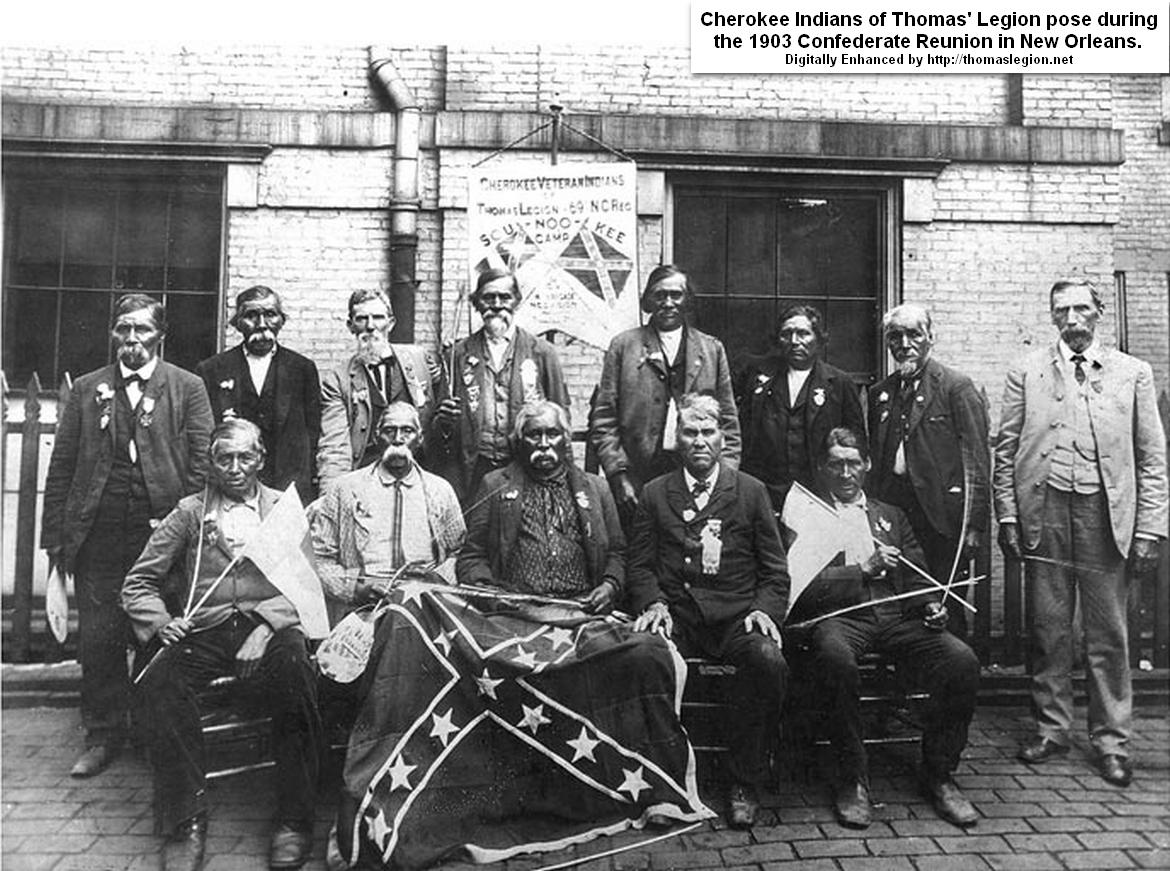
| Confederate Cherokee Indian Veterans |
|
| 1903 New Orleans Confederate Reunion |
(About) The following caption appears under the original image: Above is shown the last photograph ever
taken of the remaining members of the famous Thomas Legion, composed of Cherokee Indians in the Confederate Army. The photograph
was made in New Orleans at the time of the New Orleans Reunion of Confederate Veterans. The inscription on the banner, displayed
in the photograph, is as follows: "Cherokee Veteran Indians of Thomas Legion. 69 N. C. Regiment. Suo-Noo-Kee Camp U. C. V.
4th Brigade, N. C. Division." Reading from left to right, those in the picture are: front row, 1 Young Deer; 2 unidentified;
3 Pheasant; 4 Chief David Reed; 5 Sevier Skitty; back row, 1 the Rev. Bird Saloneta; 2 Dickey Driver; 3 Lieut. Col. W. W.
Stringfield of Waynesville; 4 Lieutenant Suatie Owl; 5 Jim Keg; 6 Wesley Crow; 7 unidentified; 8 Lieutenant Calvin Cagle.
All of these men are now dead with the exception of Sevier Skitty, who lives one mile from Cherokee. Lieut. Col. Stringfield
and Lieut. Cagle were white officers of the legion. Names of the men in the photograph were furnished by James R. Thomas of
Waynesville, son of the late Col. W. H. Thomas, who commanded the Thomas Legion. This band of Indians built the first road
across the Great Smoky Mountains.
(Final Formal Surrender of Confederate forces "East of the Mississippi")
(Final Formal Surrender of Confederate forces "West of the Mississippi")
| Cherokee Indians and the American Civil War |
|
| Cherokee and Civil War |
Recommended Viewing:
Indian Warriors
- The Untold Story of the Civil War (History Channel) (2007). Description:
Though largely forgotten, 20 to 30 thousand Native Americans fought in the Civil War. Ely Parker was a Seneca leader who found
himself in the thick of battle under the command of General Ulysses S. Grant. Stand Watie--a Confederate general and a Cherokee--was known for his brilliant guerrilla tactics.
Continued below...
Also highlighted is Henry Berry Lowery, an Eastern
North Carolina Indian, who became known as the Robin Hood of North Carolina. Respected Civil War authors, Thom Hatch and Lawrence
Hauptman, help reconstruct these most captivating stories, along with descendants like Cherokee Nation member Jay Hanna, whose
great-grandfathers fought for both the Union and the Confederacy. Together, they reveal a new, fresh perspective and the very personal reasons
that drew these Native Americans into the fray.
Recommended Reading: The American
Indian in the Civil War, 1862-1865 (Bison Book) (403 pages) (University
of Nebraska Press). Description: Annie
Heloise Abel describes the divided loyalties of Native Americans and the American Civil War and makes it vividly clear that
it brought only chaos and devastation to the Indian Territory. For example, she describes
in detail the 1862 Battle of Pea Ridge, a bloody disaster for the Confederates but a glorious moment for Colonel (later promoted
to "General") Stand Watie and his Cherokee Mounted Rifles. The Indians were soon swept by the war into a vortex
of confusion and horror.
Recommended Reading: Storm in the Mountains: Thomas' Confederate
Legion of Cherokee Indians and Mountaineers (Thomas' Legion: The Sixty-ninth North Carolina Regiment). Description:
Vernon H. Crow, Storm in the Mountains, dedicated an unprecedented 10
years of his life to this first yet detailed history of the Thomas Legion. But it must be said that this priceless addition has
placed into our hands the rich story of an otherwise forgotten era of the Eastern Cherokee Indians and the mountain men of
both East Tennessee and western North Carolina who would fill the ranks of the Thomas Legion during the four year Civil
War. Crow sought
out every available primary and secondary source by traveling to several states and visiting from ancestors of the
Thomas Legion to special collections, libraries, universities, museums, including the Museum of the Cherokee, to
various state archives and a host of other locales for any material on the unit in order to preserve and present
the most accurate and thorough record of the legion. Crow, during his exhaustive fact-finding, was granted access
to rare manuscripts, special collections, privately held diaries, and never before seen nor published photos and
facts of this only legion from North Carolina. Crow remains absent from the text as he gives a readable account
of each unit within the legion's organization, and he includes a full-length roster detailing each of the men who served in
its ranks, including dates of service to some interesting lesser known facts.
Storm in the Mountains, Thomas' Confederate Legion of Cherokee Indians and
Mountaineers is presented in a readable manner that is attractive to any student and reader of American history, Civil
War, North Carolina studies, Cherokee Indians, ideologies and sectionalism, and I would be remiss without including the
lay and professional genealogist since the work contains facts from ancestors, including grandchildren, some of which
Crow spent days and overnights with, that further complement the legion's roster with the many names,
dates, commendations, transfers, battle reports, with those wounded, captured, and killed, to lesser yet
interesting facts for some of the men. Crow was motivated with the desire to preserve
history that had long since been overlooked and forgotten and by each passing decade it only sank deeper into the annals
of obscurity. Crow had spent and dedicated a 10 year span of his life to
full-time research of the Thomas Legion, and this fine work discusses much more than the unit's formation, its
Cherokee Indians, fighting history, and staff member narratives, including the legion's commander, Cherokee chief and
Confederate colonel, William Holland Thomas. Numerous maps and
photos also allow the reader to better understand and relate to the subjects. Storm in the Mountains, Thomas' Confederate Legion of Cherokee Indians and Mountaineers is
highly commended, absolutely recommended, and to think that over the span of a decade Crow, for us, would meticulously
research the unit and present the most factual and precise story of the men, the soldiers who formed, served, and died
in the famed Thomas Legion.
Recommended Viewing: The Great Indian Wars: 1540-1890
(2009) (230 minutes). Description: The year 1540 was a crucial turning point
in American history. The Great Indian Wars were incited by Francisco Vazquez
de Coronado when his expedition to the Great Plains launched the inevitable 350 year struggle
between the white man and the American Indians. This series defines the struggles of practically every major American Indian tribe. It is also a fascinating study of the American Indians' beginnings
on the North American Continent, while reflecting the factional splits as well as alliances. Continued below...
The Great
Indian Wars is more than a documentary about the
battles and conflicts, wars and warfare, fighting tactics and strategies, and weapons of the American Indians. You will journey
with the Indians and witness how they adapted from the bow to the rifle, and view the European introduction of the horse to
the Americas and how the Indians adapted and perfected it for both hunting and
warfare. This fascinating documentary also reflects the migration patterns--including numerous maps--and the evolution
of every major tribe, as well as the strengths, weaknesses, and challenges of each tribe. Spanning nearly 4 hours and filled
with spectacular paintings and photographs, this documentary is action-packed from start to finish.
Recommended Reading: The Blue, the Gray, and
the Red: Indian Campaigns of the Civil War (Hardcover) (288 pages). Description: Inexperienced Union and Confederate
soldiers in the West waged numerous bloody campaigns against the Indians during the Civil War. Fighting with a distinct geographical
advantage, many tribes terrorized the territory from the Plains to the Pacific, as American pioneers moved west in greater
numbers. These noteworthy--and notorious--Indian campaigns featured a fascinating cast of colorful characters, and were set
against the wild, desolate, and untamed territories of the western United States. This is the first book to explore Indian
conflicts that took place during the Civil War and documents both Union and Confederate encounters with hostile Indians blocking
western expansion. Continued below...
From Publishers Weekly:
Beginning with the flight of the Creeks into Union territory pursued by Confederate forces (including many of Stand Watie's
Cherokees), this popular history recounts grim, bloody, lesser-known events of the Civil War. Hatch (Clashes of the Cavalry)
also describes the most incredible incidents.... Kit Carson, who fought Apaches and Navajos under the iron-fisted
Colonel Carleton, arranged the Long Walk of the Navajos that made him infamous in Navajo history to this day. The North's
"Captain" Woolsey, a volunteer soldier, became a brutal raider of the Apaches. General Sibley, a northerner and first Governor
of Minnesota,
oversaw the response to the Sioux Uprising of 1862 that left several hundred dead. The slaughter of Black Kettle's Cheyennes at Sand Creek in 1864 by Colorado
volunteers under Colonel Chivington, a militant abolitionist whose views on Indians were a great deal less charitable, “forms
a devastating chapter.” Hatch, a veteran of several books on the Indian Wars that focus on George Armstrong Custer,
has added to this clear and even-handed account a scholarly apparatus that adds considerably to its value.
Recommended Reading: Civil War in the Indian Territory,
by Steve Cottrell (Author), Andy Thomas (Illustrator). Review: From its beginning with the bloody Battle of Wilson's Creek on August
10, 1861, to its end in surrender on June 23, 1865, the Civil War in the Indian
Territory proved to be a test of valor and endurance for
both sides. Author Steve Cottrell outlines the events that led up to the involvement of the Indian Territory in the war, the role of the
Native Americans who took part in the war, and the effect this participation had on the war and this region in particular.
As in the rest of the country, neighbor was pitted against neighbor, with members of the same tribes often fighting against
each other. Continued
below...
Cottrell describes
in detail the guerrilla warfare, the surprise attacks, the all-out battles that spilled blood on the now peaceful state of
Oklahoma. In addition, he introduces the reader to the interesting and often colorful
leaders of the military North and South, including the only American Indian to attain a general's rank in the war, Gen. Stand
Watie (member of the Cherokee Nation). With outstanding illustrations by Andy Thomas, this story is a tribute to those who
fought and a revealing portrait of the important role they played in this era of our country's history. Meet The Author:
A resident of Carthage,
Missouri,
Steve Cottrell is a descendant of a Sixth Kansas Cavalry member who served in the Indian
Territory during the Civil War. A
graduate of Missouri Southern State College in Joplin, Cottrell has participated in several battle reenactments including the Academy
Award winning motion picture, "Glory". Active in Civil War battlefield preservation and historical monument projects and contributor
of a number of Civil War relics to regional museums, Cottrell recently co-authored Civil War in the Ozarks, also by Pelican.
It is now in its second printing.
Recommended Reading:
The Cherokee Nation in the Civil War (Hardcover). Description: This book
offers a broad overview of the war as it affected the Cherokees--a social history of a people plunged into crisis. The Cherokee
Nation in the Civil War shows how the Cherokee people, who had only just begun to recover from the ordeal of removal, faced
an equally devastating upheaval in the Civil War. Clarissa W. Confer illustrates how the Cherokee Nation, with its sovereign
status and distinct culture, had a wartime experience unlike that of any other group of people--and suffered perhaps the greatest
losses of land, population, and sovereignty. Continued below…
No one questions the horrific
impact of the Civil War on America, but few realize its effect on American Indians. Residents of Indian Territory found the war especially devastating. Their homeland was beset not only by regular
army operations but also by guerrillas and bushwhackers. Complicating the situation even further, Cherokee men fought for
the Union as well as the Confederacy and created their own "brothers' war." About the Author:
Clarissa W. Confer is Assistant Professor of History at California University of Pennsylvania.
Recommended
Reading: The Eastern Band of Cherokees, 1819-1900, by John R. Finger. Review from University
of Tennessee Press:
This volume presents the story of the Eastern Band of Cherokees during the nineteenth century. This group – the tribal
remnant in North Carolina
that escaped removal in the 1830’s – found their fortitude and resilience continually tested as they struggled
with a variety of problems, including the upheavals of the Civil War and Reconstruction, internal divisiveness, white encroachment
on their lands, and a poorly defined relationship with the state and federal governments. Yet despite such stresses and a
selective adaptation in the face of social and economic changes, the Eastern Cherokees retained a sense of tribal identity
as they stood at the threshold of the twentieth century. Continued below…
“Most
scholars, like most Cherokees, have tended to follow the Trail of Tears west with scarcely a backward glance at the more than
1,000 Indians who stayed behind in the North Carolina
mountains. In this pathbreaking book, John R. Finger combs federal, state, and local archives to tell the story of these forgotten
natives.”
-- Journal
of Southern History
“This
work is a significant contribution to the literature on this long-ignored group….Finger works [his] sources well and
out of them has produced a narrative that is readable and that puts the Eastern Band of Cherokees as a tribal entity into
a clear, historical perspective.”
-- American
Historical Review
John R. Finger
is professor of history at the University
of Tennessee, Knoxville.
|

