|
Confederate Cherokee
Battalion of the Civil War
| Cherokee Indian Civil War Service |
|
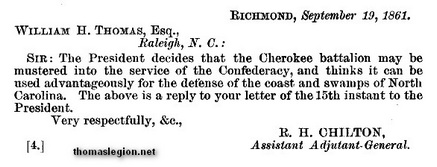
| Official Records, Series 1, Volume 51, part 2, p. 304. |
Introduction
By 1861 Chief William Holland Thomas had made a decision
to organize a Confederate military unit consisting of Eastern Cherokee Indians strictly for defense of the mountains
in Western North Carolina and East Tennessee. If Thomas had sided with the Union, the Cherokee Indians would have found
themselves deposited in the middle of the backyard of the rebellion. An unwise move, thought Thomas, but he also believed
that the Indians would be treated better if they became part of the newly formed Confederacy. Thomas
never desired to push his command miles beyond the shared border of the Old North and Volunteer states, so when Confederate
President Jefferson Davis instructed him to move the Eastern Cherokee into the swamps for defense of the eastern portion
of Old Carolina, Thomas soon persuaded Davis to abandoned the idea.
The Thomas Legion would become the largest single
military unit raised in the entire state during the Civil War. This legion, whose namesake was Chief Thomas, would remain
a single organization for merely a fraction of the conflict, because it would quickly be dismantled as its regiment would
be assigned to East Tennessee before moving and fighting in the Shenandoah Valley of Virginia in 1864. Thomas however, would remain
in Western North Carolina with the Cherokee Battalion for the duration of the conflict. The entire command would reunite
in 1865 for a last ditch defense of the Tar Heel State. Prior to its men disbanding and returning to their homes, the
Thomas Legion would make a colorful demonstration and heroic stand in Waynesville
on May 9, 1865. Like their forefathers who had repulsed the British from Cowpens to Kings Mountain, the highlanders would
never be conquered by the Federals — they would simply, as one Legionnaire put it, lay down their arms
and return to their homes. Although the Indians would suffer immensely for their involvement in the war, they
had already paid an even heavier price under the ironfisted policies of the United States government.
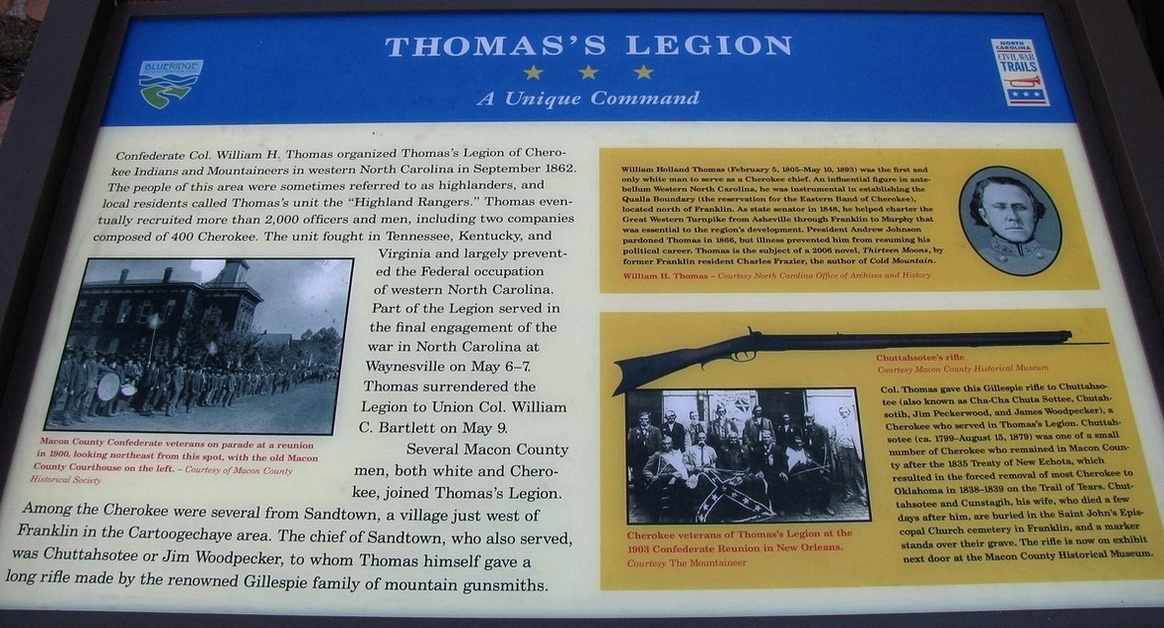
(Right) When Confederate President Jefferson Davis suggested that the Cherokee Indians be
moved into the swamps of eastern North Carolina for that region's defense, William Holland Thomas would convince him
otherwise. Thomas, who would don the hats of both Cherokee chief and Confederate colonel during the conflict, was
cousin to Jefferson Davis, and he would visit and consult with him on numerous occasions during the American Civil War
(1861-1865). Their friendship would also prove invaluable to the Cherokee Indians, and when several Confederate generals
wanted to push the Indians into Virginia, and beyond, Thomas would meet with Davis who would then countermand the move.
Unlike the fate of the other components of the Thomas Legion, the Indians would remain in the Southern Appalachian mountains
for the duration of the four year contest.
Organization
On September 15, 1861, Chief William Holland Thomas had organized
200 Cherokee Indians into a local defense force known as the "Junaluska Zouaves." Initially mustered into state service during
the Civil War (1861-1865), this formation was named in honor of Cherokee Chief Junaluska. On April 9, 1862,
the 200-man Indian command was mustered into Confederate service as Companies A & B of the “North Carolina
Cherokee Battalion” at Qualla Town, North Carolina, with Thomas being elected as Captain of Company A and
later as Major of the Battalion. From April to September 1862, the battalion was engaged in home guard duty in the mountains
of Tennessee and North Carolina. Whereas the unit was ordered into East Tennessee in September 1862, Major Thomas
would request and obtain permission from the Confederate government to recruit additional “Indians and whites as I may
select.” As a result, Thomas organized seven companies which he designated as “Thomas’ Legion of Indians
& Highlanders.” The organization now consisted of two Indian Companies and five white companies (two of which were
designated as Walker’s Battalion under Captain William C. Walker). On September 27, 1862, the regiment was officially
mustered into Confederate States service as “Thomas’ Legion” (also known as the 69th North Carolina Volunteer
Infantry Regiment) at Knoxville, with William H. Thomas as Colonel, James R. Love as Lieutenant Colonel, and William W. Stringfield
as Major of the Regiment. The regiment consisted of ten companies, eight white and two Indian. In the regimental organization,
the Junaluska Zouaves became companies C & D, but in January 1863
they were re-designated as Companies A & B of the Indian Battalion of the Legion. Thomas would organize his third
Cherokee company in December 1863 and the fourth and final company during the summer of 1864. From September 1862 to
May 1865, the Indian Battalion would operate as a local defense force and perform provost duties while in the shared
mountains of Old Carolina and Tennessee. Meanwhile, Walker's
Battalion, which would later be known as "First Battalion," completed its organization on October 1, 1862, at Knoxville,
with Lieutenant Colonel William C. Walker, commanding. The
Thomas Legion added its light artillery battery on April 1, 1863, and now consisted of one regiment, two battalions, one
artillery battery, and two companies of miners and sappers, known as the Pioneer Companies. Although Colonel Thomas
would employ bodyguards, what he referred to as the "Life Guard," for his personal defense, the 20 Cherokee
Indians of this contingent were never considered in service of the Confederacy. Thomas would increase the Indian companies
and conclude his recruitment of the Cherokee Battalion, 400 soldiers, in early 1865 and merely months before the fighting
had ceased. The Indian Battalion was present with Thomas when he formally surrendered the Thomas Legion on May 9, 1865, at Waynesville, North Carolina.
| Cherokee Indians and the Civil War |
|
| Thomas' Legion of Indians and Highlanders |
| Cherokee Indian Civil War History |
|
| Cherokee Indians and the Civil War |
| The Cherokee Battalion History |
|
| Junaluska Zouaves |
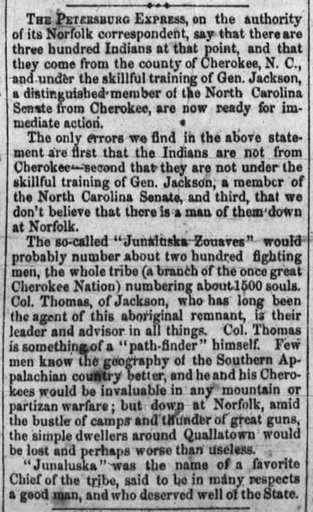
(Left) Early in the Civil War (1861-65), the North Carolina Cherokee unit was known as the Junaluska
Zouaves, in honor of the venerable Cherokee Chief Junaluska. Nearly every abled-bodied Eastern Cherokee (400) would
be mustered into Confederate service by the end of the conflict. William H. Thomas, the legion's namesake, would also
surround himself with 20 Cherokee Indians, known as his Life Guard, for personal protection against bushwhackers
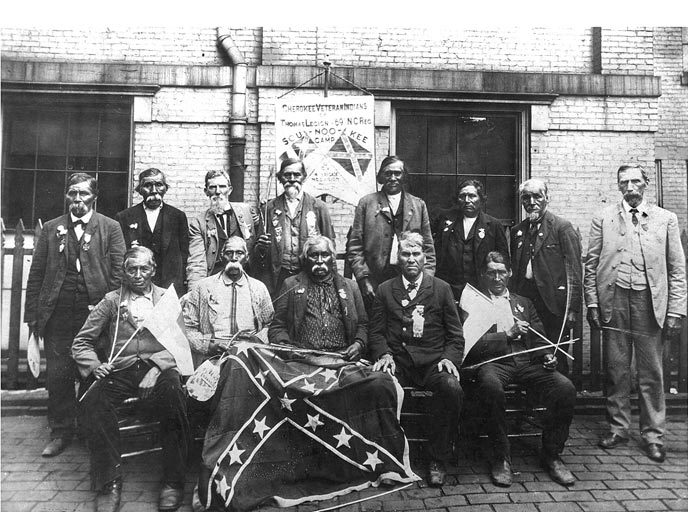
and outliers. Newbern Daily Progress (New Bern, North Carolina), Monday, May 20, 1861, page 2. (Right) The Thomas Legion's Cherokee veterans posed for their last photo during the New Orleans Confederate Reunion in 1903. Banner
Inscription: “Cherokee Veteran Indians of Thomas’ Legion, 69 N.C. Regiment, Suo-Noo-Kee Camp
U.C.V. 4th Brigade, N.C. Division.” Pictured from left to right; Front row: Usai, Kimson Saunooke, Jesse Ross, Jesse Reed,
Sevier Skitty. Back row: Bird Saconita, Dave Owl, Lt. Col. William Stringfield, Lt. Suatie (Suyeta) Owl (Owle), Jim Cag, Wesley Crow, Jessan, Lt. Calvin Cagle. (Cagle is often reported as a member of
the Legion, but no records confirm it. His presence, however, appears to connect him.) Names were furnished by the late
James R. Thomas, son of William H. Thomas. See also Photos from the Museum of the Cherokee Indian. Cherokee Confederate veterans of Thomas' Legion at the New Orleans Confederate Convention
in 1903. Photo courtesy Waynesville Mountaineer Publishing.
| Cherokee Indian Civil War Service. |
|
| Clark's Regiments, Volume IV, pp. 126-127. |
Service
The Cherokee Indians reconnoitered the enemy at Chattanooga, Tennessee, in June 1862 and subsequently fought him at Powell's Valley in September 1862; at the North Carolina - Tennessee line from September 1862 to June 1863; at Murphy, North Carolina, in October 1863; at Gatlinburg, TN., in December 1863; at Deep Creek (now
Bryson City, N.C.) in February 1864; and were instrumental in forcing the
Union army's surrender at White Sulphur Springs (Waynesville), N.C., in May 1865. See also Cherokee Battalion, Thomas'
Legion of Indians and Highlanders: The Beginning and William Holland Thomas' 20
Cherokee Bodyguards.
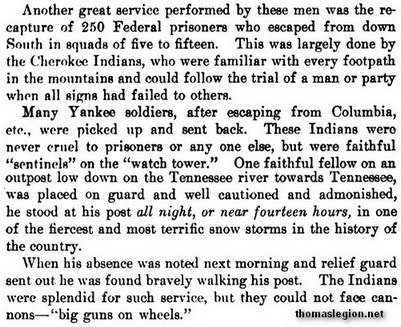
(Right) The Cherokee Battalion,
which would consist of 400 Indians, spent most of the war performing thankless, yet hazardous provost duties in East Tennessee
and the Old North State. Histories of the Several Regiments and Battalions in the Great War 1861-1865, Volume IV,
pp. 126-127.
Summary
Thomas' Legion of Indians and Highlanders, aka Thomas' Legion, was a
single unit during the Civil War consisting of one regiment, two battalions (one of whites and the other of Indians),
one artillery battery, and two companies of miners and sappers. With two Indian companies raised early in the war, Thomas
would conclude the Cherokee Battalion, consisting of four companies, in early 1865.
The Cherokee soldier was a splendid individual who
was strong and stout and very skilled in fighting his adversary. While these Indians were intelligent fighters who had
learned their warrior skills from their ancestors, they were the nation's indigenous masters
of psychological warfare. If the adversary has an army of a thousand, then make him believe, give him the impression,
that you are commanding ten thousand — because all warfare is based on deception. Well-known characteristics of these Indians were from painted faces, the wearing
of colorful feathers, the wielding of the tomahawk and bow, and to the chilling war whoops and dances. But
it was their history of scalping that would instill much fear while creating immense angst in the ranks of
the enemy during this war. Attack the enemy when and where he doesn't expect it, and let your plans be dark and
impenetrable as night, and when you move, fall like a thunderbolt. After Union troops captured and occupied a Southern town
in North Carolina the month following Lee's surrender to Grant, Colonel William Holland Thomas and the Cherokee
Battalion would capture the foe and then subsequently surrender. To capture an enemy held city in order to negotiate
its own surrender was, perhaps, the first role reversal of its kind in the annals of warfare.
While several wartime
accounts have the Eastern Cherokee always cowering and retreating in the presence of advancing Union forces in East
Tennessee, the fact is the Cherokee Indians had always fought with ambush or guerrilla tactics. Their objective
was to draw or succor the Union elements into the mountains and then to attack and eliminate them. The Cherokee prowess
for hunting large mountain game had merely transferred or transitioned to
their fighting tactics against men. From hunting bear and mountain lions to eradicating the foe, the Cherokee would apply
the terrain to their advantage: stalk, pursue, and kill. Spanning hundreds of years, they had adapted from hunting big game
to tracking and annihilating the enemy. While the Eastern Cherokee could not match the Federal units
gun for gun, they would merely welcome a zealous Union chase into the familiar rugged landscape. These indigenous inhabitants of
the Southeastern United States were neither nomadic like the Plains Indians, nor were they eager to enter into battle
in Napoleonic formations like the Europeans. During the Civil War, however, the Cherokee
would employ very effective guerrilla tactics and psychological warfare — styles of warfare that had been perfected
centuries prior to the Europeans' arrival to the Americas. The Cherokee
Indians were also a superstitious people, and prior to any skirmish or battle the Cherokee warrior was known to
consult with the traditional oracle stone to know whether or not he would live through the engagement.
An Indian from Thomas' Legion always executes an order with religious fidelity.
They scrupulously respect private property—there are no reports of depredations where they are encamped. They are the
best scouts in the world. —Knoxville
Register, February 21, 1863
For most of the Civil War, the Confederate Eastern Cherokee
were equipped with the .69 caliber musket, which could kill only at a short distance (50-100 yards) compared to the
Union soldier’s Enfield (200-300 yards). In other words, the Union soldier had a superior advantage, unless the Cherokee,
without being detected, could shorten the distance and then strike first. And guerrilla warfare would allow the Indians to
meet this objective while also avoiding the dreaded artillery which they referred to as those "big guns on wheels." See also
Civil War Small Arms, Cherokee Indians: Weapons and Warfare and The American
Civil War and Guerrilla Warfare.
| Cherokee Indians of Thomas' Legion |
|
| Official Records, Series 1, Volume 49, part 2, pp. 754-755. |
| The Thomas Legion Cherokee History |
|
| Official Records, Series 1, Volume 20, part 2, p. 395. |
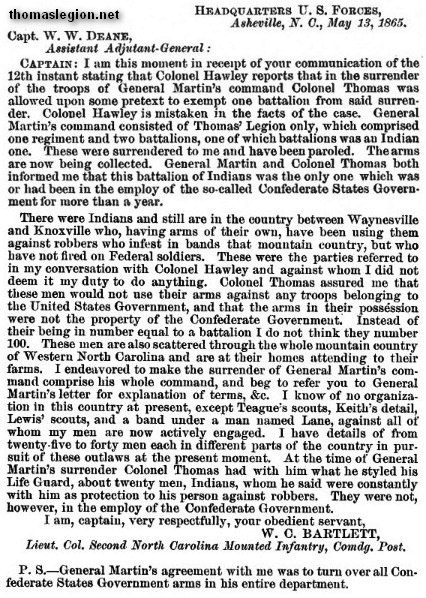
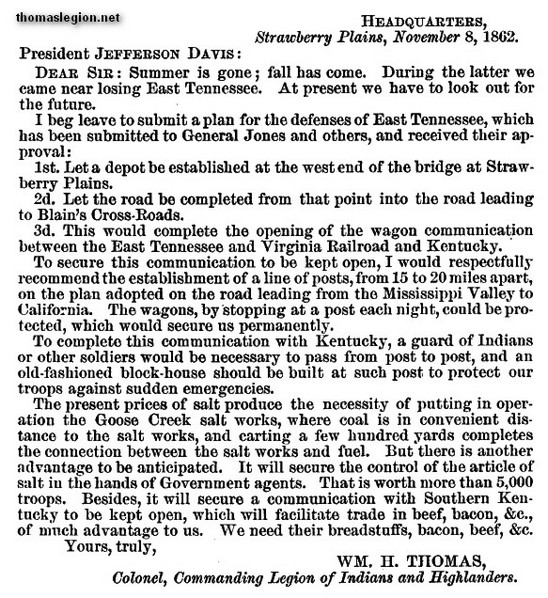
(Left) William H. Thomas submits his plan for defense
of the region to Confederate President Jefferson Davis. (Right) Official Union report discussing details of the Thomas Legion
surrender.
During
the infamous Shelton Laurel Massacre in January 1863, Colonel William Holland Thomas and the Indians were assigned to Western North Carolina and engaging bushwhackers and deserters. (Official Records, Series 1, Vol. 18, p. 811.)
While the Confederate forces in the Cumberland Gap were capitulating on September 9, 1863, Thomas and
the two Cherokee Companies were guarding the passes of the Smokies. (O.R. Ser. 1, Vol. 30,
pt. 3, p. 661.) When the infantry regiment of Thomas' Legion
was later ordered into the Shenandoah Valley to participate in Lt. Gen. Jubal
Early's Valley Campaigns of 1864, the Cherokee Battalion would be detached and assigned to defend the Southern Appalachian Mountains.
| Cherokee Battalion and the Civil War |
|
| Clark's Regiments, Volume IV, p. 124. |
Just one week prior to the surrender of Confederate forces
in the Cumberland Gap, Colonel William H. Thomas, now in his late 50s, was following Gen. Buckner’s Orders when,
on September 2, 1863, while at Strawberry Plains, Tennessee, he spoke with Major William W. Stringfield's sister,
Mollie, before he and the two Cherokee Companies marched down the West
Valley Road toward Sevierville and over the mountains and into familiar Western North Carolina. The dispatch to Thomas
was the general's best response to an unchecked thrashing and plundering of
this vast mountainous swath by outlaws and deserters. These miscreants, a term some Carolinians now called them, had
swelled their ranks while operating as well-armed bushwhackers and guerrillas, insomuch that home guard and local units could
not contain them. The roving robbers of the region would
become such a thorn in the side of the locals, that although Confederate President Davis himself would soon be forced to address
it, the exigencies of war would continue to draw down and leave only skeleton units to challenge this ever growing threat.
With the exception
of the skirmish with Federals at Gatlinburg, TN., in December 1863, Thomas and the Cherokee Battalion would spend the remainder of the Civil War defending and patrolling the North
Carolina Smokies. (O.R., 1, 49, pt 2, pp. 754-755.)
While in the western region of the Tar Heel State, the aged colonel and his loyal Indians
were responsible for thankless recruitment and impressment duties, fighting
bushwhackers and guerrilla units, rounding up deserters and outliers, and engaging an emboldened
Union army. (Cherokee Scouts and O.R., 53, pp. 313-314.)
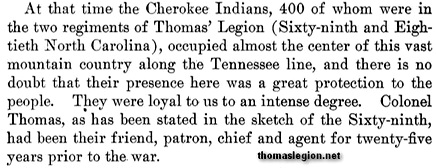
(Right) The
battle-hardened Cherokee Battalion, consisting of 400 Indians by early 1865, would spend the 4 year fight while
in their familiar backyard of the Southern Appalachian mountains. During this time, the battle-hardened unit would march, countermarch, guard from
bridges to depots to railroads, round up from deserters to bushwhackers, chase and be chased, and pursue and engage from roving
guerrilla bands to large Federal armies. It was a faithful lot, always loyal to their colonel and chief, but it would
also come, as with all conflicts, at a very heavy price to the Eastern Band. Histories of the Several Regiments and Battalions
in the Great War 1861-1865, Volume IV, pp. 124.
After Goldman Bryson's Union Company sacked the county seat of Murphy in Cherokee County, a Cherokee detachment, led by Lt. "Cam" Harrison Taylor, pursued, engaged and eliminated them in late 1863. General Braxton
Bragg and Governor Zebulon Vance would publicly applaud and
commend the Thomas Legion for exterminating “Goldman and his Robbers.” While
Thomas and the Cherokee soldiers remained vigilant in performing their many provost duties, they were also guarding
and protecting the wide range of mountains along the shared border of Tennessee and North Carolina according to Thomas' American
Civil War Strategy. Although the Thomas Legion organization had been formed to protect
and defend the mountainous terrain of East Tennessee and Western North Carolina, the exigencies
of war had demanded otherwise of its components. General Robert E. Lee's depleted army had needed fresh troops,
and that meant moving men from the ranks of the Thomas Legion into the Shenandoah Valley. When its detachment, the infantry
regiment, returned from fighting in the valley to North Carolina in November 1864, it would number less than 100 men. New
recruits and veterans alike, however, would now swell its thinned ranks, and with the Cherokee Battalion and the return
of its light artillery battery, the Thomas Legion would enjoy a short-lived reunion and one final hurrah.
| Cherokee Indians and the Civil War |
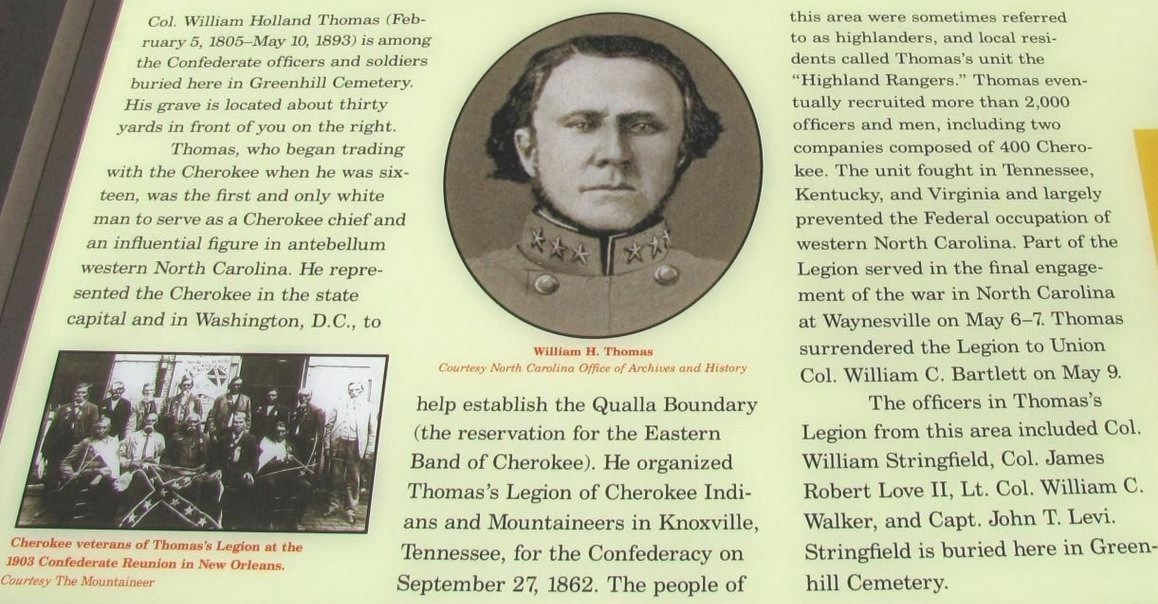
|
| Colonel William H. Thomas, commanding Thomas' Legion of Indians and Highlanders |
Prior to the Thomas Legion capturing White Sulphur Springs (Waynesville), North Carolina, in May 1865, the Cherokee Battalion would
encompass the surrounding mountains and create hundreds of bonfires while displaying their intimidating "Cherokee war
whoops and dances" during the night. On the following morning, May 7, Thomas and twenty to twenty-five Indians (the
majority likely from his Life Guard), with James Love and James G. Martin, commanding Confederate forces in the region, would parley
with one Lt. Col. William C. Bartlett. Whereas the Union men were to cease their activities and also vacate the area,
Thomas would agree to surrender his unit and refrain from unleashing his Indians
on a scalping melee through the Union ranks. Bartlett's regiment was now surrounded, Lee had already surrendered
to Grant the previous month, and Thomas, alongside Martin, had just brokered the last Confederate
surrender in North Carolina. While Bartlett kept his scalp, the
battle-hardened legion would now simply disband and the men would return to their ole homes and rebuild their lives.
While the Cherokee Indians had just assisted in capturing a Union held city in order to negotiate its very own surrender,
it was a military feat unheard of in the annals of warfare. And as
one legionnaire would later write, I say surrender, but a better word would be quit, for I don’t think we really ever
did surrender. In fact, we just disbanded and carried our guns and cartridges home with us. See also Cherokee Battalion.
*Official
Records of the Union and Confederate Armies
(Additional sources listed at bottom of page.)
Recommended Reading: Storm in the Mountains: Thomas' Confederate
Legion of Cherokee Indians and Mountaineers (Thomas' Legion: The Sixty-ninth North Carolina Regiment). Description:
Vernon H. Crow, Storm in the Mountains, dedicated an unprecedented 10
years of his life to this first yet detailed history of the Thomas Legion. But it must be said that this priceless addition has
placed into our hands the rich story of an otherwise forgotten era of the Eastern Cherokee Indians and the mountain men of
both East Tennessee and western North Carolina who would fill the ranks of the Thomas Legion during the four year Civil
War. Crow sought
out every available primary and secondary source by traveling to several states and visiting from ancestors of the
Thomas Legion to special collections, libraries, universities, museums, including the Museum of the Cherokee, to
various state archives and a host of other locales for any material on the unit in order to preserve and present
the most accurate and thorough record of the legion. Crow, during his exhaustive fact-finding, was granted access
to rare manuscripts, special collections, privately held diaries, and never before seen nor published photos and
facts of this only legion from North Carolina. Crow remains absent from the text as he gives a readable account
of each unit within the legion's organization, and he includes a full-length roster detailing each of the men who served in
its ranks, including dates of service to some interesting lesser known facts.
Storm in the Mountains, Thomas' Confederate Legion of Cherokee Indians and
Mountaineers is presented in a readable manner that is attractive to any student and reader of American history, Civil
War, North Carolina studies, Cherokee Indians, ideologies and sectionalism, and I would be remiss without including the
lay and professional genealogist since the work contains facts from ancestors, including grandchildren, some of which
Crow spent days and overnights with, that further complement the legion's roster with the many names,
dates, commendations, transfers, battle reports, with those wounded, captured, and killed, to lesser yet interesting
facts for some of the men. Crow was motivated with the desire to preserve history
that had long since been overlooked and forgotten and by each passing decade it only sank deeper into the annals of obscurity.
Crow had spent and dedicated a 10 year span of his life to full-time research
of the Thomas Legion, and this fine work discusses much more than the unit's formation, its Cherokee
Indians, fighting history, and staff member narratives, including the legion's commander, Cherokee chief and Confederate
colonel, William Holland Thomas. Numerous maps and photos also allow the
reader to better understand and relate to the subjects. Storm
in the Mountains, Thomas' Confederate Legion of Cherokee Indians and Mountaineers is highly commended, absolutely
recommended, and to think that over the span of a decade Crow, for us, would meticulously research the unit and
present the most factual and precise story of the men, the soldiers who formed, served, and died in the famed Thomas
Legion.
Recommended
Reading:
Civil War in the Indian Territory, by
Steve Cottrell (Author), Andy Thomas (Illustrator). Review: From its beginning
with the bloody Battle of Wilson's Creek on August 10, 1861, to its end in surrender on June 23, 1865, the Civil War in the
Indian Territory proved to be a test of valor and endurance for both sides. Author Steve
Cottrell outlines the events that led up to the involvement of the Indian Territory in the
war, the role of the Native Americans who took part in the war, and the effect this participation had on the war and this
region in particular. As in the rest of the country, neighbor was pitted against neighbor, with members of the same tribes
often fighting against each other. Cottrell describes in detail the guerrilla warfare, the surprise attacks, the all-out battles
that spilled blood on the now peaceful state of Oklahoma.
In addition, he introduces the reader to the interesting and often colorful leaders of the military North and South, including
the only American Indian to attain a general's rank in the war, Gen. Stand Watie (member of the Cherokee Nation). With outstanding
illustrations by Andy Thomas, this story is a tribute to those who fought and a revealing portrait of the important role they
played in this era of our country's history. Continued below...
Meet
The Author: A resident of Carthage, Missouri, Steve Cottrell is a descendant of a
Sixth Kansas Cavalry member who served in the Indian Territory during the Civil War. A graduate
of Missouri Southern State College in Joplin, Cottrell has
participated in several battle reenactments including the Academy Award winning motion picture, "Glory". Active in Civil War
battlefield preservation and historical monument projects and contributor of a number of Civil War relics to regional museums,
Cottrell recently co-authored Civil War in the Ozarks, also by Pelican. It is now in its second printing.
Recommended Viewing:
Indian Warriors
- The Untold Story of the Civil War (History Channel) (2007). Description:
Though largely forgotten, 20 to 30 thousand Native Americans fought in the Civil War. Ely Parker was a Seneca leader who found
himself in the thick of battle under the command of General Ulysses S. Grant. Stand Waite--a Confederate general
and a Cherokee--was known for his brilliant guerrilla tactics. Continued below...
Also highlighted
is Henry Berry Lowery, an Eastern North Carolina Indian, who became known as the Robin Hood of North Carolina. Respected Civil
War authors, Thom Hatch and Lawrence Hauptman, help reconstruct these most captivating stories, along with descendants like
Cherokee Nation member Jay Hanna, whose great-grandfathers fought for both the Union and the Confederacy. Together, they reveal a new, fresh perspective and the very
personal reasons that drew these Native Americans into the fray.
Recommended Reading:
The Cherokee Nation: A History. Description: Conley's book, "The Cherokee Nation: A History" is an eminently readable, concise but thoughtful account of
the Cherokee people from prehistoric times to the present day. The book is formatted in such a way as to make it an ideal
text for high school and college classes. At the end of each chapter is a source list and suggestions for further reading.
Also at the end of each chapter is an unusual but helpful feature- a glossary of key terms. The book contains interesting
maps, photographs and drawings, along with a list of chiefs for the various factions of the Cherokee tribe and nation. Continued below...
In addition
to being easily understood, a principal strength of the book is that the author questions some traditional beliefs and sources
about the Cherokee past without appearing to be a revisionist or an individual with an agenda in his writing. One such example
is when Conley tells the story of Alexander Cuming, an Englishman who took seven Cherokee men with him to England
in 1730. One of the Cherokee, Oukanekah, is recorded as having said to the King of England: "We look upon the Great King George
as the Sun, and as our Father, and upon ourselves as his children. For though we are red, and you are white our hands and
hearts are joined together..." Conley wonders if Oukanekah actually said those words and points out that the only version
we have of this story is the English version. There is nothing to indicate if Oukanekah spoke in English or Cherokee, or if
his words were recorded at the time they were spoken or were written down later. Conley also points out that in Cherokee culture,
the Sun was considered female, so it is curious that King George would be looked upon as the Sun. The "redness" of Native
American skin was a European perception. The Cherokee would have described themselves as brown. But Conley does not overly
dwell on these things. He continues to tell the story using the sources available. The skill of Conley in communicating his
ideas never diminishes. This book is highly recommended as a good place to start the study of Cherokee history. It serves
as excellent reference material and belongs in the library of anyone serious about the study of Native Americans.
Additional Sources: Official Records
of the Union and Confederate Armies; Vernon H. Crow, Storm in the Mountains: Thomas' Confederate Legion of Cherokee Indians
and Mountaineers; Walter Clark, Histories of the Several Regiments and Battalions from North Carolina in the Great War 1861-1865;
National Park Service: American Civil War; National Park Service: Soldiers and Sailors System; Weymouth T. Jordan and Louis
H. Manarin, North Carolina Troops, 1861-1865; D. H. Hill, Confederate
Military History Of North Carolina: North Carolina In The Civil War, 1861-1865; Christopher M. Watford, The Civil War
in North Carolina: Soldiers' and Civilians' Letters and Diaries, 1861-1865. Volume 2: The Mountains; William F. Fox, Regimental
Losses in the American Civil War.
|
