|
"The singular purpose of the soldier was to fight a battle and win."
Life of the American Civil War Soldier
"The odds of dying far outweighed the odds of surviving the
four year Civil War."
The average American Civil War (1861-1865) soldier was 5'8'' and weighed 143 lbs. 1 in 65 died in combat, 1 in 10 was wounded in combat, and 1 in 13
died from disease. The average age of the soldier was 25. In the Union Army, it is estimated that 100,000 soldiers were less
than 15 years old. It is believed that the youngest soldier wounded in combat was William
Black, age 11 (almost 12). He was wounded in his left arm. Drummer boys were as young as 9 years. And some regiments, unknowingly,
recruited female combatants.
The combat
fatalities, horrors of a prison camp, diseases (including mumps, measles, smallpox, influenza, malaria, typhoid, dysentery,
cholera, chronic diarrhea, gangrene, tuberculosis, pneumonia, yellow fever, and venereal diseases), wounds (lack of medication and medical care), forced marches, no shoes and inadequate clothing, harsh winters
and frost bite, heat stroke receptive summers, sleep deprivation, and very little food and water took a massive toll
on the soldiers of the Confederate Army.
Because of medical procedures of the
era, thousands of soldiers died of gangrene and staphylococcus (staph infections).
Scurvy, a disease caused
by lack of Vitamin C, was common due to the absence of fresh fruits and vegetables, and, with weakened immune systems,
soldiers easily succumbed to it. It was common for the soldier to experience weeks or
months without bathing. Poor hygiene, such as drinking water that had been contaminated with human feces, was a serious problem
that plagues both armies. To better relate to the soldier of the conflict, imagine each of the five
senses pushed to extremes month after month and year after year. The men, and boys, had often been told that the war would
be a quick one and that it should be over in one to three months. This was the "soldier's life."
Now colonel,
for the honor of the Good Old North State, forward! —Brigadier General James Johnston Pettigrew at
the Battle of Gettysburg on July 3, 1863
Although regiments often sustained 25% casualties in a single battle, the high
casualty rate would occur battle after battle. And while comrade and kin would fall during
the many battles, the army would continue to move from battlefield to battlefield. The regiment of the war
was raised with some 1,000 men, but in 1865 the majority had been reduced to less than 100. The odds of dying
far outweighed the odds of surviving the American Civil War.
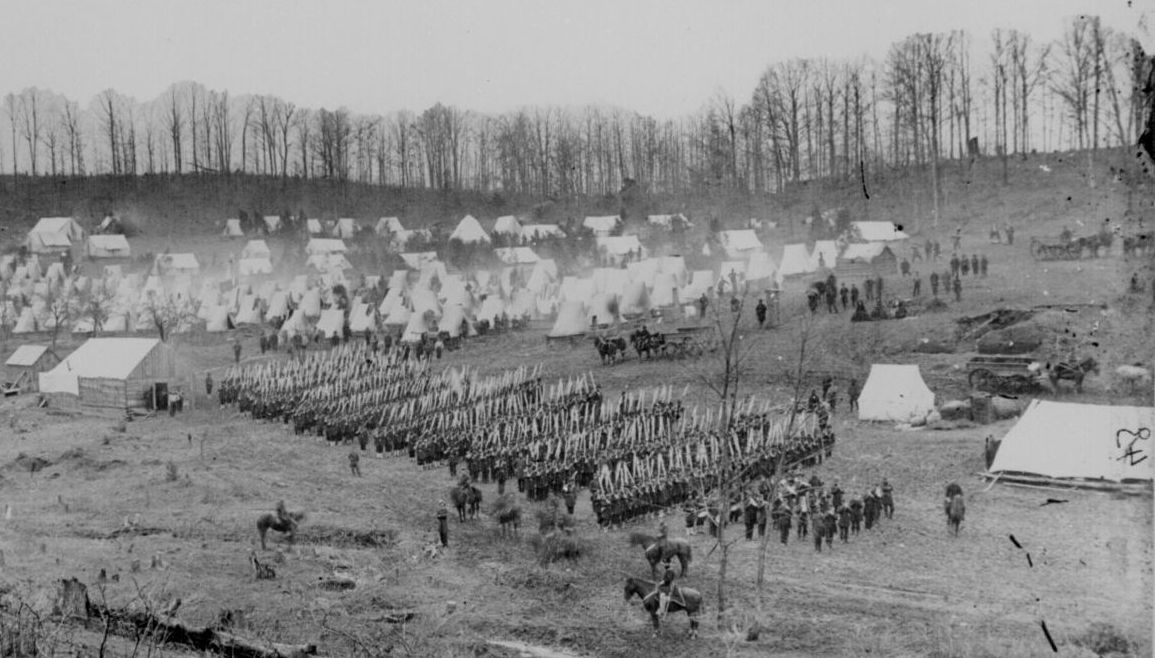
| The life of the American Civil War soldier |
|
| Daily life of the Civil War soldier while in camp |
I
am not as brave as I thought I was. I never wanted out of a place as bad in my life. The balls hurled, the shells sang, and
the grape shot rattled. I want in no more battles. —Captain Alfred W. Bell, Company B, 39th North Carolina Infantry, after the Battle of Stones River
The soldier experienced various traumatic stressors such as witnessing death or dismemberment, handling dead bodies, traumatic loss of
comrades, realizing imminent death, and killing others and being helpless to prevent others' deaths. Rare soldiers' letters allow the reader the most detailed insight to their experiences, describing even intimate and personal experiences,
such as diseases, privation, wounds, loneliness, exhaustion, heartache, and even the
injuries that were slowing killing the soldier. As the Union and Confederate soldiers tramped from battlefield to battlefield
during the conflict's four years, many held letters from family members and sweethearts. From comforting and loving words
to details of the untenable conditions on the home front, soldiers, longing for hearth and home, continued to embrace
and reread the same letters with hopes of soon arriving at the finality of a war that many said would be over in just
90 days.
"Diseases
and Napoleonic Tactics were the contributing factors for the high casualties during the American Civil War."
It was common practice
for family, friends and neighbors to enlist in the same locally raised unit. The reason that any given soldier
fought in all those battles was because he didn't want to be called a coward, show the white feather, says many present-day
scholars, but this reasoning is incorrect, it is flawed.
The soldier or Marine did not go through hell and back on the battlefield because he wanted to avoid being called
a coward. Men stood, held their ground, and fought as soldiers then as they do for the same motivating factor now. Ask
anyone who has been in combat or battle, why did you do it? The answer through history has a familiar tone. I fought
for the guy next to me, I fought for my buddies, I fought for my unit. Perhaps the white feather
argument has been splashed on the pages of textbooks by historians, but it was not drawn from the real life experiences of
the men who had actually been in combat. During battle it was therefore typical for father and son to advance directly into enemy shot
and shell, making it a leading factor in the high death toll during the fight.
During the aftermath, or postwar, many suffered from the war's great destruction and devastation. Countless
veterans were riddled with diseases, wounds, destitution, and mental illnesses. Many soldiers recovering from wounds were referred to as having the Old Soldier's
Disease, a term applied to soldiers addicted to pain killers. Hearing loss was common due to the horrendous
sounds associated with cannon and weaponry in combat. Furthermore, during the American Civil War,
there was no shell shock, battle fatigue, or Post Traumatic Stress Disorder (PTSD) to help explain and legitimize
a mysterious condition. The aftermath witnessed tens-of-thousands of homeless veterans.
The veteran either had no home to return to or a disability prevented him from enjoying life's basic tasks and responsibilities. Union soldiers and veterans didn't
receive the Department of Veterans Affairs' benefits and assistance, because it wasn't created until the
twentieth century. (See also Shook over Hell: Post-Traumatic Stress, Vietnam, and the Civil War .) Family and friends were all the hope and help that many veterans had, for to fall into the hands
of the state is exactly why insane asylums boomed across the nation after the war. .) Family and friends were all the hope and help that many veterans had, for to fall into the hands
of the state is exactly why insane asylums boomed across the nation after the war.
The hardest work I have had since we got here was
standing guard duty six hours night before last. —Private John T. Jones, Company D (Orange Light Infantry), First Regiment
North Carolina Volunteers, May 8, 1861
While not in battle, drilling, or standing guard, the troops read, wrote letters to their loved ones and
played any game they could devise, including baseball, cards and boxing matches. One competition
involved racing lice or cockroaches across a strip of canvas. The
soldier's favorite beverage was coffee, but alcohol was occasionally smuggled into camp. See also The American Civil War Soldier.
"Penicillin had not been invented, so soldiers
treated venereal diseases with herbs and minerals"
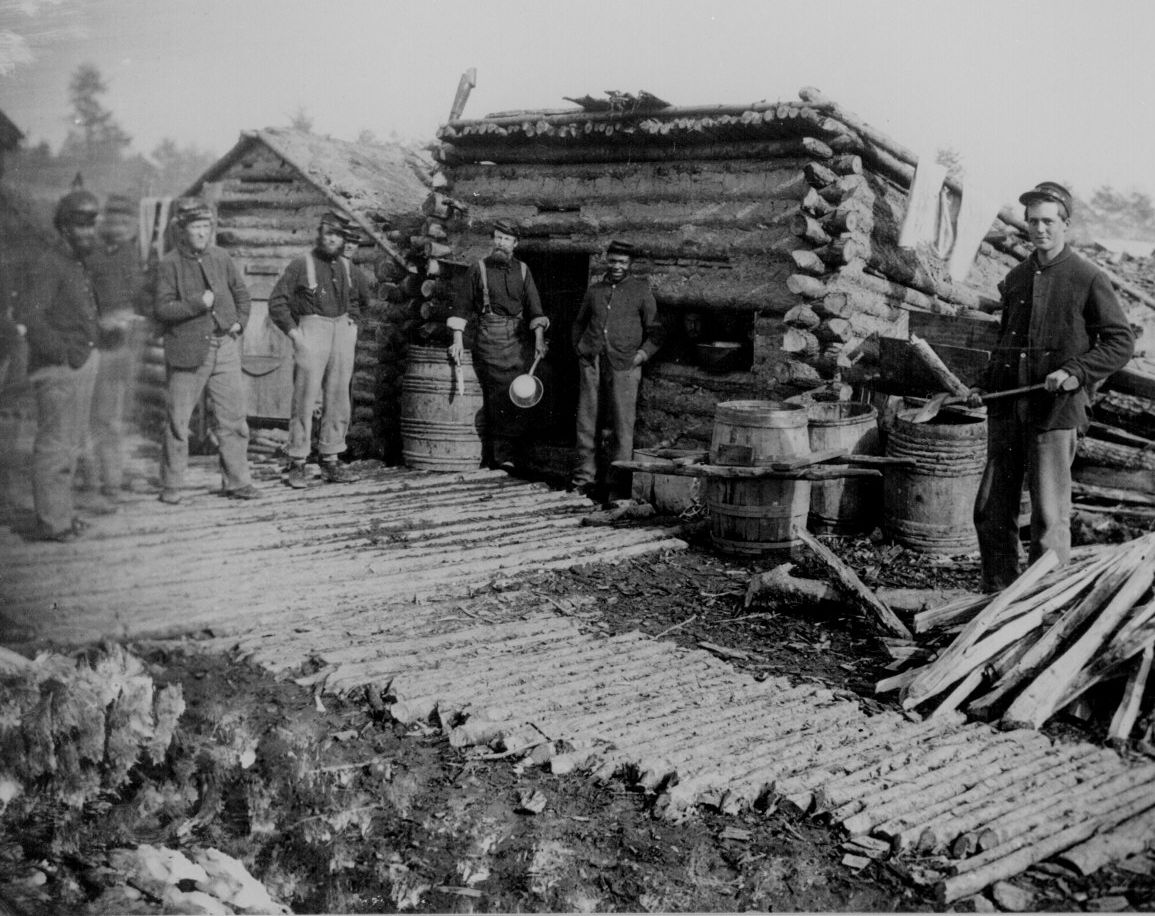
| Life for the American Civil War soldiers |
|
| Civil War soldiers gathering for meal at the makeshift kitchen |
Thousands of prostitutes
thronged the cities in the war zones and clustered about the camps. By 1862,
for instance, Washington,
D.C., had 450 bordellos and at least 7,500 full-time prostitutes; Richmond
was the center of prostitution in the Confederacy and had about an equal number of bordellos and
prostitutes. Venereal disease among soldiers was prevalent and largely uncontrolled. About eight percent of the soldiers in
the Union army were treated for venereal disease during the war; many cases were unreported. Penicillin had not been invented,
so soldiers treated venereal diseases with herbs and minerals. Union General Joseph "Hooker" was widely known for his endorsement
of prostitution; hence, his name is credited, associated, and synonymous with "prostitutes and prostitution."
We have a revival going on in our Regt. & it is general through the army.
Our Chaplain is doing much good. —Lieutenant Colonel William Henry Asbury
Speer, Twenty-eighth Regiment North Carolina Troops, April 28, 1863
"I would have never surrendered if
I knew that being a prisoner was worse than death."
I do not exaggerate when I say that it [Johnson's
Island] is worse than a hog pen. —Colonel Robert F. Webb, Sixth Regiment
North Carolina State Troops, February 25, 1864
Camp life as a Confederate soldier was hard, but prison
life in Camp Morton was harder. —Confederate Prisoner of War
Eighty Acres of Hell, a.k.a. Prisoner of War Camp Douglas, reveals
that the Union was more than capable of matching the Confederates atrocity-for-atrocity. While 12,000 prisoners entered Camp
Douglas, only 6,000 survived. The rest were victims of calculated cruelty, torture and neglect. And Southern soldiers were
not the only targets of this treatment--many prominent Chicago citizens were incarcerated under the banner of martial law,
unjustly convicted of imagined offenses by ruthless military tribunals. According to Official Records of the Union and Confederate armies, Series II - Vol. 8, p. 348, Confederate prisoners
were placed in condemned Union Prisoner of War Camps Douglas and Chase; they were condemned because they were
infected with smallpox. The Official Records further state that several Union officials
protested and called Camp Douglas an atrocity. However, Union prisoners of war were in equally atrocious conditions
See also Union and Confederate
Civil War Prisoner of War and Prison History: Homepage and American Civil War Prisoner of War Camps.
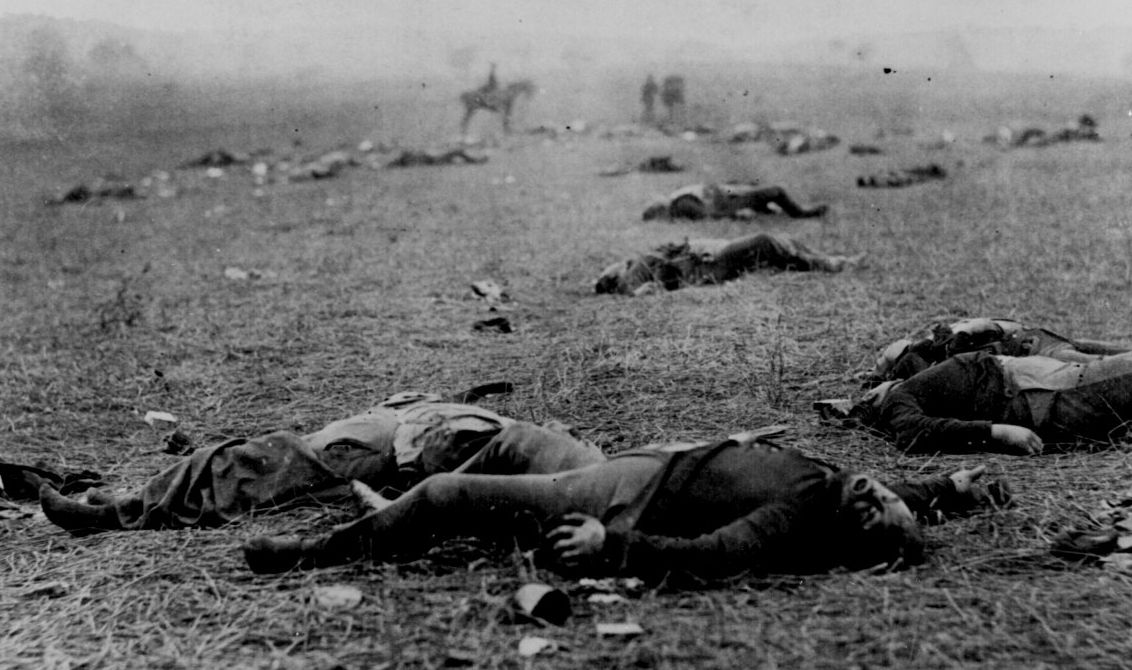
| Death was a reality for any Civil War soldier |
|
| American Civil War soldiers killed in battle |
"I fought in very many battles of the Confederate war
because my brother, my uncle, and all my friends had served in the same local company."
During the last months of the American Civil War, when the Lost Cause was
embraced, many Southern soldiers were unofficially promoted by their peers to fill vacancies, and it also explains
why the officially mustered out rank and grade was often times lesser than claimed in soldiers' diaries, memoirs and
papers. During the last months of the war, privates were being
unofficially appointed to the rank or grade of lieutenant to fill the void. Concurrently, some Confederate commanders were destroying all, or what remained, of the regimental
records. Said conditions also make it difficult for Civil War researchers and genealogists.
"I apprehend
that if all living Union soldiers were summoned to the witness stand, every one of them would testify that it was the preservation
of the American Union and not the destruction of Southern slavery that induced him to volunteer at the call of his Country.
As for the South, it is enough to say that perhaps eighty percent of her armies were neither slave-holders, nor had the remotest
interest in the institution...both sides fought and suffered for liberty as bequeathed by the Fathers--the one for liberty
in the union of the States, the other for liberty in the independence of the States." Reminiscences of the Civil War, by John
B. Gordon, Maj. Gen. CSA
(General
Gordon was shot 5 times during the Battle of Antietam but did not die until January 9, 1904. Regarding General John Gordon, President Theodore Roosevelt
stated, "A more gallant, generous, and fearless gentleman and soldier has not been seen by our Country.")
The Aftermath and Reconstruction proved that the scars from the American Civil War deeply affected veterans and civilians for years.
(Sources and related reading below.)
Recommended Reading: The Fighting Men of
the Civil War, by William C. Davis (Author), Russ A. Pritchard (Author). Description: "A must for any
Civil War library!" The sweeping histories of the War Between the States often overlook the men in whose blood that history
was written. This account goes a long way toward redressing the balance in favor of the men in the ranks. The reader follows
the soldiers from enlistment and training to campaigning. Attention is also given to oft-forgotten groups such as the sailors
and black troops. Continued below...
No effort has been spared to include rare war era photographs and
color photos of rare artifacts. Engagingly written by William C. Davis, the author of more than thirty books on the American
Civil War. Award winning author and historian James M. McPherson states: "The most readable, authoritative, and
beautifully designed illustrated history of the American Civil War."
Recommended Reading:
Eyewitness to the Civil War (Hardcover) (416 pages) (National Geographic)
(November 21, 2006). Description: At once an informed overview for general-interest readers and a superb resource for serious
buffs, this extraordinary, gloriously illustrated volume is sure to become one of the fundamental books in any Civil War library.
Its features include a dramatic narrative packed with eyewitness accounts and hundreds of rare photographs, pictures,
artifacts, and period illustrations. Evocative sidebars, detailed maps, and timelines add to the reference-ready quality of
the text. Continued below...
From John Brown's raid to
Reconstruction, Eyewitness to the Civil War presents a clear, comprehensive discussion that addresses every military, political,
and social aspect of this crucial period. In-depth descriptions of campaigns and battles in all theaters of war are accompanied
by a thorough evaluation of the nonmilitary elements of the struggle between North and South. In their own words, commanders
and common soldiers in both armies tell of life on the battlefield and behind the lines, while letters from wives, mothers,
and sisters provide a portrait of the home front. More than 375 historical photographs, portraits, and artifacts—many
never before published—evoke the era's flavor; and detailed maps of terrain and troop movements make it easy to follow
the strategies and tactics of Union and Confederate generals as they fought through four harsh years of war. Includes captivating
rare photos of soldiers to the realistic firsthand battlefield photo. Photoessays on topics ranging from the everyday lives
of soldiers to the dramatic escapades of the cavalry lend a breathtaking you-are-there feeling, and an inclusive appendix
adds even more detail to what is already a magnificently meticulous history.
Recommended Reading:
The Life of Johnny Reb: The Common Soldier of the Confederacy (444
pages) (Louisiana State University Press) (Updated edition: November 2007) Description: The Life of Johnny Reb does not merely
describe the battles and skirmishes fought by the Confederate foot soldier. Rather, it provides an intimate history of a soldier's
daily life--the songs he sang, the foods he ate, the hopes and fears he experienced, the reasons he fought. Wiley examined
countless letters, diaries, newspaper accounts, and official records to construct this frequently poignant, sometimes humorous
account of the life of Johnny Reb. In a new foreword for this updated edition, Civil War expert James I. Robertson, Jr., explores
the exemplary career of Bell Irvin Wiley, who championed the common folk, whom he saw as ensnared in the great conflict of
the 1860s. Continued below...
About
Johnny Reb:
"A Civil War
classic."--Florida Historical Quarterly
"This book
deserves to be on the shelf of every Civil War modeler and enthusiast."--Model Retailer
"[Wiley] has
painted with skill a picture of the life of the Confederate private. . . . It is a picture that is not only by far the most
complete we have ever had but perhaps the best of its kind we ever shall have."--Saturday Review of Literature
Recommended
Reading:
Life of Billy Yank: The Common Soldier of the Union (488 pages) (Louisiana State University Press). Description: This fascinating social history reveals that while the Yanks and the Rebs fought for very different causes, the men
on both sides were very much the same. "This wonderfully interesting book is the finest memorial the Union soldier is ever
likely to have. . . . [Wiley] has written about the Northern troops with an admirable objectivity, with sympathy and understanding
and profound respect for their fighting abilities. He has also written about them with fabulous learning and considerable
pace and humor.
Editor's Pick: Co.
Aytch: A Confederate Memoir of the Civil War. Description: Of the 120 men who enlisted in "Company H"
(Or Co. Aytch as he calls it) in 1861, Sam Watkins was one of only seven alive when General Joseph E. Johnston's Army of Tennessee
surrendered to General William Tecumseh Sherman in North Carolina
in April, 1865. Of the 1,200 men who fought in the First Tennessee, only 65 were left to be paroled on that day. "Co. Aytch: A Confederate Memoir of the Civil War" is heralded by many historians as one of the best
war memoirs written by a common soldier of the field. Sam R. Watkin's writing style in "Co Aytch" is quite engaging and skillfully
captures the pride, misery, glory, and horror experienced by the common foot soldier. Continued below…
About the Author: Samuel "Sam"
Rush Watkins (June 26, 1839 - July 20, 1901) was a noted Confederate soldier during the American Civil War. He is known today
for his memoir Company Aytch: Or, a Side Show of the Big Show, often heralded as one of the best primary sources about the
common soldier's Civil War experience. Watkins was born on June 26, 1839 near Columbia, Maury County, Tennessee, and received his formal education at Jackson
College in Columbia.
He originally enlisted in the "Bigby Greys" of the 3rd Tennessee Infantry in Mount Pleasant, Tennessee, but transferred shortly
thereafter to the First Tennessee Infantry, Company H (the "Maury Greys") in the spring of 1861. Watkins faithfully served
throughout the duration of the War, participating in the battles of Shiloh, Corinth, Perryville,
Murfreesboro (Stones River),
Shelbyville, Chattanooga, Chickamauga, Missionary Ridge, Resaca,
Adairsville, Kennesaw Mountain (Cheatham
Hill), New Hope Church, Zion
Church, Kingston, Cassville, Atlanta,
Jonesboro, Franklin, and Nashville.
Of the 120 men who enlisted in "Company H" in 1861, Sam Watkins was one of only seven alive when General Joseph E. Johnston's
Army of Tennessee surrendered to General William Tecumseh Sherman in North Carolina
April, 1865. Of the 1,200 men who fought in the First Tennessee, only 65 were left to be paroled on that day. Soon after the
war ended, Watkins began writing his memoir, entitled "Company Aytch: Or, a Side Show of the Big Show". It was originally
serialized in the Columbia, Tennessee
Herald newspaper. "Co. Aytch" was published in a first edition of 2,000 in book form in 1882. "Co. Aytch" is heralded by many
historians as one of the best war memoirs written by a common soldier of the field. Sam's writing style is quite engaging
and skillfully captures the pride, misery, glory, and horror experienced by the common foot soldier. Watkins is often featured
and quoted in Ken Burns' 1990 documentary titled The Civil War. Watkins died on July 20, 1901 at the age of sixty-two in his
home in the Ashwood Community. He was buried with full military honors by the members of the Leonidas Polk Bivouac, United
Confederate Veterans, in the cemetery of the Zion Presbyterian Church near Mount
Pleasant, Tennessee.
Editor's Picks and Recommended
Reading for "The American Civil War Soldier; Life as a Civil War Soldier"
Sources: Official Records of the Union and Confederate Armies; Walter Clark,
Histories of the Several Regiments and Battalions from North Carolina in the Great War 1861-1865; National Park Service: American
Civil War; Weymouth T. Jordan and Louis H. Manarin, North Carolina Troops, 1861-1865; D. H. Hill, Confederate Military
History Of North Carolina: North Carolina In The Civil War, 1861-1865; Library of Congress; North Carolina Office of Archives
and History; North Carolina Museum of History; State Library of North Carolina; North Carolina Department of Cultural
Resources; North Carolina Department of Agriculture; National Archives and Records Administration; and Tennessee State Library
and Archives.
|
