|
Lieutenant Colonel William W. Stringfield
(May 7, 1837 -- March 6, 1923)
| William W. Stringfield |
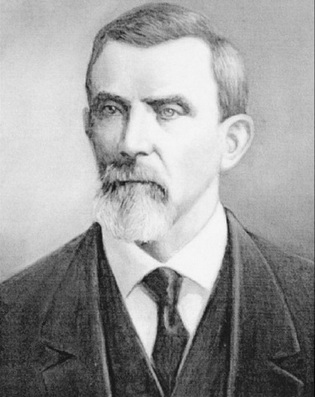
|
| William Stringfield, postwar, undated. |
| William Stringfield |
|
| W.W. Stringfield, ca. Civil War. |
W. W. Stringfield’s Memoirs and Diary Entries
Introduction
Tennessean William Williams
Stringfield was in his early 20s when he offered his services to the Confederate cause (1861-1865).
Known simply as W.W. by most, the young Stringfield initially served as a private in the 1st (Carter's) Tennessee
Cavalry Regiment in 1861. In 1862 he served as Captain of Company E, 39th (Bradford's) Tennessee Infantry, a regiment
which had previously be known as the 31st (William M. Bradford's) Tennessee. By authority of Maj. Gen. E. Kirby Smith,
dated May 7, 1862, Captain Stringfield was appointed Deputy Provost Marshal (DPM) for Carter and Johnson counties, East Tennessee.
On September 25, 1862, according to Official Records of the Union and Confederate Armies, Series II, Vol. IV, pp.
899- 900*, Stringfield was appointed Deputy Provost Marshal of Sixth District, East Tennessee, and responsible for
the counties of Knox, Union, Anderson and Morgan. Two days later on September 27, 1862, he was elected Major of Infantry Regiment,
Thomas' Legion, and subsequently promoted to Lieutenant Colonel, Walker's
Battalion, in January 1865. With the
cessation of hostilities, the battle-hardened Stringfield would receive his Executive Pardon from the Rebellion on November 13, 1865. On January 2, 1871, in Haywood
County (North Carolina County Registers of Deeds), Stringfield married Maria
Love, who was sister-in-law to William Holland Thomas, the Thomas Legion's namesake. After
the war he settled in the pristine mountain community of Waynesville, North Carolina, but had business interests
in nearby Asheville from 1868 to 1872. In 1879 he built the White Sulphur Springs Hotel near Waynesville and was the proprietor
for many years. He would serve as a member of the North Carolina Legislature in 1882-1883 and North Carolina State Senate
in 1901 and 1905. Stringfield would live five years after the First World War ended before dying of natural
causes on March 6, 1923. He was buried next to his wife in the Green Hill Cemetery, Waynesville.
*Official Records of the Union and Confederate Armies;
hereinafter cited as O.R.
Exhausted by the
carnage that always accompanies conflict, the energetic Stringfield would quickly jot a sentence or two describing
his experiences each day during the American Civil War (1861-1865). Unknown to the young Confederate colonel at
the time, was that his writings would serve as the genesis for the history of the famed Thomas Legion, the single
largest fighting unit raised from the mountains of western North Carolina. The Thomas Legion would field some 2,500
soldiers early in the war, and its men were recruited mainly from North Carolina and East Tennessee. While the organization was
the only legion ever raised by the Old North State to serve during the conflict, it had recruited and numbered among
its ranks some 400 Cherokee Indians, nearly every abled-bodied Indian of the Eastern Band. Stringfield established a close
bond with the Indians during the late war, and their mutual respect and admiration would be seen with W.W. Stringfield
being the only white man in an otherwise all Cherokee Indian photo that was taken during the 1903 Confederate Reunion
in New Orleans. Stringfield would outlive most who had served in the old legion, and in 1901, by request of the State of North
Carolina, he would submit the official history for the Thomas Legion. He would conclude the work by saying that the
men of the legion held no bitterness toward their late foe. Stringfield lived a long, prosperous life and 22 years after
completing the legion's history, he died and was buried in Waynesville, a city that had been founded by his wife's ancestor.
Entries
July20 [1861]
I was this day mustered into the Volunteer service of the state of Tenn. for twelve months. This is quite an undertaking
[but no one is] more accustomed to hardship than I—but this is not the time—nor am I the man to flinch from duty,
while my country needs my help—in this or any other capacity I consider it the bounded duty of every man to stand by
the late decision of the ballot box—with [his] property—limb and even life if necessary. I was warmly and honestly
in favor of the maintenance of the Federal Union as long as there was the most remote hope of such an end but Lincolns Proclamation
of 15th of April last completely changed my feelings. I immediately changed my allegiance from the Federal to the Southern
Union. Our company this day was organized by electing Jas C. Bradford captain—T.D. Fox—lst Lt.—Joseph [H.]
Hynds, 2nd Lt. and Alex M. Goforth 3rd Lt. I ran for first Lt. but was defeated by Fox. Afterwards rec’d from Capt.
Bradford the appointment of 2nd Sergt. The company was organized at Mossy Creek and mustered in by Cot [James W.] Gillispie
after which the good citizens of that community gave us a good dinner in front of the [Joseph A.] Branner hotel. Jo Branners
wife [is] Miss Josephine Love of Waynesville NC a very superior as well as handsome woman. All the boys from around my home
at the Plains came up yesterday evening to [spend] one more night with our home folks before going into camps. I gave the
boys a good “snack” and fed all their horses for dinner—as they passed my home to day. We all started for
Knoxville at one o’clock—traveling the right hand road—fording Holston River & going by Flat Creek.
We arrived at K. at 4 pm. We did not get into camps till after dark. We all got wet—in the rain—coming down. We
left our camps at the fair grounds—all in confusion— pell mell. “Rough & tumble” with us this
evening. I anticipate rare times till we get used to things. We are to sleep on the soft side of the hard ground—without
straw.
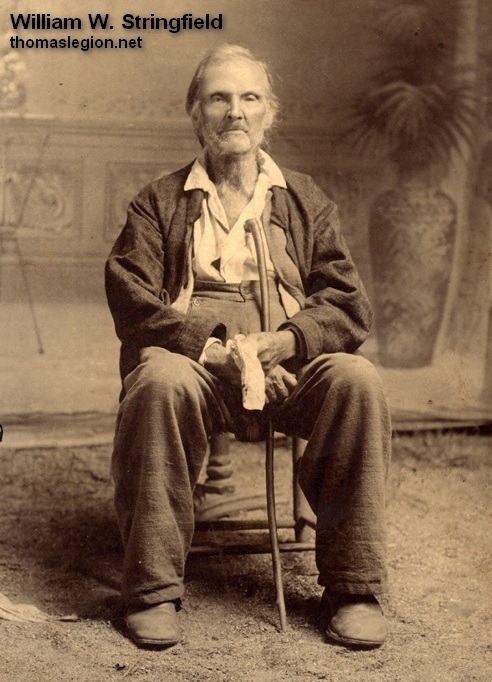
|
| William W. Stringfield, undated. |
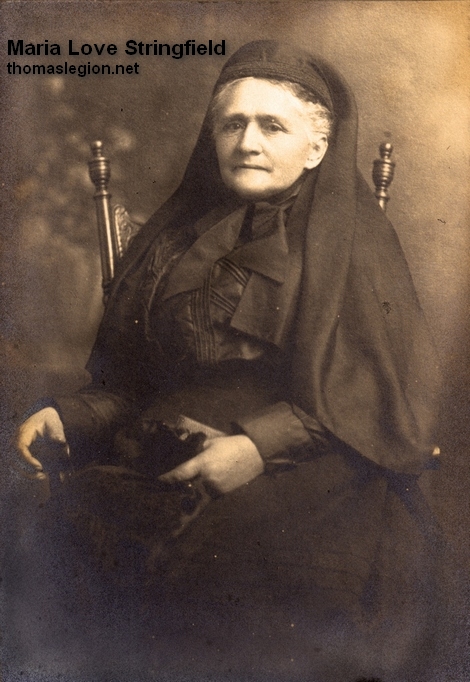
|
| Maria Love Stringfield, undated. |
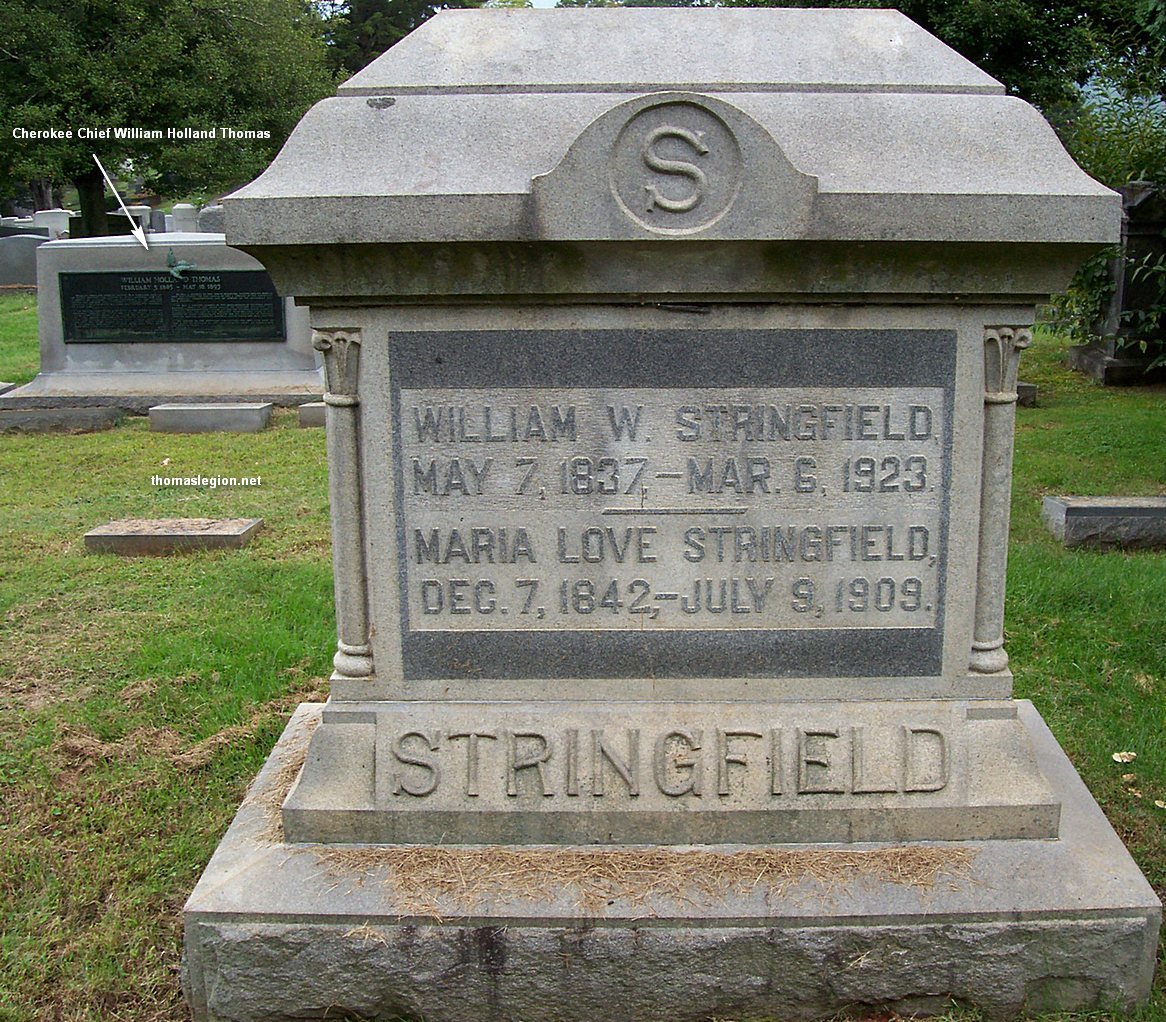
|
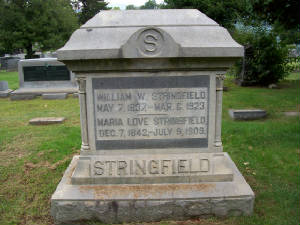
| Stringfield Gravesite, Green Hill Cemetery, Waynesville, NC |
Green Hill Cemetery, Waynesville, N.C.
Lieutenant Colonel William Williams Stringfield and wife Maria Love Stringfield.
Tlage’si
"Field"; the Cherokee name for Lieutenant-Colonel William
Williams Stringfield. It is an abbreviated rendering of his proper name. From Robert F. Jarrett’s
1916 "Occoneechee, the Maid of the Mystic Lake"
July 22 This
is a hard day on us. Curtain—it commenced raining on us early and rained all night. My tent was ditched around but it
leaked some. Most of the boys tents leaked badly—They did not ditch around & woked up almost diluged. It is raining
all day We can’t cook. We went up to sister Jesse Kirkpatrick’s and got breakfast—dinner and supper at 3
pm.
July 23 As I am not going to make an every day business
of keeping this “diary” I will only try to write down such big events as I can and give vent to my feelings. When
I get “too full in influence” like the boy that eats the big dinner.
July 24 Our
camps are located in the old Fair grounds— near the Observatory. Our horses are hitched to stakes and fences. I am as
much concerned about my horse as of myself. I have a first rate little horse that I bought of Jno Smith and that suits me
very well. he was formerly owned by Miss Blanch Branner. I will ride him off to the war and back if our lives are spared and
then sister Mary can ride him about home.
July 25 Now
for work. 20 of us under Lt. Hynds are ordered off to guard the wagons to Big Creek Gap in the Cumberland mts.
July 28 Our
party ret’d from mts yesterday evening, had a rough time— sunshine—dust—rain—mud. Our Lt. is
fond of whisky. We passed through two towns of Clinton and Jacksboro on the Sabbath. it seems— however—that soldiers
appropriate this day to themselves as a military necessity. I shall never approve of such procudure—however much I may
be compelled to do it.
Aug. 1 The
ladies of Knoxville gave us soldiers a good Dinner in the grove south of the Fair grounds to day. It was well gotten up and
carried through. It is cheering to soldiers to receive such favors when accompanied by the sweet smiles of “Dear women”.
Aug. 10 With
10 men I went “on picket” on the tip top of Cumberland mts.— was all day at “Childress Gap”
in my shirt sleeves. It was raining all day but I had on a oil cloth. A beautiful view of Powells Valley is here seen for
several miles up and down. A thunder storm—thunder—lighting—sunshine and showers. “The lighting—red
glare” painting hill of the sky all below me. While we at this Gap it is reported that Dr. Thornburg was taken prisoner
in his efforts to escape to Ky. We were half an hour too late for the fun.
Oct. 20-31
Left Flat Lick [Creek, Knox County, Kentucky] —and came on to Wild Cat River 3 pm next day. Finding road blockaded
returned by dark so our artillery couldnt pass. At once General Zollicoffer ordered Col Brazeltons Battalion Cavalry to dash
forward and learn the strength of the Enemy & their position. Charge was made in gallant style by Col B. leading his own
battalion. A little before reaching the river we advanced slowly over and round quite a hill. Another co of Infantry on our
right. The Yankee Picket was a short distance ahead unconcious of our coming. [Captain John Q.] Arnold [of the 29th Tennessee]
Killed the videt and at once we all dashed forward down the hill to the river bridge—all were halted at river—dismounted—counted
off by fours—No. 1 hold the horses—2-3 & 4 double quick forwd. The Yankee Picket dispersed—my place
to hold the 2-3 & 4 horses. While thus occupied near the old Picket line—one stray Yankee came walking up &
of course I captured him. He was Dutchman and I am sure he was glad to be captured from his actions. We camped on or near
this place & early the next day the Wild Cat battle occured on a steep mt side in or near woods near a Gap or narrow place
in the road and accessible only to Infantry. The Yanks were under the command of Gen. Geo. H. Thomas—while our men [were]
in the fight—I was giving rations to our company in the flat near the creek. I had quite a talk with Gen Z. [General
Felix Zollicoffer] and divided my rations with him. Bread—meat and hot coffee. After hearing my name he spoke quite
Kindly of my father. On this day I saw my first dead man and a lot of arms & legs cut off of the wounded men from the
battle. Yankees are from Ten—Ind.—Ohio and Ky. This war is a dreadful thing hard on foot and cavalry. We ride
poor horses most all day and much of every night. All on Picket. Rain—rain—rain and mud.
I am sure from our movements that our Generals do not understand
what the Yanks are up to. It is reported that the enemy are re-enforced and driving us back towards C. Gap and the other Gaps—S.
& West. I am getting sick and wornout. If the Lord dont come to our help we are all in a bad way. I am in the saddle all
day and much of the night. I often ride 30-40 miles in a day and then walk half a mile or more in the rain—dust for
horse feed. I write most of this several days after the date. We are returning to C. Gap and possibly Tenn. Gen. Z. has gone
towards Somerset & Fishing Creek, etc. All going back—where—when or howl can hardly tell. I am sick—sleep in Doctors wagon—on toward C. Gap—rain—rain——rain.
[Three months later at the Battle of Mill Springs General Zollicoffer was shot three times and died. See also O.R., i, 7, 86, O.R., i, 7, 102, and O.R., i, 7, 108].
Nov. 1 All
are going back. Doctor told me last night that I shall have 30 days furlough. That is almost enough to make me well.
Nov. 4 Pattersons
Near the Gap. This house has been almost turned into a hospital. I am on my way home and spending night here. Miss Patterson
an old acquaintance and exceedingly Kind to me—has put me in a clean bed although I am dirty and covered with body lice.
Good women are “above [oders]”—God Bless our dear ones.
Nov. [8] I
came home last night after a ride of 51 miles via Clinch mt—Blains X roads—Howell Smarts Ferry at 9 ½ or 10 pm.
The back way on my own farm. Saw Jas Keelan only 2 or 3 hours before he saved the bridge & became a Southern Hero.
Thomas' Legion of Cherokee Indians
and Highlanders
This
command was originally intended for local defense in the mountains of East Tennessee and Western North Carolina, and was generally
known as part of "Thomas' Legion of Indians and Highlanders." Colonel W. H. Thomas, its founder, was an old-line Democrat,
and a leading citizen and politician in Western North Carolina – was a man of considerable means, and was personally
well known to President Davis and Cabinet. He was born in Haywood county and raised to manhood close by the Cherokee Indians
and at an early day espoused their cause, and prevented the forced removal to the West, of those in Western North Carolina, by General Scott [General Winfield Scott] in 1836 to 1838. He was adopted by the Indians and upon the deaths of their old chiefs, Yona-gus-kee and Juna-lus-kee,
he was made chief and for twenty-five years prior to the war was also the Government Agent for these Indians.
When the war had progressed for a year and conscription had become
a necessity and a certainty, this command was organized at Knoxville, Tenn., into a regiment, and a battalion.
Several of the companies had been in service for several months,
but General E. Kirby Smith, commander of the Department of East Tennessee and Western North Carolina (an old West Point army
officer), was very much opposed to a temporizing or conservative policy, and would not allow Colonel Thomas the latitude he
wanted; but the latter being a personal friend of President Davis, generally carried his points, and often went to Richmond
to consult with him.
The organization of the regiment was completed at Knoxville, Tenn.,
27 September, 1862, by the election of the following Field and Staff officers:
William H. Thomas, Colonel, Jackson county, N. C
James Robert Love, Lieutenant-Colonel, Jackson county, N. C.
William W. Stringfield, Major, Strawberry Plains,
Tenn.
Luther C. May, Adjutant, Virginia.
James W. Terrell, A. Q. M. Jackson county, N. C.
Lucius M. Welch, A. C. S., Haywood county, N. C.
John W. Lawing, Surgeon, Lincoln county, N. C.
John C. Love, Assistant Surgeon, Jackson county, N. C.
Hezekiah West, Chaplain, Haywood county, N. C.
Alex
R. Carmack, Sergeant Major, Pennsylvania. . . .
Total number of officers and men in the regiment, 1,125. . ..
About this time the enforcement of the conscript law was begun
in earnest, and consequently it was a serious time in the short life of the Southern Confederacy – and thinking men
were fully alive to the herculean task before us. East Tennessee was placed under martial law and many of the most prominent
citizens were in rebellion against the South. The celebrated Parson Brownlow, editor of the Knoxville Whig, a widely
circulated paper, who was afterwards elected Governor of Tennessee, and after the war was United States Senator, took bold
grounds against the South. His paper had some circulation in Western North Carolina, and quite an influence with the old Whig
element. Brownlow was a kind man at heart, to those that did not cross him personally. If he had been reasoned with instead
of being bitterly denounced he and numerous others would have espoused the Southern cause. But, then, as now, party passion
often dethrones reason. Brownlow, with such men as Governor Andrew Johnson, then United States Senator, and afterwards President
of the United States; Horace Maynard, member of Congress; Thos. A. R. Nelson, John Netherland, R. R. Butler, members of Congress;
Rev. N. G. Taylor, also an old Congressman, father of Governor Bob. Taylor, with scores of smaller, but equally determined
men, boldly threw themselves into the breach, openly defied the South, and in large numbers daily left Tennessee, crossing
the Cumberland mountains and joined the Federal army in Kentucky and Ohio.
The wisest statesmen of the South were divided as to the best
policy to pursue, but Southern blood was aroused and Southern men were expected to stand by the South, right or wrong. There
was much homogeneousness between these mountain people of Tennessee and North Carolina, and there is an independence of thought,
speech and action in the average mountaineer, not usually found elsewhere, superinduced perhaps by their grandly beautiful
surroundings, combining, as some think, to the development of a high type of physical, intellectual and spiritual manhood.
A great majority of the people were poor and had no interest in
slavery, present or prospective. But most of them had little mountain homes, and, "be it ever so humble, there is no place
like home." So when husband, father and brother went into the army the wife, sister and daughter had largely increased home
cares, and often went into the corn field.
No grander type of womanhood is developed anywhere than in these
mountains. Neither the men or women were cowards, but when the Federal army occupied East Tennessee and threatened North Carolina,
the women in their lonesome homes naturally became restless and timid, made more so when spies and forays of the enemy penetrated
this country. Soldiers in the army would have been unnatural protectors of home, had they not become uneasy also, and oft
times desperate, especially when informed, as hundreds were, that their homes had been robbed and the country pillaged, as
was the case for two years in all the border counties along the Tennessee line from Ducktown to Watauga, a distance of near
200 miles. No people were more zealous for the South than Western Carolinians, after the rejection by the Lincoln regime of
the peace overtures made by the border States. East Tennessee and Western North Carolina had a common heritage of ancestral
heroes through the Seviers, Tiptons, Averys, Campbells, Lenoirs, Loves, McDowells, Brittons, and others, who fought at King's
Mountain, Cowpens and Guilford Court House; in later years at Lookout, Emuckfau, Horseshoe, and New Orleans, and later still
in the numerous battles of Mexico. Such an element may be easily led, but, never forced. In Tennessee this anti-war element
was fully aroused and as soon as conscription was fully determined upon, Colonel Wm. H. Thomas at once went to Richmond to
get a modification of the law. His efforts were unavailing, the law must be enforced, it was enforced and 33,000 were added
to the Federals and a few thousand fire-tried veterans to the Southern army. Colonel Thomas largely recruited his own command,
forming soon afterwards another regiment, with two companies of Sappers and Miners, and one company of artillery (Levi's Battery).
He had some unique ideas concerning these matters, and while known
to be intensely loyal to the South, he had gained the confidence of this East Tennessee disloyal element and several thousand
at various times had agreed to form companies for local defense, and for road and bridge building. Not being allowed to do
this, these men went to the Federal army and ever afterwards were troublesome enemies.
From September, 1862, to June, 1863, there was little to break
the monotony of camp life and provost duty. There was much of an unpleasant, nature to be done by men of similar characters.
Enforcing conscription – disarming the people – the impressment of property, forcing magistrates and civil authorities
to take an oath of allegiance to the Confederacy, was disagreeable work. Much hard work was done in building block houses
and stockades on the entire railroad line, 250 miles. This was a fine agricultural region and an indispensable line of communication
between the armies of Lee and Bragg.
| Stringfield's Official Amnesty Papers |
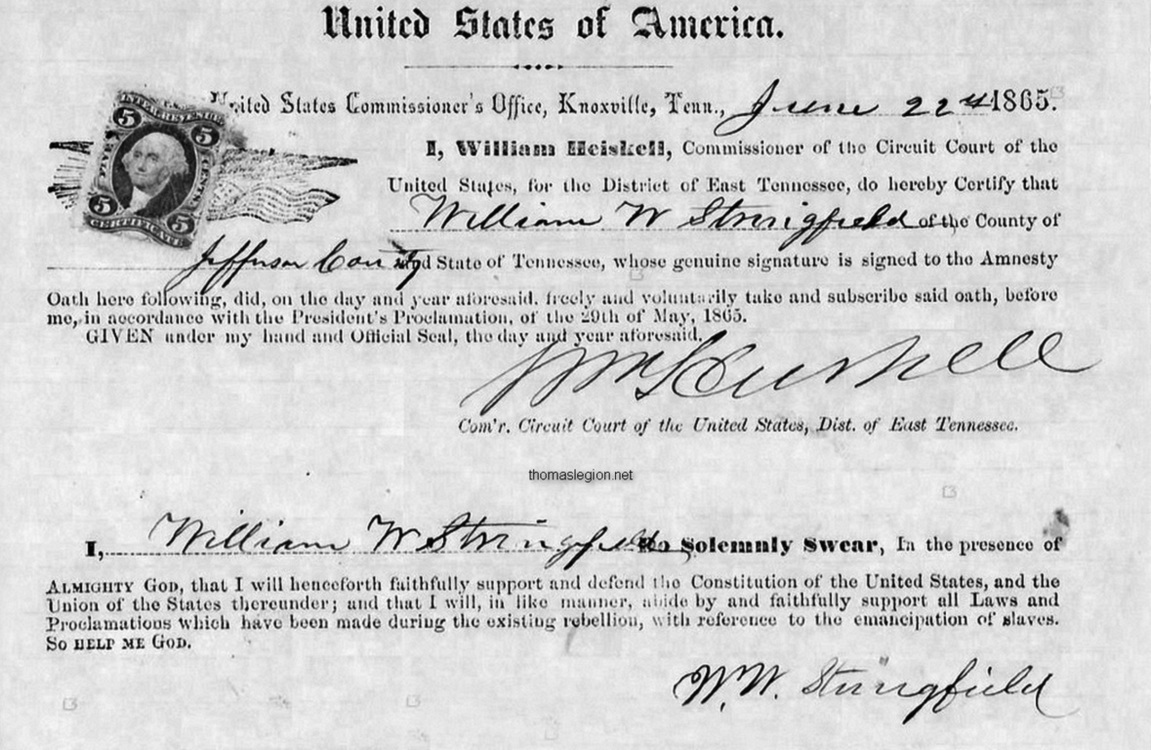
|
| Lt. Col. W.W. Stringfield takes the Amnesty Oath |
August 4, 1863 - Reward for Confederate deserters
$240
REWARD.
Headquarters,
Thomas' Legion
Zollicoffer, July 25th, 1863.
A
Reward of thirty dollars each will be paid for the following named deserters from Capt. Love's Company, (D,) of Col. W. H.
Thomas' Legion who deserted their encampment July 22d, 1863.
Sergeant
John H. Lyons, aged 26 years, 5 feet 9 inches high, complexion dark, eyes dark, hair dark, residence Knox county Tennessee.
James
Reed, aged 32 years, height 5 feet seven inches, complexion fear, eyes
blue,
hair light, residence Knox county Tennessee.
Leander
Reed, aged twenty-one years, height five feet eleven inches,
complexion
fair, eyes gray, hair light, residence Knox county Tennessee.
Joseph
Hooker, aged 46 years, height 5 feet 6 inches, complexion fair, eyes
blue,
hair dark, residence Union county, Tennessee.
Thomas
Simmons, aged 38 years, height 5 feet 8 inches, complexion fair, eyes
gray,
hair dark, residence Jefferson county Tennessee.
John
C. Lee, aged twenty-four years, height 5 feet 4 inches, complexion dark
eyes
dark, hair dark, residence Jefferson county Tennessee.
Also
the following named men who deserted on the 17th day of July 1863.
William
Hatcher, aged 22 years, height 5 feet 8 inches, complexion fair, eyes
blue,
hair light, residence Jefferson county Tennessee.
George
Hunter, aged 26 years, height 5 feet 7 inches, complexion fair, eyes
gray,
hair light, residence, Claiborne county Tennessee.
Arrest
these men and bring them to justice.
C. C. M'BEE 1st Lt., com'dg Co."D"
W. W. STRINGFIELD, Major, com'dg Thomas' Legion.
[Knoxville
Daily Southern Chronicle, August 4, 1863].
President Davis consented to evacuation only as a trap
for Burnside's army, but the cowardly surrender of Cumberland Gap by General J. W. Frazer, 9 September, 1863, however, proved
it a double triggered trap for us. The Federal authorities were fully alive to the importance of grasping from us and holding
this section, so fertile for all, and so loyal to them, being urged thereto by the highest consideration of honor, duty and
interest. [General Frazer surrenders the
Cumberland Gap]
The Sixty-ninth Regiment was never idle, especially after current
rumors of. Federal invasion early in 1862, following the defeat and death of the noble [Gen.] Zollicoffer at Fishing Creek.
This defeat practically made the Cumberland Mountains our line of defense. The Union element became restless and defiant and
many were arrested and sent South to prison. Clark,
"Sixty-Ninth Regiment by William W. Stringfield," 729-36.
Several companies of the Sixty-ninth were ordered to Powell's
Valley in 1862, between Jacksboro and Cumberland Gap – one Indian company at Baptist Gap had quite a battle with some
Federals, killing, wounding and driving back their force. The Indians were led by Lieutenant Astooga Stoga, a splendid specimen
of Indian manhood and warrior, who was killed in the charge. This noble Indian is worthy of a lengthy sketch but the writer
has not the data, if he had time and space. Like most of the leading Indians of his tribe, he was a professed Christian, and
largely by his efforts the New Testament was translated into the Cherokee language by the great American Bible Society. The
Indians were furious at his death and before they could be restrained, they scalped several of the Federal wounded and dead,
for which ample apology was made at the time. In the Spring of 1863 the regiment in Gen. Alfred E. Jackson's Brigade was in the Department of East Tennessee commanded by Brigadier-General
Daniel S. Donalson. In March, 1863, it was at Strawberry Plains and in April at Jonesboro, and in July at Zollicoffer, Tenn.
Some time afterwards Bragg's army entered Kentucky from middle
Tennessee, and after quite a campaign there, returned to Tennessee by way of Cumberland Gap to Knoxville. This campaign caused
a temporary lull in East Tennessee affairs, but the retreat of Lee from Maryland and Pennsylvania and the surrender of Vicksburg
was followed by outspoken defiance all over East Tennessee.
Spies and recruiting officers from the Union Army were almost
everywhere. Several cavalry raids burned and attempted to burn railroad bridges and depots until finally, on 4 September,
General Burnside captured Knoxville, the stronghold of East Tennessee, without firing a gun or meeting an enemy. Some time
prior to this all the white companies of the regiment and several companies, of Walker's Battalion (of our Legion) were concentrated
for drill and discipline at Greenville, Tenn., and were brigaded with the Sixtieth and Sixty-second Regiments and Twelfth
Battalion, Georgia Troops, and several Virginia, Georgia and Florida Regiments.
After Burnside's occupancy of Knoxville there was a general "On
to Richmond," "On to Chattanooga," and "On to Atlanta" cry in the Federal army. The hopes of this cry were realized afterwards,
but at very great cost of life to the enemy. Those were gloomy days to those of us who left our homes and loved ones at the
mercy of the enemy. This territory was never reclaimed, afterwards almost every foot of it was fought over, time and again,
and its occupancy was costly to the enemy, but of great political significance to them.
Part of the Sixty-ninth and most of the Eightieth (Walker's Battalion,
which had been raised to a regiment), with detachments of the Twenty-ninth, Thirty-ninth, Sixtieth and Sixty-second North
Carolina Regiments, fell back to the gap of the Smoky Mountains, or the North Carolina line, there to guard against the invasion
of that region.
The greater part of the Sixty-ninth, with part of Singleton's, Berry's, Whitaker's and Aikin's companies of the Eightieth, fell back towards Bristol, Va. Immediately
upon his occupancy of Knoxville, Burnside sent forces up the railroad which had been surrendered without, a struggle, or the
destruction of a bridge, to Jonesboro, Tenn., also sent cavalry to Blount, Sevier, Cocke, and Washington counties, Tennessee,
guarding against surprises from that direction, and .threatening North and South Carolina by way of Murphy, Webster, Waynesville
and Asheville, and attempting to capture Colonel Thomas' forces, good turnpike roads penetrating these mountains. But the
"fighting end" of Thomas' Legion was not idle in upper East Tennessee, and marched and counter-marched in every county in
that end of the State, and up to Saltville, Va., leaving the bones of their comrades (since kindly gathered at Knoxville by
the noble women of Tennessee) all over that section.
When Tennessee was fully surrendered great gloom overspread the
soldiers from the border States, and many Kentucky, Tennessee, Alabama and North Carolina troops returned to their homes.
Bragg's army with a muster roll of 83,767, had few over 40,000 guns, and guns are all that count in battle.
General Bragg wrote to General Lee that after seven months of
conscription, not a soldier was added to his army; that Kentucky, Tennessee and North Carolina troops could not be depended
upon, a very unjust aspersion cast upon all, especially North Carolinians, most of whom, even after leaving their regiments
in the East and West, did good service at home. No section of the Union furnished as many soldiers to the Union Army according
to the population as East Tennessee. With such surroundings as these it is no wonder that so many were induced to desert,
or more properly stated, returned to their homes.
The same day that General Burnside occupied Knoxville, Colonel
Thomas, with several hundred men, fell back from Strawberry Plains, passing through Sevierville to the North Carolina line,
taking all the Indians and many whites. He was closely followed by the Federals and had quite a skirmish near Sevierville,
on 7 or 8 September, 1863, but he crossed the Smoky Mountains and at once securely blockaded all the roads leading in that
direction from near Paint Rock to near Ducktown.
Lieutenant-Colonel Love and Major Stringfield, with 600 or 700
men, were ordered to fortify and hold Carter's Depot at the railroad bridge across the Watauga, about twenty miles west of
Bristol.
General John S. Williams, of Kentucky, since United States Senator,
then commanded the Department of East Tennessee which was abandoned to the foe, after the shameful surrender of Cumberland
Gap 9 September, 1863.
Burnside's forces, composed largely of native Tennesseeans, rather
recklessly took charge of the country. One regiment of troops (One Hundredth Ohio) went to Jonesboro on the cars 5 September,
1863, and several hundred ventured up to Carter's and demanded the surrender of the fort. The next day Major Stringfield was
ordered to take 200 of his men and a battalion of cavalry (McLin) under Captain D. D. Anderson, and reconnoitre the position
of the enemy. He took this force to Jonesboro and below. On 7 September General A. E. Jackson came up with the balance of
the Sixty-ninth North Carolina, the Fourth Kentucky Cavalry and Sixteenth Georgia Cavalry and Borrough's Battery, and learning
that the enemy were fortifying in and around the old limestone blockhouse and a stone mansion near by, the Sixty-ninth was
ordered up by General Jackson and at 3:00 a. m. on the 8th, we drove them from Telford's depot to Limestone, where they made
a determined stand, evidently being handled by some veteran officers. Closing in upon them on all sides, we forced them to
surrender with a loss of 20 killed, 30 wounded and 314 prisoners, with 400 splendid small arms. Our loss was six killed and
fifteen wounded. Our regiment was immediately armed with the guns here captured (Enfield rifles). The enemy were the One Hundredth
Ohio Regiment (Infantry) and were a fine looking body of men. Knowing that this capture would arouse the enemy, we fell back
towards Carter's. Ten days afterwards the enemy approaching in force with several regiments of cavalry, battle was given them
at Carter's. Our cavalry was much weaker than theirs. Owing to the general advance movements by the enemy, the capture of
Cumberland Gap, or rather its shameful surrender by General Frazer 9 September, 1863, and advance movements all up to the
Salt Works and into West Virginia – a long line of defense – we were compelled to draw in our line and concentrate
our forces.
[1863] Some of our
men are Deserting to the Enemy. Poor fools like a fool fish “jump out of the frying Pan into the fire”. Better
“bear the ills we have than to fly to those we know not of.” We are marching from Paint Rock to Horse Creek—in
and around Greenville—Jonesboro—Telford—Blountsville—Kingsport—Rogersville etc. I am on court
marshall often acting as “judge and advocate” etc. I am getting along well with officers and men. All seem to
like me. I find it a disagreeable duty to have to discipline men—but I have less of this than I did with Tenn troops.
In my marching around in these upper counties I meet with many old friends who seem glad to meet as it is often a protection
to meet friends. I often see old friends in the army. I will protect citizens regardless of Politics.
Sept. 5
Carter Co. I came here this morning from Zollicoffer to assume command of
the post. Troops—200 Infantry. 75 Cavalry and 50 Artillery—[Hugh L. W.] McClungs Battery make up the force. Some
home guards under [Owen M. White and [John. B.] McLin—[James M.] McConnell & [Thomas A.] Butlers Co.s of the [Legion].
The Yanks are supposed to be in force as the demand to surrender was made in the name of “Maj General Burnside”.
This is the first time that his name has been used up here in E Ten.
Sept. 6 Jonesboro.
At daylight this AM I took 75 Cavalry and started in search of the Yankees—but “nary Yank” do I see. I got
here by 9am, but the Enemy of 400 or 500 had left by sunrise on a train. I first galloped through the town—midst the
smiles and cheers of beautiful women & waving of handkerchiefs. I remained in town all day and on Picket below town most
of the night.
Sept. 7 This
am Gen. Alfred E. Jackson came down with the 4th Ky. Cavalry—the 16th Ga. Batt. & [William H.] Burroughs Artilery
etc—and we will wake up the Yanks tomorrow.
Sept. 8 This
am we all moved down upon the Enemy at Telfords Depot—6 miles below this. The Enemy fought well [and] were evidently
commanded by a Veteran—but we drove them in to the Block House. I commanded the cavalry. I went on Picket down to Leesburg
at daylight, thence across to Telfords—drove Enemy 6 miles to Limestone where after a stubborn fight of 2 hours we captured
290 Prisoners, 30 wounded & 20 Killed of them. Our losses 6 Killed & 15 wounded. I took a splendid sword from the
commander. . . also a good gum cloth. These men were of the 100th Ohio [and] of [our] troops engaged were Major [James A.] McKamy with 100 of our Batt. also [James W.] Cooper’s and [Julius M.] Welch’s cos—all
did their duty. Prisoners were all sent off same evening to Richmond Va.
Sept. 9 In
this fight Enemy were in a block house across Lick Creek. At Depot Col [James Robert] Love—Maj McKamy—[ Captains] Cooper—Welch—[Elisha G.] Johnson.
I Killed one fellow in the round up, he was hid in a briar thicket in front, near me. I was the first one to reach fort after
the white flag was raised. We also captured a fine large Drum.
Sept. 20 Carter’s
Depot. A large Federal force is in our front. Major Gen [Colonel Eugene W.] Crittenden Federal a brother of our General [Colonel
George B.] Crittenden is in command. A strange meeting to day of these two brothers in opposing armies.
Sept. 21 This
Carter’s Station is at the river with a ford on the river 3 miles below and one 4 miles above. Yanks under Burnside
in large force. Forces are fighting all day & part of the night in full view of each of them & the depot. This place
is 5 or 6 miles on river north of the Co seat of Carter Co which is the strongest Union Co in E. Ten., near the home of Senator
[Landon] C. Haynes and his bro-in- law Hon. [Nathaniel] G. Taylor, M.C. from Tenn in U.S. Congress.
We have made several hard marches one notable one of 61 miles
in 30 hours. I walked myself to let tired and sick men ride my horse. On one trip between Zollicoffer or Union as the Yanks
call the name I saw the grave of my great grand father Jas King under an Iron slab. We built some breast works to welcome
the Yanks, who are this side of Bristol. Let them come, we are ready.
Our position at Carter's on the east bank of the Watauga river,
was impregnable, and the enemy, after two assaults, flanked us at Devault's Ford on the north, and Taylor's on the south side,
causing us to fall back to Zollicoffer, or "Union Depot," now Bluff City. The enemy about this time hearing about our great
victory over them at Chickamauga, hastily retired towards Knoxville. We followed them to Bull's Gap, the Sixty-ninth being
the only infantry regiment. On 5 October, 1863, the cavalry had a fight at Greenville, killing seven, wounding twelve and
capturing ten of the enemy, with a loss of three killed and seven wounded, General Jno. S. Williams, of "Cerro Gordo" fame,
commanding our troops. On 15 October, after several days skirmishing with the enemy, General Williams gave battle at Blue
Springs with his 1,800 dismounted men, holding in check Burnside's 7,000 veterans. The Sixty-ninth was ordered to his aid,
but hearing of a flank movement of the enemy, we were ordered to retreat towards Jonesboro, and finally to Abingdon, Va. In
our retreat three miles above Greenville, our cattle, wagons, artillery and infantry, in order named, were surrounded before
we knew it. General Burnside had thrown General Foster with 3,000 cavalry in our front, attempting our capture. The first
intimation we had of their presence was in the capture of our Adjutant, L. C. May, and Captain Tip (H. H.) Taylor,
Acting Adjutant-General of our brigade. Captain May escaped and gave us warning.
In a few moments after the presence of the enemy was known Colonel
turned back the wagons, ordered forward the Sixty-ninth at double quick, threw it in line of battle across the road, and bringing
forward the artillery, began at the earliest dawn of day a furious artillery fire upon the enemy in corn fields and meadows
confronting us, fortunately for us, bursting shells in their very midst. Before they could realize the sudden change of the
situation, the Sixty-ninth, with the "bear hunter's rebel yell," was upon them. Our men realized at once that quick and deadly
work must be done, or we would all be captured. The entire 600 men at sunrise dashed forward at the enemy in a heavy skirmish
line, Love upon the right and Stringfield upon the left, with company officers all in place, all cheering and directing their
men. Lieutenant Welch, of Company F, afterwards killed at Winchester, was shot through the thigh by the side of the writer;
very few others hurt. This was a running fight for ten miles. Two Federals were killed in the yard of Senator Patterson, son-in-law
of President Johnson. Twelve or fifteen, others were killed. General Williams, while slowly retreating
before Burnside, heard our artillery open upon the enemy. Dashing forward at a gallop, he materially aided us in the achievement
of one of the most brilliant retreats of the war. General Williams was profuse in his compliments, personally and in special
orders, to our regiment. We retreated sixty-two miles in thirty hours, fighting and driving the enemy much of the way towards
Jonesboro, but not losing cattle or wagons and but few men. The retreat did not stop until we reached Virginia and fortified
Abingdon, and covered Saltville, where we were reinforced by the brigades of Corse and Wharton, Virginia troops, under General
Robert Ransom. We remained quietly here until 1 November, when we began another forward movement towards Knoxville, Tenn.
While here a beautiful Carolina maiden, having heard of the heroism of our men and of complimentary orders about them, sent
the following acrostic to our gallant Colonel, J. R. Love, who several years since has "crossed over the river and is resting
under the shade of the trees."
While we were waiting
a few days near Blountsville, Tenn., our cavalry under William E. Jones, made a nice capture of twelve or fifteen hundred
of the enemy's cavalry at Rogersville, and near 100 wagons of the Second Tennessee (United States) and Seventh Ohio. The citizens
here-abouts were mostly our friends, something unusual in East Tennessee, and had noble kindred in our army, mostly with Bragg.
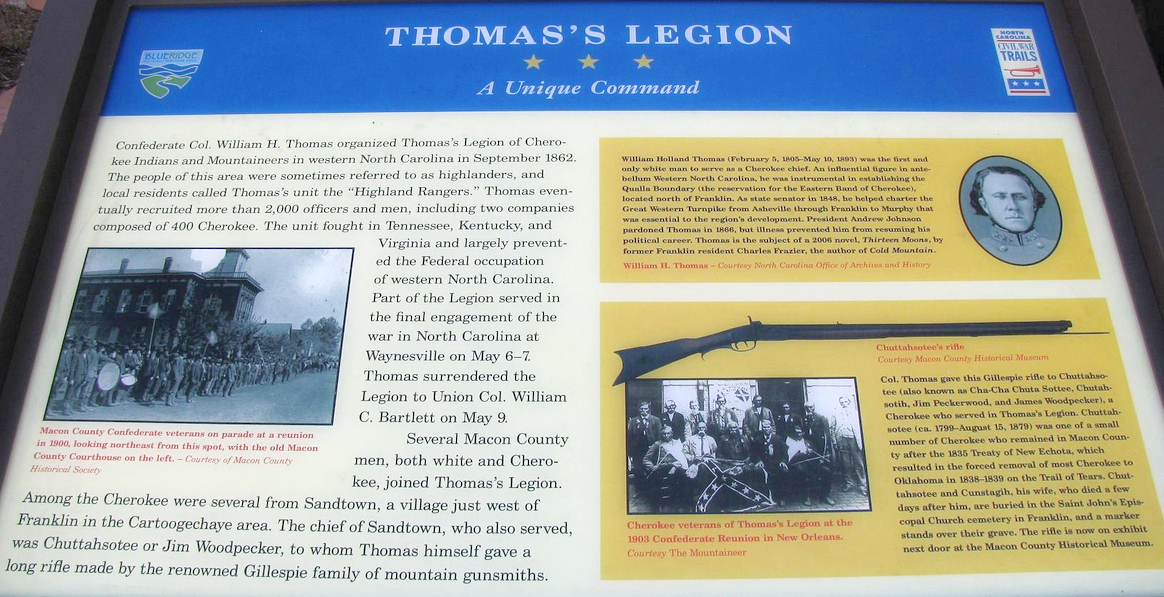
|
| The Thomas Legion |
While around Blountsville, company and regimental
drill was daily enforced. Lieutenant Thomas Ferguson, a good soldier, afterwards made Captain and captured at Piedmont, joined
us here with 75 recruits. A painful example for discipline was made here, one poor fellow of Company K, a Tennesseean, with
two others of Tennessee troops, captured at Rogersville, Tenn., by General W. E. Jones, in the uniform of the enemy, were
court-martialed and shot at the stake. The army then moved down the Rogersville and Kingsport Valley towards Knoxville, on
the north side of Holston river, wading the river and creeks in the ice.
General Robert Ransom was a fine disciplinarian and fighter. Sometimes unpopular in camp, or upon
the march, but universally popular in battle, where it was an inspiration to see him. He did not "snuff battle from afar,"
but rushed into the thickest fray, to cheer and guide his men. In all this dread winter campaign the Sixty-ninth were cheerful
and obedient. Winter quarters were built near Rogersville in December, but were occupied only one week. After this neither
the men or officers had tents or houses, but faced the storms of rain and snow, mud and ice, in tramps several miles above
and below Rogersville, down towards Knoxville.
Nov. 13 Below Blountsville. For the first time in my life, I saw Three soldiers shot to death, at the stake for
Desertion. Poor fellows. At an early hour this morning—all our 8 or 10 thousand soldiers were marched on in an open
field and formed into a hollow square. One was of Butlers Co. “K”—Silvery Hamilton of 19th Ten, the other
was of [W.C.] Kains Battery.
Nov. 26 Lt.
Tom Ferguson with 71 new men came in today from N.C. March down the road forded river, cold wading. Gen Robert Ransom—at
point of pistol made some men wade. I let lots of them ride my horse. We are marching down toward Knoxville, something is
up. Rain, rain, mud, mud. March 12 to 14 miles a day. Heard of the death of James Petty an old neighbor at Plains. He belonged
to a Yankee cavalry and was Killed in a battle near Blountsville. Died near Big Creek.
Nov. 30 Morisburg.
March 18 miles, cold, cold, too cold to ride.
Dec. 1 Camps
1 mile West of Rogersville. Retreating again for what—God help my home folks. Marched 20 miles.
Dec. 2 Camp
4 M West of Beans Stations,—all night again. Men are cheerful and in good spirits, by tomorrow I hope to be down near
home 20 miles.
Dec. 3 At
home. Thank God I am at home again and once more see the faces of My loved ones. Alex Carmack, Wm Parker and I came by
way of Rutledge. I find mother and sister Mary much better off than I expected from what I had heard. We crossed the Holston
river at the mo. of Mossy Creek & via New Market. Got supper at Mr. [William] H. Moffatts & had pleasure of seeing
the Young Ladies. [General James] Longstreet has given up the siege of Knoxville.
That is bad—but all will be right some of these days.
Dec. 4 Camp
near Blains X Roads. I returned to camp from home this AM. I expected to find the army on road to Knoxville, but we are meeting
Longstreets troops. I fear another retreat. They are demoralizing to the men.
Dec. 5 Four
mile E of Blains X Roads. Our army retreated 4 miles toward Rutledge. As we move out Longstreets forces occupied our ground.
Dec. 6 Quiet.
Dec. 7 Yesterday
I was ordered by Gen Ransom to take Alex Carmack and Wm Parker and go over to the Plains on a scout and bring in any Absentees
& Deserters. We went directly across by Dan McBuz—3 miles above Plains. There we heard of 8 or 10 Renegades under
Tom Smart. They had searched my house and sister Sarah and had “cut up” generally. Smart is a Deserter from our
Army. If we catch him he will find the force of outrageous justice. We returned to camp by New Market and mouth of Mossy Creek.
Dec. 8 In
camp.
Dec. 9 Near
Morrisburg. We are still falling back. Very cold. In camp our fires are large & we Keep as warm as we can. I dont like
so much retreating
Dec. 10 Yellow
Store—I am very tired from my very tiresome walks. I let sick men ride my horse. Marched 18 miles. An old friend C.C.
Miller of fathers lived here. Resting a day or so.
Dec. 14 Marble
Hall. Marched from Yellow Store to day extremely disagreeable tramps. Mud—mud—mud. We distinctly hear cannon in
direction of Beans Station. I never saw weather or roads so bad. We moved out at daylight another 24 hours will bring us face
to face with Burnside’s Army. Then perhaps I may have to surrender my life upon my country’s Alter. I fear not
to face the issue, whatever it may be for head, heart, limb and life are with my country. When God, in His infinite mercy,
calls me hence I hope to go to a better world. Lets us advance upon them and drive them out.
Dec. 15 Camp
near Beans Station. A pretty hard march brought us here. I was in command of rear guard of 200 men. I did not reach camp on
the immediately South of Beans Station. Started AM West of Moristown road. Cold has moderated a little. Cannonading distinctly
heard in the direction of Rutledge. The fight here yesterday was quite severe. Enemy driven from Morrisburg to 1 mile west
of here. Our loss 14 Killed 50 wounded. Enemies not know. 2 dead and 2 mortally wounded found. They took shelter in the large
Hotel and the sharpshooters hurts us much till our cannon riddled the Hotel with shot & shell. The marks of deadly conflict
can never be effaced from that and other Buildings near. We are likely to stay here for a day or so. I say go on.
Dec. 16 and 17
Beans Station—We remained quietly for 2 days “All hands and the cooks” are well rested and we are
ready to advance upon the retreating foe. I hope that E. Tenn is soon to be redeemed & distingishly. God grant it.
Dec. 18 Beans
Station—Still quietly here. I can but give vent to my pent up feelings of disgust and displeasure of the apparent tardiness
of our comd. General in not moving on the Enemy. But I hope all is for the best. I hope. As I am not responsible for those
delays, I will try to rest easy. But Oh, how I do want the Enemy driven from my home and country.
Dec. 19-20
B. Station—Still here. Some half of our Div—Ransom—going over toward the mo of Chueky . . . prefer
that to Rogerville, [Bull’s?] Cap or Kingsport, but any where I am a soldier in the service of my Native South.
Dec. [21] Beans
Station—I hear we are to go into Winter Qrs near Rogersville. So be it. Yesterday. . . I called upon Ed Burruss son
of Jno W Burruss of Woodville Miss—a nephew of my dear step mother. He is a nice young man, is clerking in the AAG office
of Maj. [Brigadier] Gen. [Benjamin G.] Humphreys, [General Lafayette] McLaws
Division, Longstreets corps. Heard from the McGehe family, all well.
Dec. 22 Morrisburg,
Tenn. Camp 1 mile W of Rogersville. Very cold. Called on my old co in 31St Ten.
Poor boys I am sorry for them. They treated me very badly, but it was best for me in the long run.
Dec. 25 Winter
Quarters near Rogersville—Christmas 1863—In co with Col JR Love & others I, went in to R. called on the Alexander
family & others. Also came out to home of Col [Richard G. ] Fain & helped eat a big Xmas turkey. 2 nice Young Ladies
& a very clever old Lady Mr. Dix Alexander is an old friend of father’s. Knew him 30 or 40 yrs back.
Dec. 29 Broke
camp & moved toward Austin Mills & Russellville, Ten. Sgt. Geo W Bryson, Co. “F” died here a day or so
ago. Splendid man. The ford being too deep our wagons went by upper ferry. After a march of 10 miles we came to camp 1 ½ miles
North of Whitesburg. This day ends the campaign of 1863 an eventful one. I came in at S. Plains Jan. l—63 and closed
here about 34 miles from the beginning. Crow,
The Justness of Our Cause, 78-83.
General Alfred E. Jackson was our brigade
commander this winter in all our campaigns. He was a cultivated gentleman and personally a brave man. He was a good man and
always managed the men to the best advantage in so hostile a region. He was personally and scrupulously honest, and demanded
the same of his men; but he was a little too strict for the "old soldier" ideas of those who wanted to prowl. The marches
below Rogersville and down to Blaine's Cross Roads were mostly made in bad, and very cold weather. When we met Longstreet's
returning forces after his repulse at Knoxville, and our great defeat at Missionary Ridge, the entire army fell back near
Rogersville, and the Sixty-ninth, with others crossed the Holston river and went into camp on the railroad near Russelville
on 1 January, 1864. Soon afterwards the Sixty-ninth returned to our old quarters at Carter's Depot, where with that as a base
of operations we could "swing around" the mountains on several trips, after "renegades," blockade stills and deserters. Clark, "Sixty-Ninth Regiment by William W. Stringfield," 736-43.
Jan. 1 [1864]
Camp near Whitesburg Ten—A happy new year to all the loyal citizens of the South. The year came in midst storm
& tempest—bringing with it extreme cold—the most stinging & bitter cold thus far of the winter. I greet
the incoming year with mingled feelings of hope and fear, hope predominating. I have fears lest some mismanagement on the
part of those in power may prolong the war beyond the limits of this year and thereby entail more misery upon women and children.
While there is life I have hope. I must hope, do hope—I will continue to hope as long as we have an organized army in
the field. My honest belief & faith is staked in the triumph of Southern arms. “Pluck will win”—whether
in love or arms & Southerners Soldiers as a general thing are pluckey but above all I have an abiding faith in the Justness
of our cause & consequently in the help of Him who doeth all things will. With such feelings I enter upon the duties &
hardships of the Year.
Jan. 8 Camp
near Bulls Gap—Moved from Whitesburg Yesterday. Are comfortably ensconced in the Winter Quarters built by Gen [John
C.] Vaughn’s brigade near the residence of Thos. Jacksons. Weather extremely cold deep snow on ground now.
Jan. 9 I
applied for ten days leave of absense to visit Emory & Henry & upper E. Tenn. I shall visit Jonesboro—Carter
Co. etc.
Jan. 10 Geo.
Folsom & myself left camp at sunrise this morning & have come to Mr. Morrows—within 8 miles of Jonesboro. I
am now out on my first furlough of the Kind during the war & shall visit Sister Linda & my friends & some Ladies.
Jan. 11 Happy
Valley. I came by Jonesboro & rested one hour & came on to Mrs. Taylor’s where I am singly quartered—I
find Miss Mollie as interesting as usual.
Jan. 12 Zollicoffer
Tenn—I came by Elizabethton and Carter’s Depot to day & am staying at Wm Piles’ Hotel.
Jan. 13 Bristol
Tenn—Came here by 3 pm & am stopping at Uncle Kings where I am always welcome & treated as an own son, good
uncle and aunt. Zollicoffer Bridge is completed & the cars will go to Carter to day. I rec’d a favor from Miss Lizzie
Rhea a splendid dye in the wool Confederate at Zollicoffer [aka Union City and Bluff City] this morning. Many Thanks.
I hope she may be well and won by a worthly & gallant soldier of the South. I must not fail to record here my Kind acknowledgements
to my particular friend Miss Mollie Taylor of Carter for the splendid pair of socks Knit by her own fair hands & presented
to me at her home a day or two since. Such presents are calculated to make a bachelor—such as I—one of necessity
inclined to give up the charms of ‘single blessedness”.
Bristol, TN
January 13th 1864
Came here by 3pm & am at Uncle King’s
where I am always welcome & treated to as can be by my good aunt and uncle. The Zollicoffer
Bridge is completed and the cars will go to Carters to day. I rec’d as a
present from Miss Lizzie Rhea—a splendid waist coat at 2 this morning. Many thanks. I hope she may be wooed and won
by a worthy man and gallant soldier of the South. I must not fail to record here in kind acknowledgments to my particular
friend Miss Mollie T. at Carters for two splendid pairs of socks. Knit by her own hand and presented to me at her house. Such
presents are calculated to make a bachelor such as I, one of necessity, inclined to give up dreams of single blessedness.
Diary of William W. Stringfield: W. W. Stingfield Papers (109) Private Manuscripts Collection, North
Carolina Division of Archives and History.
Jan. 14 Emory
Virginia—I came to sister Melindas this Evening & found her in the midst of the measels. Very glad to see me. Quite
a revival of religion in progress near here. Met Mr. Kennedy & Bro Frank Butler who dropped in a few minutes after my
arrival.
Jan. 18 Bristol,
Tenn—I bid adieu to sister Linda this Sabbath morning & started back to the “Army of E Tenn”. I shall
go by the way of Carter Co. etc.
Jan. 22 Greeneville
Tenn Came to Aunt Williams this Evening. I spent two nights in Carter (waiting for my boots and seeing the girls) & one
night in Jonesboro. I hear a rumor that my Rgt is moving towards mts on a bushwhacking scout—but hope its not. So far
I want to press on towards my home & loved ones there. Since I left the command at B. Gap it has moved towards Morristown
& I hear that the Yanks are falling back towards Knoxville.
Jan. 23 Greene
Co. Tn—My fears are realized. I followed the command to this place (six miles south of G) it is on a general bushwhacking
spree.
Jan. 24 Greene
Co. Tenn—Resting to day prepretory to a march through the mountains tomorrow after bushwhackers.
Jan. 25 We
leave camps this Evening for the “Big Laurel” region. I will record events when I return to the wagons.
Jan. 27 Clark
Creek—Returned to wagons this evening at this place—Washington Co. 12 miles south of Jonesboro. First Evening
we marched to Aliens Stand some 12 miles at which place we ***...at Acola Springs [?] reached at 11 pm. Here we remained till
4 pm next morning when we marched into the Laurel Mountains. Oh what a “howling wilderness” this is away from
law & order, away from civilization, away from all that is refinded or delicate noble and humane. These people are next
to the aboriginal inhabitants of these mountains. We captured a few fellows. Passed “Cold Springs” on this pinnacle
of the mountains. The grandest view I ever saw [in] all E. Ten sprawled out before one’s eyes belongs to Aunt Williams
of Greeneville.
Feb. 1 Carter’s
Depot, Tenn—Returned from a five days scout in Grasy Cove etc. Back to our old “Stamping ground”—guarding
bridges seems to be my fate—I will submit for a while—& in the mean while hunt “Buffalo” [Union
men] to pass away time.
Feb. 2 A
letter has just been handed me from home—sister Mollie [Mary] same old story—”Every thing torn up &
burnt down”—May God protect the innocent & helpless.
Feb. 6 Carter’s
Depot, Tenn—The excitment of an Enemy “raid” on this place has subsided & our great hurry from the mountains
useless. I go home tomorrow on a 3 days furlough.
Feb. 7 Bulls
Gap—Cars ran off track & will be detained till tomorrow. Ought to have been at home by night.
Feb. 8 Strawberry
Plains—My home is deserted, left to the mercy of a rude soldiering. Every thing destroyed out side. Bro Frank moved
his family to Saltville—mother & sister Mary go to Bristol for a while & thence follow. Alice & child have
so far eluded capture. “Flag of truce” from Knoxville— up to day all quite along the Holston. All negros
gone to Knoxville.
Feb. 11 Carter
Depot Ten—Returned to camp this evening—absent five days.
Feb. 14 Valentines
day. I rec’d one pretty little missive—Thanks to my sweet “Incong”—Went “Buffalo”
hunting to day and caught a “tar tan”.
Mar. 31 Carter’s
Depot—This month has passed off quietly I have spent some very pleasant hours in the adjacent country with the good
people especially with the Young Ladies. I have visited Jonesboro several times & had nice times there. Yesterday &
to day Longstreet’s Army have been passing here in an unbroken stream. The pontoon bridge was stretched across the river
just below Cunningham’s Mills upon which wagons, horses etc—passed. I saw [Generals] Longstreet, [Charles W.]
Fields, Ransom, Bushrod Johnston [Johnson], [George T.] Anderson, [Joseph B.] Kershaw, [Micah] Jenkins, [Simon B.] Buckner, [Archibald] Gracie, etc. with a
score of Cols & who have & will distinguish themselves in this war. This
country is to be given up again. Even the cavalry are to be drawn back behind this point. Crow, The Justness of Our Cause, 83-5.
Apr. 1 & 2
The cavalry have reached this point & are to go to Shells between this & Zollicoffer, Kingsport, etc. The 1st
Ten Cavalry is camped near here. Brother James remained 2 nights with me. Rec’d Robt Wilkerson, Thad Williams &
other old neighbors called on me. Major Alex Goforth—my old mess mate & Lt.—died at Bristol last night of
wounds rec’d at Morristown two weeks since. I wrote to Cousin Fannie Deadrick at Warrenton N.C. to day
April 21 I
started at mid night last night for Elizahethton to repel a bushwhacker’s raid upon that place. After scouting all around
& hearing nothing of them. I an now resting at Taylors school house with Co’s “F” & “K”—of
course I called over on the Creek for supplies etc to chat a bit. Alf Taylor was burried to day
Apr. 24 Carter’s
Depot, Ten—I returned from Jonesboro this morning with my men. We marched from Carter Co. via “Cherokee”
to Jonesboro first day & remained 2 days in J. I called on several of my old friends among others Miss Namin & Rhodie
[Rhoda A.] Rhea, Cousin Sue Deadrick, Mrs. Dosser & Mrs Nancy Slemons. I must say for Mrs. Sleinons that she has always
treated me with more Kindness than I ever met with at that place by persons not related to me.
Apr. 26 Carter’s
Depot, Tenn—Yesterday & to day are noted ones for this place & people. The Yankees came & attacked us 700
strong yesterday morning about 11 am—The 3rd md & 9th Michigan Cavalry & 13th E. Tenn. This first demonstration
was at Deavault’s Ford below this—the river being too deep to ford—they returned to this point & “pitched
in” to us. They were hansomely repulsed at all points. I ran some narrow risks—but a Kind Providence shielded
me through all, our loss 5 captured—11 Killed. Theirs 3 captured 3 killed & 17 wounded. One reports their loss at
19 Killed and 27 wounded besides several drowned at the ford. Ed Gammond’s Co is said to have acted gallantly. Our men
all did their duty well. The fight lasted till dark last Evening & from day light till 9 am to day, afterwhich the Enemy
retired towards Jonesboro. I was ordered by Gen Jackson to follow them a few miles which I did to Johnson’s Depot &
learned that they had finally left. So much for standing ones ground & fighting when the occasion presents like this.
Levi’s Battery & the 44th Tenn Vol. reinforced us this evening. So let the Yankees come.
May 1 Carter’s
Depot—All quiet here to day I spent last night & this fore noon over on Buffalo. Of course I enjoyed myself &
came away very reluctantly to wear away time here. The Yankees that were repulsed here last week have gone towards Knoxville—as
far as Strawby Plains—my home—I hope ere long they may be driven entirely out of Tenn. I let Col Robt Love (of
Carter Co) have my horse to work on the 29th of April.
May 6 Carters—I
to day have gotten permission to visit my mother & sister at Emory Va for three day to spend my 27th birthday—which
will be to-morrow. I go to Bristol this Evening. Came to B. this evening—supper at Uncle Kings. Vaughn’s Cavalry
at Bristol. Uncle King and Aunt “Mourning Micajah” are always Kind to me. Dear good old people.
May 7 Emory,
Va—This is my 27th birthday I came here at 3 this morning. Sister & mother all well & made me welcome by a good
turkey dinner, many good wishes. Mrs. Buchannan & Miss Mag Wiley spent the day Sister Mary & I took tea at Dr. Wiley’s.
Pleasant family I should be very thankful for being thus allowed to spend another birthday at home—or with my home folks
& friends, how much has transpired since my last birthday, much has this 12 mos. changed the aspect of affairs. East tenn
invaded—run over, occupied, laid waste & deserted by both armies. My once happy & comfortable home is totally
ruined, but I cheerfully loose all for my country. I am not yet ready to cry “hold enough” I say never submit.
I am willing & determined to fight on as long as we have an organized army & then bushwhack if necessary.
| Thomas Legion Cherokee Veterans |
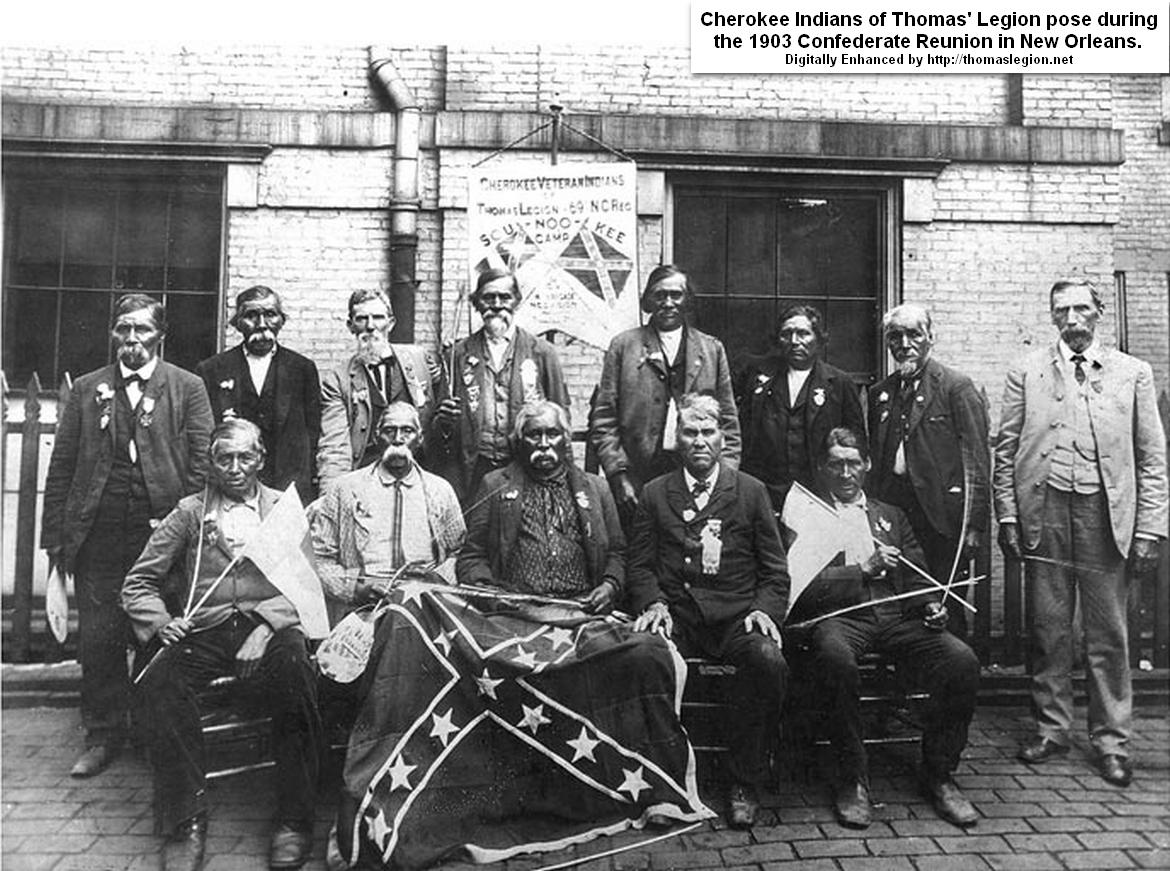
|
| 1903 New Orleans Confederate Reunion |
(About) The following caption appears under the original image: Above is shown the last photograph ever
taken of the remaining members of the famous Thomas Legion, composed of Cherokee Indians in the Confederate Army. The photograph
was made in New Orleans at the time of the New Orleans Reunion of Confederate Veterans. The inscription on the banner in the
photo is as follows: Cherokee Veteran Indians of Thomas Legion. 69 N. C. Regiment. Suo-Noo-Kee Camp U. C. V. 4th Brigade,
N. C. Division. Reading from left to right, those in the picture are: front row, 1 Young Deer; 2 unidentified; 3 Pheasant;
4 Chief David Reed; 5 Sevier Skitty; back row, 1 the Rev. Bird Saloneta; 2 Dickey Driver; 3 Lieut. Col. W. W. Stringfield
of Waynesville; 4 Lieutenant Suatie Owl; 5 Jim Keg; 6 Wesley Crow; 7 unidentified; 8 Lieutenant Calvin Cagle. All of these
men are now dead with the exception of Sevier Skitty, who lives one mile from Cherokee. Lieut. Col. Stringfield and Lieut.
Cagle were white officers of the legion. Names of the men in the photograph were furnished by James R. Thomas of Waynesville,
son of the late Col. W. H. Thomas, who commanded the Thomas Legion.
May
8 My command came here from Glade Springs this Evening. Yesterday I learned
that the command rec’d orders to leave Carter’s the morning after I left. I walked from Emory up to Glade Springs
& there joined the “Legion” this afternoon. The 45th Va & [John H.] Morgan’s dismounted men left
for Dublin Depot immediately upon our arrival here to repel a Yankee raid upon that place. We were ordered there but orders
countermanded. I wish we had gone.
May 12 Saltville,
Va—We’ve been prepared to give the Yankees a warm reception should they come here, but they will not come here.
Late news from Dublin indicated a Yankee raid of strong force upon that place. I called at Col Hu. L. M. McClung’s this
evening. Kindly rec’d.
May 13 Yankees
overpowered our troops at Dublin—burnt depot’s new river bridge, central Depot, etc. Morgan after them. I spent
last night at Mr. Palmer’s with Bro. F.A. Butler, clever family. Met with Mrs. Gen Morgan—pleasant lady, think
the general is same.
May 15 Saltville,
Virginia—Sabbath. Remained in camp reading & thinking. Glorious news from [Generals Robert E.] Lee, [Joseph E.]
Johnston & [Sterling] “daddy” Price. Our prospects are greatly
in the ascendent thanks to a Kind Providence, efficient officers & brave troops.
May 22 Saltville,
Va—Sabbath. All quiet, no war or rumor of war within striking distance of this place. The blood of strife around Richmond
is still in progress. Our arms are still triumphant. Still supported by a merciful God. This quiet Sabbath finds me well.
I attended preaching to day at Saltville. Dr. E E. Wiley was expected, but Prof [Edmund] Langley came in his place. Rev Mr
Cameron of Gen Morgans command preached this afternoon—an Episcoplian. I dined at Mr Palmer, clever people. The Late
Maj Gen Stuart’s mother resides here with her son.
May23 Saltville,
Va. Fifer [Charles] Burriss of Co. “E” died last night of camp colic & was burned with military honors to
day. funeral service by the Rev Mr. Cameron of Morgans command. Miss Bell Pierce, a niece of Maj Gen Stuart, sent a wreath
of flowers to go upon this soldiers coffin.
May 30 Left
Saltville at 5 PM & arrived at New River bridge at 9 am this am.
May31 Arrived
at Central Depot at dark. Bridge burnt—cooked 2 days rations for trip to [Shenandoah] Valley of Va. !!
June 1 Bound
for the Valley of Va.—good. Passed through Lynchburg this evening on way to Staunton.
June 2 Passed
through Charlottsville to day. Called on friend Hughs of the Chronicle [Charlottesville Chronicle] arrived at Staunton &
marched 6 miles down the valley towards Harrisonburg Va.
June 3 Moved
at daylight & came 10 or 12 miles to Mt. Crawford. We were brigaded to day with 45th & two Batts of Va troops, Col
[William H. Browne] Brown Com’g Brigade.
June 4 Marched
out to meet the Yankees under Hunter. They came not but took the New Hope road. Marched back four miles & camped near
Mt. Sidney.
June 5 Battle
of New Hope [Battle of Piedmont Virginia - June 5-6, 1864]. Gen W.E. Jones commanded our army & placed
us before the Enemy who attacked us vigorously at 9am. We repulsed every assault gloriously till 3 P.M. when our right wing
held by the 60th Va Regt. gave way & threw the line into confusion—giving the field to the Enemy. My men did well.
Our loss will reach 100 Killed—250 wounded & 955 prisoners. Enemy’s loss very great in Killed & wounded.
We lost no wagons or artillery. Loss in my Regt.—15 Killed, 24 wounded & 21 missing.
June 6 Camped
at Fishersville last night & arrived through Waynesboro to Rock Fish Gap (Tunnel) here we are likely to stay for several
days & rest our weary limbs. Camped 2 [miles] east of W. near the foot the Mountain.
Crow, The Justness
of Our Cause, 85-9.
July the 11 1864
Monday Evening. In front of Washington
City DC! See the unfurnished dome of the Capitol. I am still very unwell and remain with the wagons which are one mile in
advance of my division which is guarding the rear. Gen. Early [General Jubal Early] has demanded the surrender of the
city which he can take by considerable loss of life. The enemy are driven back to their inside works. The mansion of Post
master Genl. Blair is burnt. Our army is very anxious to enter Washington city. I fear for the people if they ever do enter
there. So much misery has been brought on our people by the vile miscreants living there that they could not be restrained.
If the proper ones were the only sufferers I would say turn them loose upon the city. It always will be a bone of contention
among us any way. I am very weak and not able for duty but must travel [Route of Gen. Early's Raid on Washington].
Diary of William W. Stringfield, W. W. Stringfield Papers (109),
Private Manuscripts Collection, North Carolina Division of Archives and History.
Tuesday August 3/64
Army remains in Status quo waiting for the approach of the enemy who seem inclined
to meet us since the rout at Kernstown. Brother James preached for our command at 8 am today. At 10 Maj. Bell, formally of
Gen, Steuart's staff preached to our brigade. At night the chaplain of the 36 Va preached in the village. The clergy seem
to be a little aroused. I am glad for it, for oh the wickedness in camp. I am making a poor effort to do right but it is a
struggle against a swift opposing current. May heaven protect and sustain me and return me uncorrupted to those I love. A
good letter from "my girl." All right.
Diary of William W. Stringfield: W. W. Stingfield Papers (109) Private Manuscripts Collection,
North Carolina Division of Archives
and History.
Oct. 1 Near
Greeneville Augusta Co Va—Glorious thought—I am “on my journey home”—Capt Reese—[Adam
A. Himes] Hines & myself left the “Army of the Valley” this morning bound for Asheville N.C. I leave this
army with many regrets, having formed many pleasant acquaintances. Col Smith my brigade commander & Gen Wharton my div
commander were very Kind & flattering in their farewells. Gave Gen. Wharton a pocket inkstand.
Oct. 2 Near
Lexington Va—Travelled slowly yesterday & to day & are at the house of Dr. Leybune—nice people
Oct. 3 Near
Buchannan Va—Rained all day—passed (reviewed) the Natural Bridge.
Most magnificent sight indeed.
Oct. 4 Near
Salem Va—Stopped at the house of Mr. McCorkle—a clever man, living 4 miles north of Salem.
Oct. 5 Lynchburg—Arrived
here & found baggage safe.
Oct. 6 Lynchburg—Remained
over here to day. Saw Mary Lizzie Jackson of Knoxville. Sent my trunk around to NC. [via]—Wal-hala [Walhalla, South
Carolina]—by Win. Sherrell & Jason Conley
Oct. 8 Emory
Va—”Home again”—came last night & found all well and glad to see me. I visited the Hospital to
day. The noted Champ Ferguson entered the Hospital & killed Yank Lieut. [Elza C. Smith] who he says had Killed his brother
& a Col Harrison [Hamilton] of ours.
Oct. 9 Emory
Va—Attended preaching this morning (by) Chaplain Cameron of Morgan’s command—Dined & supped at Sister
Sallies —Bro Frank over from Saltville. The Saltville fight was a complete victory. Reserves will fight.
Oct. 10 Buffalo
Creek, Carter Co.—Came down from Bristol this morning— visited my friends in Elizabethton & came here to Mr.
Taylor’s after dark and found all well & glad to find me alive.
Oct. 13 Emory
Va—I came up from Bristol this morning—yesterday morning I left Carters walked to the Depot & thence most
of the way to Bristol to day I am very sore from this walk. I will remain here till Monday morning.
Oct. 17 Emory
Va—Still at home. heard Mr. Kinn preach; have been quite unwell several days—
Oct. 19 Grayson
Co. Va—I came here last evening to Wytheville. Resting till morning. Kindly treated by Archibald Young & Lady.
Oct. 20 Near
Morganton—This busy Sabbath we stopped over at Mr. Waltons Yesterday we passed through Lenior . . . .
Oct. 21 Murphey’s
on Asheville Road—Stopped at Mr. Murpheys the fatherinlaw of Gen A.E. Jackson daughter—Mrs. Murphey—clever
old people.
Oct. 25 Alexanders—Stopping
12 miles from Asheville. Getting along pretty well, horses very much jaded and side backed.
Oct. 26 Asheville—Arrived
here by 11 am to day & rain stopping at Robt Wilkersons. Will stay here till day after tomorrow. I find several Tenn refugees
living here.
Oct. 28 Came
out 10 miles from town to Luthers—
Oct. 29 Waynesville
N.C.—Arrived here this afternoon. Stopping at Mr. Welch’s—I have hired black boy Nelse till Lucius Welch
comes home. I met with some of my Kindred living in Heywood Co—daughter of Thos Edwards. They are cousins of Fathers
& Said to be clever people—This is also the home of Love family—Miss M M. (Puss) Love.
Oct.30 Webster,
Jackson Co. N.C.—Stopping at Mr. Jno B. Love’s—father of Lt Col Love—clever folks. Saw Ganium McBee
and W.P.C. Hodges of my own neighborhood. Also the wife of Capt Wm Love who was the Grand daut-of old Capt Hodge.—4
miles above S. Plains.
Oct. 31 Quallatown
N.C.—After a long and tiresome Journey of one month I arrived at this haven of rest—this long heard of place of
security where Yankees never come and conscripts find shelter. I will now rest awhile before I undertake to straighten out
this end of the Legion.
Nov. 1 Capt
Jas W. Terrell lives near here—so also Col W.H. Thomas—I find matters in rather crude state here—but most
all seem good men & glad I am to assume command. Col Thomas, in his excess of Kindness, goes too far—but he is a
true Southerner which I formerly doubted. Troops are scattered along the Smoky Mts & Tenn line—to & beyond Murphy
in Cherokee Co. I will have to study geography a while & men afterwards— All the people here—except a few
are poor & quite primative in their manners & habits—Mrs. Sarah J. Thomas is an exception to this—being
a remarkably intelligent Lady. Col. Thomas is absent at Greensboro N.C. & Richmond Va attending a Court Martial of himself.
As he is a very shifty & polite man he is likely to come out OK in the end. I find it best to make the Head Quarters at
a more central point—so I shall remove to Franklin—Macon Co—but will myself be much in the saddle. At Franklin
I have met old Mr. Jessee Suer & wife who are splendid old people & Methodists—good friends of my dear fathers.
At Murphy I find some old friends of my fathers also—Pleasant Henry & old Gen Brittain—the latter a cousin
of my father.
Nov. 13 I
Rec’d a letter from Col Thomas at Richmond. It seems the Military Court of inquiry concluding Col Thomas has dealt quite
severely with him— finding hum guilty of all the charges, etc. The charges were l- “Insubordination” 2-
Disobedience of orders 3-Conduct Subsequence to good order and military Discipline 4-Incompetency 5-etc. etc. He was found
guilty, but upon his appeal to Pres Davis the whole matter was reversed & he fully exhonerated. Crow, The Justness of Our Cause, 98-9
As mentioned heretofore the writer of this arrived at Asheville
about 1 November, 1864, and took command of this part of the regiment, now largely increased in numbers and extending from
the French Broad river in the east to Notlay, beyond Murphy, in the west.
The department was under the command of General Jas. G. Martin, with Colonel John B. Palmer in the field. I can only detail operations that connected my men with the commanding general.
There had been some friction between the head officials of the various regiments on duty in these mountains. I took no part
in any of it. I simply tried to discharge my duty, both to those above me and to those under me. That part of the regiment
with Colonel J. B. Palmer that operated in East Tennessee between Hot Springs, N. C., and Morristown, New Market, Newport
and Bull's Gap, etc., and along the foot of Smoky Mountains by Sevierville, Maryville, etc., is reported to have done faithful
service under Lieutenant-Colonel B. G. McDowell, of the Sixty-second, who had refused to surrender at Cumberland Gap and was
a gallant officer.
The enemy in the meanwhile were not idle, but were not having
the picnic that they expected anywhere. Raids were made up all the rivers towards and into the North Carolina mountains. Several
parties of this kind nearly reached Asheville. Two reached Waynesville, one came to Bryson City and still others were made
up the Tennessee river, Hiawassee and Valley rivers to Murphy, but no permanent lodgment was made or held by them.
Clark, "Sixty-Ninth
Regiment by William W. Stringfield," 756-7.
Colonel J. R. Love after recruiting up a week or so arrived at
Asheville and made a trip into Yancey county, heading off the notorious Kirk. About the same time the writer went with 300
men up into Greene and Washington counties, Tennessee, heading off Kirk also, below the "Red Banks of Chuckey," nearly opposite,
and about ten miles south of Jonesboro, Tenn., about where the town of Unicoi is now located. This was about 1 January, 1865,
and a snow fall of eighteen inches on the mountains and near the same in the Valley, made locomotion quite difficult. It also
made the pursuit of war difficult and hazardous. This it will be remembered, was the enemy's country indeed. We were greeted
with no cheers from the brave or smiles from the fair. Meeting with neither disaster or success, I felt it my duty to retrace
my snow-trodden pathway to Paint Rock and thence soon on to Waynesville, Webster, Quallatown, near Cherokee, in Swain county,
on down Tuckaseegee, passing the present site of Bryson City at Bear's Ford, thence to the Tennessee river at the mouth of
Tuckaseegee and mouth of Nantahala, up the same crossing the Cowee Mountains and finally the Nantahala Mountains at Red Marble
Gap and down the Valley river to Murphy. I left behind me all the troops under Colonel Love, who went into winter quarters
at Locust Old Field (Canton, N. C.) This was my task the balance of the war, a lonely, perilous and desolate one, often travelling
twenty, thirty to fifty miles absolutely alone. This was then almost a pathless wilderness. Now the pathway of the Western
North Carolina Railroad, it was then a wild section, sparsely settled, especially along the route named.
Fortunately for our country, the Cherokee Indians inhabited the
wildest section and were loyal to us to the last. These big mountains extended from the great Smoky range and the Tennessee
line back to the South Carolina and Georgia line on the Blue Ridge. The Nantahala, Cowee, Balsam and Newfound or Pisgah ranges
connected these two great ranges, and cut the water courses asunder. This route along the railroad, beautiful and grand now
to behold from car windows and rear platforms where "distance indeed lends enchantment to the view" in the hours of peace,
was then my rough "field of operations" by day and night.
In January, 1865, while I was in Cherokee county, several hundred
Indiana cavalry came up the Tennessee river and captured a small party of my men at the mouth of Deep creek, now Bryson City.
This was a surprise but was of little value to them, costing them much more than gained. Ghormley and Everett's Cavalry, of
the Eightieth North Carolina (Walker's) Regiment, followed and harrassed them
greatly. Clay, Cherokee and Graham counties were protected by that regiment mostly. Those counties were much infested by the
Union element, some very good men among them. There were some very indiscreet and very unwise men and soldiers on our side
in this section. Much bad feeling existed. This was a sort of half-way ground between Tennessee and South Carolina and Georgia.
Negroes, horses and other property were stolen in Tennessee, carried to Georgia and South Carolina and sold. My soldiers from
the Valley of Virginia did not like this and I had plenty of help to put it down. I gave protection to such as deserved it
and ordered the others to leave the State. Several bands of "scouts" caused much of this trouble. I ordered these to their
commands, took horses, cattle and other property from them, several times at muzzles of their pistols.
Early in March, 1865, Colonel G. W. Kirk invaded Haywood county
via Cataloochee. He had about 400 cavalry and 200 infantry. It had been reported in Tennessee that Federal troops would be
welcomed in North Carolina. They were, but "with bloody hands to hospitable graves." Several good citizens, however, were
killed and numerous horses stolen. Colonel Love met and fought them in Haywood county and Lieutenant Conley fought and drove
them across the Balsam Mountains at Soco Gap.
On the morning of 6 March, 1865 the troops located in Jackson
county and Swain, met and fought them on Soco creek, thence driving them across Smoky Mountains towards Sevierville, Tenn.,
the writer travelling all of two nights and one day to get there. This fight, insignificant within itself, was an era with
the Indians and was only noticeable from its locality. It was fought upon a historic spot. At or over an old town house there
the celebrated creek chief, "Tecumseh," held a council of war with the old Cherokee Chief Yonah-guskee, about the year 1812,
when Tecumseh tried in vain to get the Cherokee to join in this great Indian war, but this "Old Father of the Cherokees" flatly
refused. And now on the same spot both white and Indian descendants of the noble sires that fought side by side under Jackson,
bravely fought the invaders of their soil, and but for the want of ammunition would have badly worsted, if not destroyed Kirk's
entire force. It is but fair to say that some of Kirk’s men and officers refused to obey many of his beastly orders.
This raid had a good effect upon the people, drawing them more closely together and intensified Southern sentiment. The Indians
themselves were always friendly to the whites and loyal to their neighbors, which fact had a potent influence ever after in
keeping out army raids. Soon after this the enemy everywhere became more active and aggressive. The end was now rapidly approaching,
as slow as our people were to believe it.
On 10 March, 1865, General J. G. Martin reported 1,745 present
for duty, of which the fragments of the Sixty-second, Sixty-fourth and Sixty-ninth North Carolina reported 488.
Colonel Bartlett, of New York, came up the French Broad river
to near Asheville, surprising and almost capturing that place. But for the prompt and vigorous steps taken by Colonel G. Westly
Clayton, of the Sixty-second North Carolina, the place would have been taken. This was shortly prior to its final capture. Colonel J. R. Love, of the Sixty-ninth, was
ordered to hold the gap at Swannanoa tunnel against the enemy approaching from Salisbury. He met them and drove them back
to Mill Creek, McDowell county, 17 April, 1865.
About this time rumors of the surrender of General Lee were current,
although the people discredited them. Colonel Love returned with his forces to Asheville and there with General Martin went
on to Waynesville and Balsam Gap. About 25 April, General Martin sent written directions to the writer to go with a flag of
truce to Knoxville, Tenn., to General Stoneman regarding terms of the surrender of this Department. On this very day a soldier
of the Ninth North Carolina (First Cavalry) came to my headquarters at Franklin, Macon county, and said that General Lee had surrendered. I put him in jail till that evening or the next morning, when another soldier came in with a proper parole,
showing sure enough that Lee had surrendered. The first soldier was, of course, released. The flag of truce went directly
on to Knoxville, Tenn., one hundred miles through the mountains, but did not return. The bearers were all thrust into jail
for refusing to take the oath after having been grossly insulted upon the streets, and our flag trampled under foot. Captain
W. B. Reese, Captains Everett, M[atthew]H[ale] Love, Thomas Butler, John Henderson and others, twenty-three in all, were in the party.
The day before out a few miles south of Maryville, we were all
halted and inspected by a party of eighty-four Federals. After quite a parley I was ordered to surrender three of my men,
Captains Love, Everett and Henderson, which, of course, I refused to do, whereupon we were severely threatened, but finally
allowed to pass on. General Martin hearing nothing from us at Franklin, went towards Waynesville with Major Gordon, of his
staff, and while spending the night at John B. Love's, near Webster, Colonel Love, his son, came in from the front and told
of the fight with Federals that day, 9 May, above and around Waynesville, and that he and Colonel Thomas had demanded the
surrender of Bartlett's forces, and that next day, 10 May, was fixed for a further consultation. This was the last gun
fired during the war in this State.
During one of these parleys Colonel
Thomas, who was usually very cool and discreet, became quite boisterous, especially when told that Bartlett's men were traversing
the entire county and taking every horse and fat cow or ox. He demanded the surrender of Bartlett's forces and went into town
with twenty or twenty-five of his biggest and best warriors all painted and feathered off in good old style. Colonel
Love arrived about this time with his 250 men. Colonel Thomas and Lieutenant Conley had three hundred more whites and 200
more Indians, all the Indians making the welkin ring with their war whoop. Terms of surrender were suggested and soon agreed
to. All the officers and men were paroled and all allowed to retain their arms, ammunition, etc. This concession
was agreed to on account of the disturbed condition of the country. Kirk was told by Bartlett that he must control his
men and by Love and Thomas that if he didn't they would. Clark, "Sixty-Ninth Regiment
by William W. Stringfield," 757-61.
"The men of the old Legion are not ashamed of their Confederate record and there is no bitterness to our
late foe." Lt. Colonel William Stringfield on May 10, 1901
Editor's Notes
In 1863, Major,
later Lt. Colonel, W.W. Stringfield states, "The Eightieth (Walker's
Battalion, which had been raised to a regiment)."
Lt. Col, William C. Walker served in the 29th North Carolina
Infantry before commanding Walker's Battalion of the Thomas Legion, and whereas the battalion would be referred to as 80th North Carolina Regiment
by many at the time, it would never receive any official recognition above battalion status. Many believed that the unit qualified with regimental strength and therefore
called it a regiment, but the numerical designation of 80th would never appear on any official wartime document. The term 80th
NC Regiment was also widely used postwar by many a soldier turned writer, but if increasing the battalion to regimental strength was being circulated
among the ranks, causing many to infer 80th regt., it too has never been linked to any record or document of the war itself.
Early in the war, Walker's Battalion had 700 men in its ranks, but it would remain shy of the 1,000 plus men associated
with regimental strength. The unit had simply been raised as a battalion, and, absent noted circulated writings, there
is no evidence to suggest otherwise.
In 1861, any given regiment mustered between 1000 and 1,100 soldiers, including
musicians and field and staff. In late 1863 and by early '64, due to attrition caused by killed-in-action, diseases,
wounds, missing-in-action, desertions, enlistment expiration, and those captured by the enemy, many regiments
were reduced by 70%. Although in late
1864, when compared to the preceding comment, Walker's Battalion met or qualified by reason of its numerical strength,
it had to initially reach the 1,000 mark and been designated by headquarters to be a regiment.
Stringfield himself was mentioned by name eight times in the
Official Records of the Union and Confederate Armies.
O.R. Series II, Volume, IV Page 899-900:
HEADQUARTERS DEPARTMENT OF EAST TENNESSEE,
OFFICE PROVOST-MARSHAL,
Knoxville, September
25, 1862.
By authority of the major-general commanding the Department of East Tennessee the following persons
have been appointed deputy provost-marshals for the districts following, to wit:
First District, Johnson, Carter and
Sullivan, Captain A. L. Gammon, Blountsville; Second District, Washington and Greene, Captain Giles Cecil, Jonesborough; Third
District, Jefferson, Grainger, Sevier and Cocke,
Captain William McCampbell, Morristown;
Fourth District, Hawkins, Hancock and Claiborne, Captain Walter R. Evans, Tazewell; Fifth District, Campbell, Scott and Fentress,
Captain J. D. Thomas, Jacksborough; Sixth District, Knox, Union, Anderson and Morgan, Captain W. W. Stringfield, Knoxville;
Seventh District, Blunt, Monroe and Roane, Captain W. J. Hicks, Loudon; Eighth District, McMinn, Polk and Bradley, Captain
J. M. Carmack, Athens; Ninth District, Meigs, Rhea and Beldsoe, Captain W. E. Colville, Washington; Tenth District, Hamilton,
Marion and Sequatchie, Captain C. W. Peden, Chattanooga.
JOHN E. TOOLE,
Colonel and Provost-Marshal.
(See also Related Reading below.)
Recommended Reading: Storm in the Mountains: Thomas' Confederate
Legion of Cherokee Indians and Mountaineers (Thomas' Legion: The Sixty-ninth North Carolina Regiment). Description:
Vernon H. Crow, Storm in the Mountains, dedicated an unprecedented 10
years of his life to this first yet detailed history of the Thomas Legion. But it must be said that this priceless addition has
placed into our hands the rich story of an otherwise forgotten era of the Eastern Cherokee Indians and the mountain men of
both East Tennessee and western North Carolina who would fill the ranks of the Thomas Legion during the four year Civil
War. Crow sought
out every available primary and secondary source by traveling to several states and visiting from ancestors of the
Thomas Legion to special collections, libraries, universities, museums, including the Museum of the Cherokee, to
various state archives and a host of other locales for any material on the unit in order to preserve and present
the most accurate and thorough record of the legion. Crow, during his exhaustive fact-finding, was granted access
to rare manuscripts, special collections, privately held diaries, and never before seen nor published photos and
facts of this only legion from North Carolina. Crow remains absent from the text as he gives a readable account
of each unit within the legion's organization, and he includes a full-length roster detailing each of the men who served in
its ranks, including dates of service to some interesting lesser known facts.
Storm in the Mountains, Thomas' Confederate Legion of Cherokee Indians and
Mountaineers is presented in a readable manner that is attractive to any student and reader of American history, Civil
War buffs, North Carolina studies, Cherokee Indians, ideologies and sectionalism, and I would be remiss without including
the lay and professional genealogist since the work contains facts from ancestors, including grandchildren, some of which
Crow spent days and overnights with, that further complement the legion's roster with the many names,
dates, commendations, transfers, battle reports, with those wounded, captured, and killed, to lesser yet
interesting facts for some of the men. Crow was motivated with the desire to preserve
history that had long since been overlooked and forgotten and by each passing decade it only sank deeper into the annals
of obscurity. Crow had spent and dedicated a 10 year span of his life to
full-time research of the Thomas Legion, and this fine work discusses much more than the unit's formation, its
Cherokee Indians, fighting history, and staff member narratives, including the legion's commander, Cherokee chief and
Confederate colonel, William Holland Thomas. Numerous maps and
photos also allow the reader to better understand and relate to the subjects. Storm in the Mountains, Thomas' Confederate Legion of Cherokee Indians and Mountaineers is
highly commended, absolutely recommended, and to think that over the span of a decade Crow, for us, would meticulously
research the unit and present the most factual and precise story of the men, the soldiers who formed, served, and died
in the famed Thomas Legion.
Recommended Reading:
North Carolina Troops, 1861-1865: A Roster (Volume XVI: Thomas's Legion) (Hardcover) (537 pages), North
Carolina Office of Archives and History (June 26, 2008). Description: The volume
begins with an authoritative 246-page history of Thomas's Legion. The history, including Civil War battles and campaigns, is
followed by a complete roster and service records of the field officers, staff, and troops that served in the legion. A thorough
index completes the volume.
Volume
XVI of North Carolina Troops: A Roster contains the history and roster of the most unusual Confederate unit from North
Carolina, and significant because of the large number of Cherokee Indians who served in its ranks. Thomas's Legion was
the creation of William Holland Thomas, an influential businessman, state legislator, and Cherokee chief. He initially raised
a small battalion of Cherokees in April 1862, and gradually expanded his command with companies of white soldiers raised in
western North Carolina,
eastern Tennessee, and Virginia.
By the end of 1862, Thomas's Legion comprised an infantry regiment and a battalion of infantry and cavalry. An artillery battery
was added in April 1863. Furthermore, in General Early's Army of the Valley, the Thomas Legion was well-known for its fighting
prowess. It is also known for its pivotal role in the last Civil War battle east of the Mississippi
River. The Thomas Legion mustered more than 2,500 soldiers and it closely resembled a brigade. With troop roster, muster records, and Compiled Military Service Records (CMSR) this volume
is also a must have for anyone interested in genealogy and researching Civil War ancestors. Simply stated, it is an outstanding
source for genealogists.
Recommended Reading:
Touring the Carolina's
Civil War Sites (Touring the Backroads Series). Description: Touring the Carolina's Civil War Sites helps travelers find
the Carolinas' famous Civil War battlefields, forts, and memorials, as well as the lesser
skirmish sites, homes, and towns that also played a significant role in the war. The book's 19 tours, which cover the 'entire
Carolinas,' combine riveting history with clear, concise directions and maps, creating a book that is as fascinating to the
armchair reader as it is to the person interested in heritage travel. Below are some examples from this outstanding book:
1. Fort Fisher - the largest sea
fort in the war that protected the vital town of Wilmington N.C., and the blockade runners so important for supplying Lee's
Army of Northern Virginia.
2. Charleston - where the whole shootin' match started.
3. Bentonville - the last large scale battle of the war.
4. Outer Banks - early Union victories here
were vital to capturing many parts of Eastern North Carolina from which the Union could launch
several offensives.
5. Sherman's March - the destruction of certain towns
in both Carolinas (particularly South Carolina) further
weakened the South's will to continue the struggle.
I also enjoyed reading about the locations of various gravesites of
Confederate generals and their Civil War service. Indeed, if not for this book, this native North Carolinian and long-time
Civil War buff may never have learned of, and visited, the locations of some of the lesser-known sites other than those mentioned
above.
Johnson's writing style is smooth--without being overly simplistic--and contains several anecdotes (some humorous
ones too) of the interesting events which took place during the Civil War years. Highly recommended!
Recommended Reading: The Fighting Men of the Civil War,
by William C. Davis (Author), Russ A. Pritchard (Author). Description: The sweeping histories of the War Between the States often overlook the men in whose blood that history
was written. This account goes a long way toward redressing the balance in favor of the men in the ranks. The reader follows
the soldiers from enlistment and training to campaigning. Attention is also given to oft-forgotten groups such as the sailors
and black troops. Continued below.
No effort has
been spared to include rare war era photographs and color photos of rare artifacts. Engagingly written by William C. Davis,
the author of more than thirty books on the American Civil War. Award winning author and historian James M. McPherson states:
"The most readable, authoritative, and beautifully designed illustrated history
of the American Civil War."
Recommended Viewing: The Civil War, A Film by Ken Burns. Review: The
Civil War, A Film by Ken Burns is the most successful public-television miniseries in American history. The 11-hour Civil War didn't just captivate a nation,
reteaching to us our history in narrative terms; it actually also invented a new film language taken from its creator. When
people describe documentaries using the "Ken Burns approach," its style is understood: voice-over narrators reading letters
and documents dramatically and stating the writer's name at their conclusion, fresh live footage of places juxtaposed with
still images (photographs, paintings, maps, prints), anecdotal interviews, and romantic musical scores taken from the era
he depicts. Continued below...
The Civil War uses all of these devices to evoke atmosphere and resurrect an event that many knew
only from stale history books. While Burns is a historian, a researcher, and a documentarian, he's above all a gifted storyteller,
and it's his narrative powers that give this chronicle its beauty, overwhelming emotion, and devastating horror. Using the
words of old letters, eloquently read by a variety of celebrities, the stories of historians like Shelby Foote and rare, stained
photos, Burns allows us not only to relearn and finally understand our history, but also to feel and experience it. "Hailed
as a film masterpiece and landmark in historical storytelling." "[S]hould be a requirement for every
student."
Sources: Vernon H. Crow, The Justness of Our Cause; The Civil War Diary of William W. Stringfield, Johnson
City, TN: East Tennessee Historical Society Publications; Walter Clark, Histories of the Several Regiments and Battalions
from North Carolina in the Great War 1861-65, Volume 3; William W. Stringfield, Memoirs of the Civil War (1938); Official Records of the Union and Confederate Armies; Western Carolina University.
|
