|
"A great majority of the people were poor and had no interest in slavery, present or prospective. But most of them had little mountain homes and, be it ever so humble, there is no place
like home...but when the Federal army occupied East Tennessee and threatened North Carolina..." Lt. Col. William W. Stringfield: Histories of the Several Regiments and Battalions from North Carolina in the Great War 1861-'65, Vol., 3, p.
734.
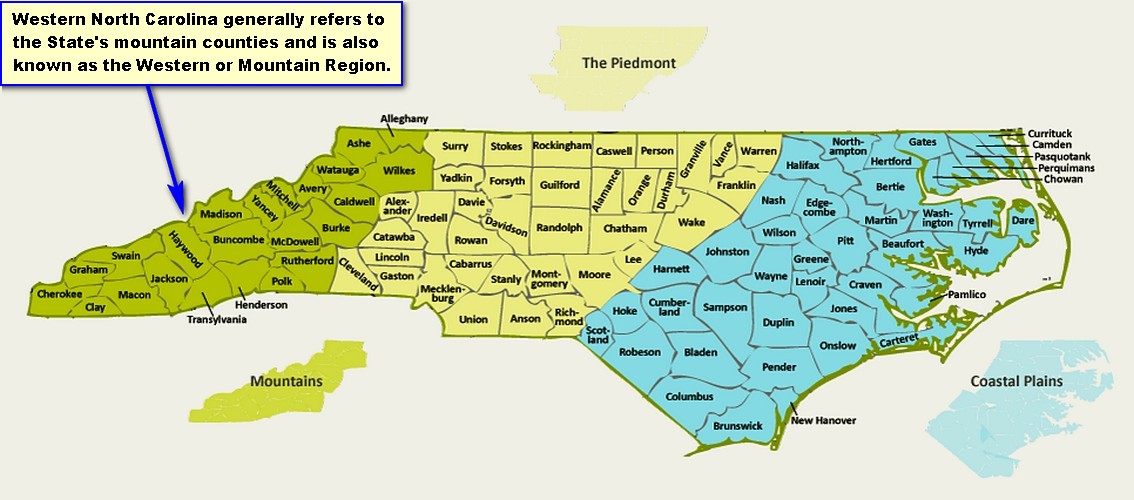
| Western North Carolina Civil War Map |
|
| Western North Carolina Civil War Map. Known as the Mountain Region, WNC Hosts the Mountain Counties |
Western North Carolina Civil War History
| Western North Carolina Map |
|
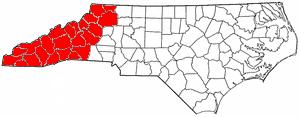
| Map of Western North Carolina (WNC) |
(About) Highlighted in red is the Mountain Region known as Western North
Carolina. Although county lines have been redrawn and additional counties have been added, the mountains remain the mountains
and so does the geographical region named Western North Carolina. Why were county lines redrawn and new counties added? County
histories vary state by state, but in North Carolina, by restricting the size of the county, it allowed those traveling
on horseback and wagon the opportunity to arrive in the business center -- known as the county seat -- in a single day.
| Western North Carolina Map |
|
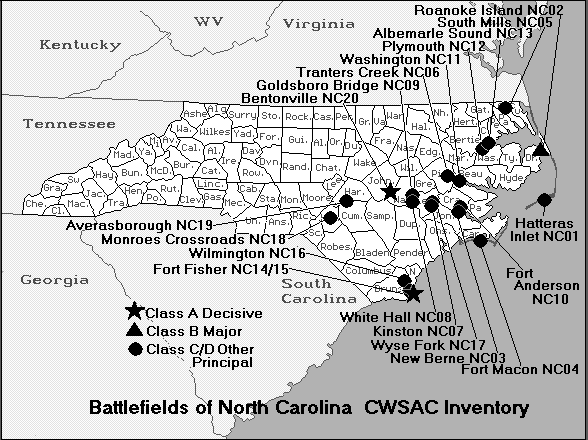
| WNC MAP |
"The
Cumberland Gap is the Gibraltar
of America," General Ulysses S. Grant in January 1864
Western North Carolina proved invaluable in the defense of the vital and strategic Saltworks and railroads. For example, while guarding the Strawberry Plains
Bridge, the Thomas Legion's Private James Keelan was posthumously awarded the rare Confederate Medal of Honor for saving what was considered a "most necessary bridge for moving troops and
supplies during the Civil War. The Western North Carolina mountains were also in striking distance of several major battles, and during the war it was a preferred
refuge for bushwhackers, deserters and a group known as outlaws.
During the 1864 Valley Campaigns, General Jubal Early's Army of the Valley absorbed the majority
of the Department of East Tennessee and Western District of North Carolina (aka District of Western North Carolina). By transferring
the bulk of both commands into the Shenandoah Valley, it allowed bushwhackers to plunder Southern Appalachia. The
ruthless Shelton Laurel Massacre epitomized the region's lawlessness and anarchy, while Captain Goldman Bryson's Union Volunteers reflected the region's divided loyalties.
During the Civil War, William Holland Thomas,
a Cherokee chief, Confederate colonel, and senator, had a defensive fighting strategy, but the exigencies of battle
and the political infighting nullified Thomas's
strategy. To defend the mountains, Confederate
President Jefferson Davis wrote an official letter of confidence in Thomas' Legion, dated January 4, 1865, but in 1865 it was too little too late, because Union
General George Stoneman led a mounted force of nearly 6,000 troops, known as Stoneman's Raid, throughout the mountains, destroying and stealing as they traversed back and force between Old Carolina
and Virginia.
Many
East Tennesseans also served in Western North Carolina regiments, and similar to the border states, the two regions,
while sharing the same border, held many common characteristics. East Tennessee was the poorest of Tennessee's Three Regions, it possessed the least amount of slaves, it was made up of rugged
mountainous terrain, experienced lawlessness and anarchy during the Civil War,
and the shared border regions watched their sons fight in many of the same battles.
Divided loyalties in the regions
had no boundaries, however, and during the aftermath many new feuds would last for decades. According to John L. Ransom,
Andersonville Diary (1881), pp. 20-21, Madame Collier was a federal soldier from East Tennessee who enjoyed army life until her capture and subsequent imprisonment
at Belle Isle, Virginia. She decided to make the most of the difficult situation and continued concealing her
gender, hoping for exchange, but another prisoner learned her secret and reported it to Confederate authorities, who sent
her North under a flag of truce.
1860 Western North Carolina Census Data
(Although North Carolina owned 86 counties in 1860, presently there are 100 counties
in the Old North State.)
Western North Carolina was composed of 18 counties in 1860, but by 1861 it added 3 mountain counties. Although created
after the 1860 census, the 3 newly formed western counties were carved from existing counties so they
had no impact on the 1860 population. The 3 additional counties
in 1861 were Clay County (formed from part of Cherokee County), Mitchell
County (formed from parts of Burke, Caldwell, McDowell, Watauga, and Yancey counties), and Transylvania County (formed from
parts of Henderson County and Jackson County).
Sources: University of Virginia Library; United States Census
|
County |
Total Pop.
|
White |
Free
Blacks |
Slaves |
|
Alleghany |
3590
|
3351 |
33 |
206 |
|
Ashe |
7956
|
7423 |
142
|
391 |
|
Buncombe |
12654 |
10610 |
111
|
1933 |
|
Burke |
9237
|
6645 |
221
|
2371 |
|
Caldwell
|
7497
|
6295 |
114
|
1088 |
|
Cherokee* |
9166
|
8609 |
38 |
519 |
|
Haywood |
5801
|
5474 |
14
|
313 |
|
Henderson |
10448
|
8981 |
85
|
1382 |
|
Jackson** |
5515
|
4179 |
6
|
268 |
|
Macon* |
6004 |
5370 |
115 |
519 |
|
Madison
|
5908 |
5678 |
17 |
213 |
|
McDowell |
7120 |
5542 |
273 |
1305 |
|
Polk* |
4043 |
3317 |
106 |
620 |
|
Rutherford |
11573 |
9059 |
123 |
2391 |
|
Surry |
10380 |
8950 |
184 |
1246 |
|
Watauga |
4957
|
4772 |
81 |
104 |
|
Wilkes |
14749 |
13280 |
261 |
1208 |
|
Yancey |
8655 |
8226 |
67 |
362 |
Total 145,253** 125,761
1,991 16,439
* The 1860 census does not include the Cherokees in Cherokee, Macon, and Polk counties. In 1860,
however, additional census records reflect 26 Cherokees in Cherokee County, 55 Cherokees in Macon County, and 5 Cherokees in Polk County.
** The 1860 census includes the 1062 Cherokees in Jackson County.
Western North Carolina's slaves were
11.3% of the Mountain Region's total population in 1860, but the State's total slave count made up 33% of the Tar Heel State's entire population. The Coastal Plain Region of the Old North State was where the majority of the citizens lived, including the slaves,
because of the seaports with their shipping and maritime lifestyles.
Recommended Reading: Bushwhackers, The Civil War in North Carolina:
The Mountains (338 pages). Description: Trotter's book (which could have been titled "Murder, Mayhem, and Mountain Madness") is an epic backdrop
for the most horrific murdering, plundering and pillaging of the mountain communities of western North Carolina during the
state’s darkest hour—the American Civil War. Commonly referred to as Southern Appalachia, the North
Carolina and East Tennessee mountains witnessed divided loyalties in its bushwhackers
and guerrilla units. These so-called “bushwhackers” even used the conflict to settle old feuds and scores, which,
in some cases, continued well after the war ended. Continued below...
Some bushwhackers
were highly organized ‘fighting guerrilla units’ while others were a motley group of deserters and outliers,
and, since most of them were residents of the region, they were familiar with the terrain and made for a “very formidable
foe.” In this work, Trotter does a great job on covering the many facets of the bushwhackers, including their: battles,
skirmishes, raids, activities, motives, the outcome, and even the aftermath. This book is also a great source for tracing
ancestors during the Civil War; a must have for the family researcher of Southern Appalachia.
Recommended Reading: Touring the Western North Carolina Backroads (Touring the Backroads).
Editorial Review: This guidebook, unlike most, is so encyclopedic in scope that I give it as a gift to newcomers to the area.
It is also an invaluable reference for the visitor who wants to see more than the fabulous Biltmore Estate. Even though I
am a native of the area, I learned nearly everything I know about Western North Carolina
from this book alone and it is my primary reference. I am still amazed at how much fact, history and folklore [just enough
to bring alive the curve of the road, the odd landmark, the abandoned building] is packed in its 300 pages. The author, who
must have collapsed from exhaustion when she finished it, takes you on a detailed tour, laid out by the tenth of the mile,
of carefully drawn sections of backroads that you can follow leisurely without getting lost. Continued below...
The author
is completely absent from the text. The lucid style will please readers who want the facts, not editorial comment. This book,
as well as the others in this publisher's backroads series, makes an excellent gift for anyone, especially the many seniors
who have relocated, or are considering relocating to this fascinating region. It is also a valuable reference for natives,
like me, who didn't know how much they didn't know.
Recommended Reading for Western North Carolina
American Civil War History and WNC Mountaineers and Highlanders:
The Civil War brought tough conditions to the folks in Western North
Carolina. See O.R., Series IV, pt. 2, pp. 732-734, O.R., Series 1, Volume 53, pp. 324-336, and O.R., Series 1, Vol. 32, pt. II, pp. 610-611.
The
below site is highly recommended for persons interested in their Western North Carolina genealogy, heritage, and history.
It is a Yahoo Group and free to join; come and discover your roots and even share your information. Through this group I also
discovered cousins residing only 45 miles away. Inform the moderator that Matt Parker sent you.
Western North Carolina Genealogy Research Group
The mass exodus from Western North Carolina to Washington State:
According to Kathy Reim, "Connections between North Carolina and Washington state are “heartfelt and
lasting.” Today some 17,000 people (about 16 percent of the population) in Skagit County (home of Sedro-Woolley) trace
their families to North Carolina, said Kathy, whose mother is from Gastonia."
Ms. Terry Parker Berger states: "The Skagit Valley is full of names that appear all over your Parker History
for North Carolina. Parker, Queen, Bryson, and Wood are a few I remember. Many of the cousins are still there. If
you drive East on Highway 20 and look at the names on the mail boxes you will see a lot of familiar family names from the
western North Carolina area."
|


